Bernardus Silvestris, also known as Bernard Silvestris and Bernard Silvester, was a medieval Platonist philosopher and poet of the 12th century.
Bernard of Chartres was a twelfth-century French Neo-Platonist philosopher, scholar, and administrator.
Decretals are letters of a pope that formulate decisions in ecclesiastical law of the Catholic Church.
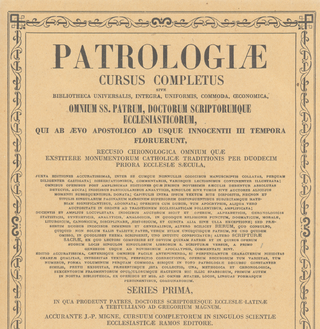
The Patrologia Latina is an enormous collection of the writings of the Church Fathers and other ecclesiastical writers published by Jacques-Paul Migne between 1841 and 1855, with indices published between 1862 and 1865. It is also known as the Latin series as it formed one half of Migne's Patrologiae Cursus Completus, the other part being the Patrologia Graeca of patristic and medieval Greek works with their medieval Latin translations.
The Gelasian Decree is a Latin text traditionally thought to be a decretal of the prolific Pope Gelasius I (492-496). The work consists of five chapters: the second chapter of which is a list of books of Scripture defined as part of the biblical canon by a Council of Rome, traditionally dated to Pope Damasus I (366–383) and thus known as the Damasine List. The fifth chapter of the work includes a list of works not encouraged for church use.

Huguccio was an Italian canon lawyer.
The Corpus Juris Canonici is a collection of significant sources of the Canon law of the Catholic Church that was applicable to the Latin Church. It was replaced by the 1917 Code of Canon Law which went into effect in 1918. The 1917 Code was later replaced by the 1983 Code of Canon Law, the codification of canon law currently in effect for the Latin Church.
Dominium mundi is an idea of universal dominion developed in the Middle Ages. Inspired by the memory of the Roman Empire, dominium mundi implied the recognition of one supreme authority, which generated a prolonged political and spiritual struggle between imperial and ecclesiastical power. This struggle can be said to have begun with the Investiture Controversy, and was mainly embodied by the Holy Roman Empire and Catholic Church, which elevated the emperor and Pope, respectively, to the status of supreme ruler.
Collections of ancient canons contain collected bodies of canon law that originated in various documents, such as papal and synodal decisions, and that can be designated by the generic term of canons.

The Decretals of Gregory IX, also collectively called the Liber extra, are a source of medieval Catholic canon law. In 1230, Pope Gregory IX ordered his chaplain and confessor, Raymond of Penyafort, a Dominican, to form a new canonical collection destined to replace the Decretum Gratiani, which was the chief collection of legal writings for the church for over 90 years. It has been said that the pope used these letters to emphasize his power over the Universal Church.
Bernard of Compostella the Older was a canonist of the early thirteenth century, a native of Compostela in Spain. He is called Antiquus to distinguish him from Bernardus Compostellanus Junior.
Bernard of Botone was a noted Italian canonist of the thirteenth century. He is generally called Bern(h)ardus Parmensis or Bernard of Parma, from his birthplace Parma.

Peter of Benevento was an Italian canon lawyer, papal legate and cardinal.
Prospero Fagnani was an Italian canon lawyer. Some writers place his birth in 1598, others in 1587 or in 1588.
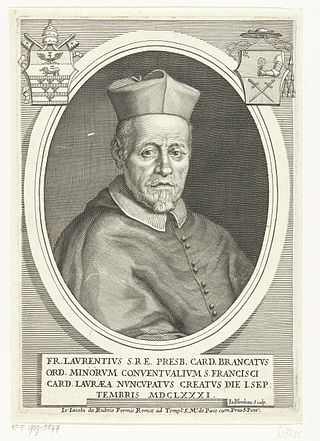
Francesco Lorenzo Brancati di Lauria was an Italian cardinal and theologian.
The Liber Septimus may refer to one of three Catholic canon law collections of quite different value from a legal standpoint which are known by this title.
The term Extravagantes is applied to the canon law of the Roman Catholic Church, to designate some papal decretals not contained in certain canonical collections which possess a special authority. More precisely, they are not found in Gratian's Decretum or the three official collections of the Corpus Juris Canonici.

In the history of canon law, the decretalists of the thirteenth century formed a school of interpretation that emphasised the decretals, those letters issued by the Popes ruling on matters of church discipline, in preference to the Decretum Gratiani (1141), which their rivals, the decretists, favoured. The decretalists were early compilers of the papal decretals, and their work, such as that of Simon of Bisignano, was used by the dominant decretist school.
Jus antiquum is a period in the legal history of the Catholic Church, spanning from the beginning of the church to the Decretum of Gratian, i.e. from A.D. 33 to around 1150. In the first 10 centuries of the church, there was a great proliferation of canonical collections, mostly assembled by private individuals and not by church authority as such.
The Quinque compilationes antiquae is a set of five collections of twelfth and thirteenth century decretals totalling between 1,971 and 2,139 chapters.


