Statement
Let denote the maximum modulus of an arbitrary function on , and let denote its derivative. Then for every polynomial of degree we have


- .

The inequality cannot be improved and equality holds if and only if . [2]
In mathematics, Bernstein's theorem is an inequality relating the maximum modulus of a complex polynomial function on the unit disk with the maximum modulus of its derivative on the unit disk. It was proven by Sergei Bernstein while he was working on approximation theory. [1]
Let denote the maximum modulus of an arbitrary function on , and let denote its derivative. Then for every polynomial of degree we have
The inequality cannot be improved and equality holds if and only if . [2]
In mathematical analysis, Bernstein's inequality states that on the complex plane, within the disk of radius 1, the degree of a polynomial times the maximum value of a polynomial is an upper bound for the similar maximum of its derivative. Applying the theorem k times yields
Paul Erdős conjectured that if has no zeros in , then . This was proved by Peter Lax. [3]
M. A. Malik showed that if has no zeros in for a given , then . [4]
The fundamental theorem of algebra, also called d'Alembert's theorem or the d'Alembert–Gauss theorem, states that every non-constant single-variable polynomial with complex coefficients has at least one complex root. This includes polynomials with real coefficients, since every real number is a complex number with its imaginary part equal to zero.

In the mathematical field of numerical analysis, Runge's phenomenon is a problem of oscillation at the edges of an interval that occurs when using polynomial interpolation with polynomials of high degree over a set of equispaced interpolation points. It was discovered by Carl David Tolmé Runge (1901) when exploring the behavior of errors when using polynomial interpolation to approximate certain functions. The discovery shows that going to higher degrees does not always improve accuracy. The phenomenon is similar to the Gibbs phenomenon in Fourier series approximations.
In complex analysis, de Branges's theorem, or the Bieberbach conjecture, is a theorem that gives a necessary condition on a holomorphic function in order for it to map the open unit disk of the complex plane injectively to the complex plane. It was posed by Ludwig Bieberbach and finally proven by Louis de Branges.

In complex analysis, Liouville's theorem, named after Joseph Liouville, states that every bounded entire function must be constant. That is, every holomorphic function for which there exists a positive number such that for all is constant. Equivalently, non-constant holomorphic functions on have unbounded images.
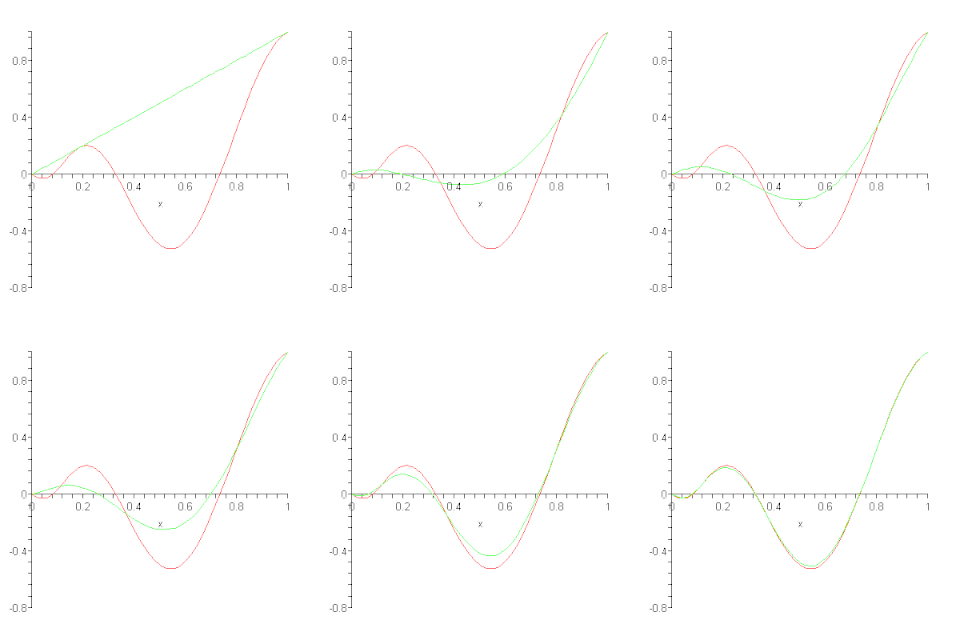
In the mathematical field of numerical analysis, a Bernstein polynomial is a polynomial expressed as a linear combination of Bernstein basis polynomials. The idea is named after mathematician Sergei Natanovich Bernstein.
In arithmetic combinatorics, Szemerédi's theorem is a result concerning arithmetic progressions in subsets of the integers. In 1936, Erdős and Turán conjectured that every set of integers A with positive natural density contains a k-term arithmetic progression for every k. Endre Szemerédi proved the conjecture in 1975.
In mathematics, a sequence (s1, s2, s3, ...) of real numbers is said to be equidistributed, or uniformly distributed, if the proportion of terms falling in a subinterval is proportional to the length of that subinterval. Such sequences are studied in Diophantine approximation theory and have applications to Monte Carlo integration.
In mathematics, the Borel–Carathéodory theorem in complex analysis shows that an analytic function may be bounded by its real part. It is an application of the maximum modulus principle. It is named for Émile Borel and Constantin Carathéodory.
The Remez algorithm or Remez exchange algorithm, published by Evgeny Yakovlevich Remez in 1934, is an iterative algorithm used to find simple approximations to functions, specifically, approximations by functions in a Chebyshev space that are the best in the uniform norm L∞ sense. It is sometimes referred to as Remes algorithm or Reme algorithm.
In additive number theory and combinatorics, a restricted sumset has the form
In mathematics, a univariate polynomial of degree n with real or complex coefficients has n complex roots, if counted with their multiplicities. They form a multiset of n points in the complex plane. This article concerns the geometry of these points, that is the information about their localization in the complex plane that can be deduced from the degree and the coefficients of the polynomial.
In mathematics, the Markov brothers' inequality is an inequality, proved in the 1890s by brothers Andrey Markov and Vladimir Markov, two Russian mathematicians. This inequality bounds the maximum of the derivatives of a polynomial on an interval in terms of the maximum of the polynomial. For k = 1 it was proved by Andrey Markov, and for k = 2,3,... by his brother Vladimir Markov.
In approximation theory, Jackson's inequality is an inequality bounding the value of function's best approximation by algebraic or trigonometric polynomials in terms of the modulus of continuity or modulus of smoothness of the function or of its derivatives. Informally speaking, the smoother the function is, the better it can be approximated by polynomials.
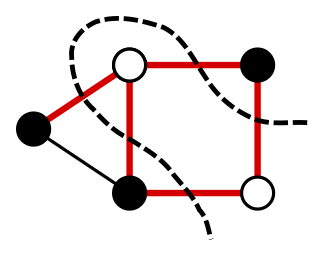
In a graph, a maximum cut is a cut whose size is at least the size of any other cut. That is, it is a partition of the graph's vertices into two complementary sets S and T, such that the number of edges between S and T is as large as possible. Finding such a cut is known as the max-cut problem.
In number theory, a Sidon sequence is a sequence of natural numbers in which all pairwise sums (for ) are different. Sidon sequences are also called Sidon sets; they are named after the Hungarian mathematician Simon Sidon, who introduced the concept in his investigations of Fourier series.
In mathematics, the conformal radius is a way to measure the size of a simply connected planar domain D viewed from a point z in it. As opposed to notions using Euclidean distance, this notion is well-suited to use in complex analysis, in particular in conformal maps and conformal geometry.
The Mason–Stothers theorem, or simply Mason's theorem, is a mathematical theorem about polynomials, analogous to the abc conjecture for integers. It is named after Walter Wilson Stothers, who published it in 1981, and R. C. Mason, who rediscovered it shortly thereafter.
In mathematics, the Erdős–Turán inequality bounds the distance between a probability measure on the circle and the Lebesgue measure, in terms of Fourier coefficients. It was proved by Paul Erdős and Pál Turán in 1948.
In complex analysis and geometric function theory, the Grunsky matrices, or Grunsky operators, are infinite matrices introduced in 1939 by Helmut Grunsky. The matrices correspond to either a single holomorphic function on the unit disk or a pair of holomorphic functions on the unit disk and its complement. The Grunsky inequalities express boundedness properties of these matrices, which in general are contraction operators or in important special cases unitary operators. As Grunsky showed, these inequalities hold if and only if the holomorphic function is univalent. The inequalities are equivalent to the inequalities of Goluzin, discovered in 1947. Roughly speaking, the Grunsky inequalities give information on the coefficients of the logarithm of a univalent function; later generalizations by Milin, starting from the Lebedev–Milin inequality, succeeded in exponentiating the inequalities to obtain inequalities for the coefficients of the univalent function itself. The Grunsky matrix and its associated inequalities were originally formulated in a more general setting of univalent functions between a region bounded by finitely many sufficiently smooth Jordan curves and its complement: the results of Grunsky, Goluzin and Milin generalize to that case.
Wiman-Valiron theory is a mathematical theory invented by Anders Wiman as a tool to study the behavior of arbitrary entire functions. After the work of Wiman, the theory was developed by other mathematicians, and extended to more general classes of analytic functions. The main result of the theory is an asymptotic formula for the function and its derivatives near the point where the maximum modulus of this function is attained.





