
Sukkur is a city in the Pakistani province of Sindh along the western bank of the Indus River, directly across from the historic city of Rohri. Sukkur is the third largest city in Sindh after Karachi and Hyderabad, and 14th largest city of Pakistan by population. The city was originally founded by the Rai dynasty of Sindh. The modern city was built in the 1840s. New Sukkur was established during the British era alongside the village of Sukkur. Sukkur's hill, along with the hill on the river island of Bukkur, form what is sometimes considered the "Gate of Sindh".
Naushahro Feroze, is the capital city of Naushahro Feroze District in Sindh province of Pakistan. The district is located at 26°50'0N 68°7'0E with an altitude of 38 metres (127 feet).

Naushahro Feroze District is a district in the province of Sindh, Pakistan. Its capital is Naushahro Feroze city. Administratively subdivided into five talukas and 51 union councils, according to the 2017 census of Pakistan it had a population of 1,612,373. The Naushahro Feroze was given the status of District on 15 November 1989 and. Before, it was Taluka of Nawabshah District. On given status as district, Naushahro Feroze was placed under administrative control of Sukkur Division however, it has been placed under Shaheed Benazirabad Division during 2011.
Mehrabpur, (Sindhi:محرابپور), is a city in the Naushahro Feroze District in the Sindh province of Pakistan. The city is administratively subdivided into 8 Union Councils. It has a busy railway station on the main railway line between Karachi and Lahore. It is a junction station with a disused branch line to Naushahro Feroze.
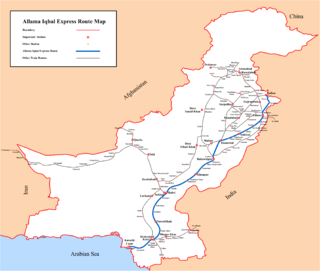
The Allama Iqbal Express is a passenger train operated daily by Pakistan Railways between Karachi and Sialkot, two important industrial hubs of Pakistan. The trip takes approximately 25 hours and 30 minutes to cover a published distance of 1,362 kilometres (846 mi), traveling along the Karachi–Peshawar Railway Line, Shahdara Bagh–Chak Amru Branch Line and Wazirabad–Narowal Branch Line.
Bhiria City, is a town in Naushahro Feroze District in Sindh province of Pakistan.
Mithiani, is a town in the Naushahro Feroze District, of Sindh, Pakistan. It is 15 km west of Naushahro Feroze City, according to 2017 censes of Pakistan it had a population of 97,734. There used to be a railway service in Mithiani which connected Mithiani with rest of Sindh. railway station, which is now defunct. Mithiani is situated on the right bank of River Indus, the town is protected by a massive bund against high flooding in the River Indus, which was constructed in 1920. Mithiani is connected to every major city and town of Sindh and Pakistan.
Miranpur is a village in Naushahro Feroze, Sindh, Pakistan. The population was 3000 at the 2017 census.
Nursing is a major component of Pakistan's health-care system. The topic has been the subject of extensive historical studies, is as of 2009 a major issue in the country, and has been the subject of much scholarly discussion amongst academics and practitioners. In 2009, Pakistan’s government stated its intent to improve the country's nursing care.
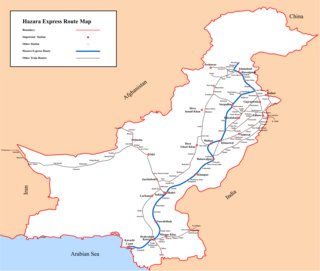
Hazara Express is a passenger train operated daily by Pakistan Railways between Karachi and Havelian in Khyber Pakhtunkhwa province. The trip takes approximately 33 hours to cover a published distance of 1,594 kilometres (990 mi), travelling along a stretch of the Karachi–Peshawar Railway Line, Khanewal–Wazirabad Branch Line, Shorkot–Lalamusa Branch Line and Taxila–Khunjerab Railway Line.

Bahauddin Zakaria Express is a passenger train operated daily by Pakistan Railways between Karachi and Multan. The trip takes approximately 16 hours and 5 minutes to cover a published distance of 929 kilometres (577 mi), traveling along a stretch of the Karachi–Peshawar Railway Line. The train named after Abu Muhammad Bahauddin Zakariya, a famous Sufi saint of the Suhrawardiyya order who lived in Multan between 1171 and 1262.
Rohri Junction Railway Station is located in Rohri, Sukkur district of Sindh province, Pakistan. It is a major railway station on the Pakistan Railways network, serving as the junction between the Karachi–Peshawar Railway Line (ML-1) and Rohri-Chaman Railway Line (ML-3). The station serves as a technical stop for all express and passenger trains. The station is staffed and has advance and current reservation offices. Food stalls are also located on all of its four active platforms. The land of the station is taken on lease for 100 years from Nawab Mir Yakoob Ali Shah.

Tezrao was a daily express train (5-Up/6-Down) service in Pakistan. The train ran between Karachi and Peshawar. Its name was changed to Zulfiqar Express during the Peoples Party government. After the Peoples Party government its name changed again to Tezrao. The train had economy and first-class sleeper accommodation. In 2008, its route was changed to Mardan to Karachi by the then railway minister Ghulam Ahmed Bilour .It was suspended on 20 July 2010 due to lack of locomotives.
Padidan is a town in Naushahro Feroze district of Sindh province in Pakistan. It is located at 26° 46 North and 68° 17 East and has an altitude of 150 feet (46 m).

Bhiria Road Railway Station is located in Bhiria road city, Naushahro Feroze district of Sindh province, Pakistan.
Pad Idan Railway Station is located in Padidan town, Naushahro Feroze district of Sindh province, Pakistan.
Kot lalu is a town located in Khairpur district, in Sindh, Pakistan. The town's name in English is also spelt Kot Lalloo. Kot lalu is rich with fertile lands and some areas are covered with sand dunes. The town has a hot climate, ranging from 40° to 60° Celsius. In winter, the average temperature falls by 10 °C. There is ancient muddy kot situated in Kot Laloo on the Nawabshah Kumb bypass.
Karoondi (Sindhi:ڪرونڊي) is a small town along Mehran Highway in District Khairpur, Sindh province of Pakistan. It is situated in taluka Faiz Ganj which is one of the eight talukas of the District. The town lies between two canals: Faiz Ganj canal passes by its western side whereas Veeho canal passes by the eastern. This city was established by Rajpar Hindu and Muslim community. In 1904 Along with Relatives and all family of Usman Khan Rajper settled here from Beela Wah, Naushahro feroze District and Oman Khan Rajpar settled here from Warhecho, Nawabshah district. There are fertile farmlands around it owned by descendants of Wadeero Budhal khan Rajper, Wadeero Oman Khan Rajpar and wadeero ghulam Muhammad Rajper and Wadeero Usman khan Rajper and a number of villages in the outskirts. The main town is separated from the bypass bus stop by farm-fields and orchards. The town is relatively peaceful as the crime rate is very low. In late 1960's Wadeero Allahdad Rajpar made a Phool Bagh in Karoondi. The settlement in the town is either on the lands of Wadeero Budhal Khan Rajpar or Wadeero Oman Khan Rajpar. Late Shahnawaz Khan Rajpar, late Shaukat Ali Rajpar, Habibullah khan Rajper, Punjal Khan Rajper, Shiraz Shaukat Rajpar MPA son of late Shaukat Ali Rajpar also current chief of Husenja, Patoja and Jadeja, moheja and hotipotas


