
Look up binding in Wiktionary, the free dictionary.
Binding may refer to:
Binding may refer to:


The Document Object Model (DOM) is a cross-platform and language-independent interface that treats an HTML or XML document as a tree structure wherein each node is an object representing a part of the document. The DOM represents a document with a logical tree. Each branch of the tree ends in a node, and each node contains objects. DOM methods allow programmatic access to the tree; with them one can change the structure, style or content of a document. Nodes can have event handlers attached to them. Once an event is triggered, the event handlers get executed.

Hypertext Markup Language (HTML) is the standard markup language for documents designed to be displayed in a web browser. It defines the content and structure of web content. It is often assisted by technologies such as Cascading Style Sheets (CSS) and scripting languages such as JavaScript, a programming language.

Extensible Markup Language (XML) is a markup language and file format for storing, transmitting, and reconstructing arbitrary data. It defines a set of rules for encoding documents in a format that is both human-readable and machine-readable. The World Wide Web Consortium's XML 1.0 Specification of 1998 and several other related specifications—all of them free open standards—define XML.
XSLT is a language originally designed for transforming XML documents into other XML documents, or other formats such as HTML for web pages, plain text or XSL Formatting Objects, which may subsequently be converted to other formats, such as PDF, PostScript and PNG. Support for JSON and plain-text transformation was added in later updates to the XSLT 1.0 specification.
In computing, the Java API for XML Processing (JAXP), one of the Java XML application programming interfaces (APIs), provides the capability of validating and parsing XML documents. It has three basic parsing interfaces:
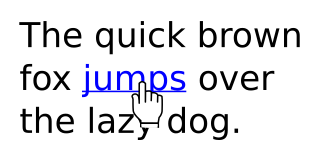
In computing, a hyperlink, or simply a link, is a digital reference to data that the user can follow or be guided to by clicking or tapping. A hyperlink points to a whole document or to a specific element within a document. Hypertext is text with hyperlinks. The text that is linked from is known as anchor text. A software system that is used for viewing and creating hypertext is a hypertext system, and to create a hyperlink is to hyperlink. A user following hyperlinks is said to navigate or browse the hypertext.
Object–relational mapping in computer science is a programming technique for converting data between a relational database and the memory of an object-oriented programming language. This creates, in effect, a virtual object database that can be used from within the programming language.
SAX is an event-driven online algorithm for lexing and parsing XML documents, with an API developed by the XML-DEV mailing list. SAX provides a mechanism for reading data from an XML document that is an alternative to that provided by the Document Object Model (DOM). Where the DOM operates on the document as a whole—building the full abstract syntax tree of an XML document for convenience of the user—SAX parsers operate on each piece of the XML document sequentially, issuing parsing events while making a single pass through the input stream.
A web service (WS) is either:
XUL, which stands for XML User Interface Language, is a user interface markup language developed by Mozilla. XUL is an XML dialect for writing graphical user interfaces, enabling developers to write user interface elements in a manner similar to web pages.
Factor is a stack-oriented programming language created by Slava Pestov. Factor is dynamically typed and has automatic memory management, as well as powerful metaprogramming features. The language has a single implementation featuring a self-hosted optimizing compiler and an interactive development environment. The Factor distribution includes a large standard library.
A user interface markup language is a markup language that renders and describes graphical user interfaces and controls. Many of these markup languages are dialects of XML and are dependent upon a pre-existing scripting language engine, usually a JavaScript engine, for rendering of controls and extra scriptability.
Windows Presentation Foundation (WPF) is a free and open-source user interface framework for Windows-based desktop applications. WPF applications are based in .NET, and are primarily developed using C# and XAML.
Streaming API for XML (StAX) is an application programming interface (API) to read and write XML documents, originating from the Java programming language community.
XMLBeans is a Java-to-XML binding framework which is part of the Apache Software Foundation XML project.
In computer science and web development, XML Events is a W3C standard for handling events that occur in an XML document. These events are typically caused by users interacting with the web page using a device, such as a web browser on a personal computer or mobile phone.
In computer science, marshalling or marshaling is the process of transforming the memory representation of an object into a data format suitable for storage or transmission, especially between different runtimes. It is typically used when data must be moved between different parts of a computer program or from one program to another.
In software development XRX is a web application architecture based on XForms, REST and XQuery. XRX applications store data on both the web client and on the web server in XML format and do not require a translation between data formats. XRX is considered a simple and elegant application architecture due to the minimal number of translations needed to transport data between client and server systems. The XRX architecture is also tightly coupled to W3C standards to ensure XRX applications will be robust in the future. Because XRX applications leverage modern declarative languages on the client and functional languages on the server they are designed to empower non-developers who are not familiar with traditional imperative languages such as JavaScript, Java or .Net.

The Web Services Description Language is an XML-based interface description language that is used for describing the functionality offered by a web service. The acronym is also used for any specific WSDL description of a web service, which provides a machine-readable description of how the service can be called, what parameters it expects, and what data structures it returns. Therefore, its purpose is roughly similar to that of a type signature in a programming language.