
Biofuel is a fuel that is produced over a short time span from biomass, rather than by the very slow natural processes involved in the formation of fossil fuels, such as oil. Since biomass can be used as a fuel directly, some people use the words biomass and biofuel interchangeably. However, the word biofuel is usually reserved for liquid or gaseous fuels used for transportation. The United States Energy Information Administration (EIA) follows this naming practice.

Biodiesel is a form of diesel fuel derived from plants or animals and consisting of long-chain fatty acid esters. It is typically made by chemically reacting lipids such as animal fat (tallow), soybean oil, or some other vegetable oil with an alcohol, producing a methyl, ethyl or propyl ester by the process of transesterification.

Ethanol fuel is ethyl alcohol, the same type of alcohol found in alcoholic beverages, used as fuel. It is most often used as a motor fuel, mainly as a biofuel additive for gasoline. The first production car running entirely on ethanol was the Fiat 147, introduced in 1978 in Brazil by Fiat. Ethanol is commonly made from biomass such as corn or sugarcane. World ethanol production for transport fuel tripled between 2000 and 2007 from 17×109 liters (4.5×10^9 U.S. gal; 3.7×10^9 imp gal) to more than 52×109 liters (14×10^9 U.S. gal; 11×10^9 imp gal). From 2007 to 2008, the share of ethanol in global gasoline type fuel use increased from 3.7% to 5.4%. In 2011 worldwide ethanol fuel production reached 8.46×10⁹ liters (2.23×10^9 U.S. gal; 1.86×10^9 imp gal) with the United States of America and Brazil being the top producers, accounting for 62.2% and 25% of global production, respectively. US ethanol production reached 57.54×10⁹ liters (15.20×10^9 U.S. gal; 12.66×10^9 imp gal) in May 2017.
Net Energy Gain (NEG) is a concept used in energy economics that refers to the difference between the energy expended to harvest an energy source and the amount of energy gained from that harvest. The net energy gain, which can be expressed in joules, differs from the net financial gain that may result from the energy harvesting process, in that various sources of energy can be priced differently for the same amount of energy.
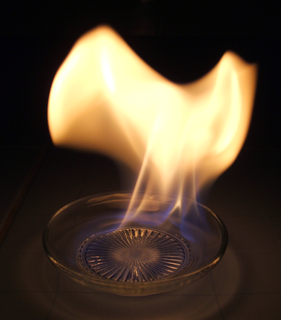
Various alcohols are used as fuel for internal combustion engines. The first four aliphatic alcohols are of interest as fuels because they can be synthesized chemically or biologically, and they have characteristics which allow them to be used in internal combustion engines. The general chemical formula for alcohol fuel is CnH2n+1OH.
Direct-ethanol fuel cells or DEFCs are a category of fuel cell in which ethanol is fed directly into the cell. They have been used as a model to investigate a range of fuel cell concepts including the use of PEM.
The United States produces mainly biodiesel and ethanol fuel, which uses corn as the main feedstock. The US is the world's largest producer of ethanol, having produced nearly 16 billion gallons in 2017 alone. The United States, together with Brazil accounted for 85 percent of all ethanol production, with total world production of 27.05 billion gallons. Biodiesel is commercially available in most oilseed-producing states. As of 2005, it was somewhat more expensive than fossil diesel, though it is still commonly produced in relatively small quantities.

Butanol may be used as a fuel in an internal combustion engine. It is more similar to gasoline than it is to ethanol. A C4-hydrocarbon, butanol is a drop-in fuel and thus works in vehicles designed for use with gasoline without modification. Both n-butanol and isobutanol have been studied as possible fuels. Both can be produced from biomass as well as from fossil fuels. The chemical properties depend on the isomer, not on the production method.
Renewable Fuels are fuels produced from renewable resources. Examples include: biofuels and Hydrogen fuel. This is in contrast to non-renewable fuels such as natural gas, LPG (propane), petroleum and other fossil fuels and nuclear energy. Renewable fuels can include fuels that are synthesized from renewable energy sources, such as wind and solar. Renewable fuels have gained in popularity due to their sustainability, low contributions to the carbon cycle, and in some cases lower amounts of greenhouse gases. The geo-political ramifications of these fuels are also of interest, particularly to industrialized economies which desire independence from Middle Eastern oil.

In 2005 the government of Sweden appointed a commission to draw up a comprehensive programme to reduce Sweden's dependence on petroleum, natural gas and other ‘fossil raw materials’ by 2020. In June 2006 the commission issued its report, entitled Making Sweden an Oil-Free Society. The report cited four reasons to reduce oil dependence:
Second-generation biofuels, also known as advanced biofuels, are fuels that can be manufactured from various types of non-food biomass. Biomass in this context means plant materials and animal waste used especially as a source of fuel.

Algae fuel, algal biofuel, or algal oil is an alternative to liquid fossil fuels that uses algae as its source of energy-rich oils. Also, algae fuels are an alternative to commonly known biofuel sources, such as corn and sugarcane. When made from seaweed (macroalgae) it can be known as seaweed fuel or seaweed oil. It is also carbon negative unless the dead plant matter is burned, as the energy is produced by solar photosynthesis and comes from the sun. The emissions from burning the hydrogen make up only water and air.
Biodiesel is rapidly becoming more common in a number of developed countries and the environmental effects of using biodiesel either as a blend such as B20 or as a straight fuel stock may be different in various countries. This is because the allowable amounts of sulphur and other compounds vary from country to country. Additionally, the average temperature in a country will dictate the amount of biodiesel that can be blended into the fuel supply before the cold filter plugging point renders the fuel unusable. The national annex of BS EN 14214 specifies a maximum CFPP for B100 biodiesel of -15 °C in the winter and -5 °C for the rest of the year. As such, the benefits and disadvantages of biodiesel will vary from those in the United Kingdom.

Food versus fuel is the dilemma regarding the risk of diverting farmland or crops for biofuels production to the detriment of the food supply. The biofuel and food price debate involves wide-ranging views, and is a long-standing, controversial one in the literature. There is disagreement about the significance of the issue, what is causing it, and what can or should be done to remedy the situation. This complexity and uncertainty is due to the large number of impacts and feedback loops that can positively or negatively affect the price system. Moreover, the relative strengths of these positive and negative impacts vary in the short and long terms, and involve delayed effects. The academic side of the debate is also blurred by the use of different economic models and competing forms of statistical analysis.
An enzymatic biofuel cell is a specific type of fuel cell that uses enzymes as a catalyst to oxidize its fuel, rather than precious metals. Enzymatic biofuel cells, while currently confined to research facilities, are widely prized for the promise they hold in terms of their relatively inexpensive components and fuels, as well as a potential power source for bionic implants.
Sustainable biofuel is biofuel produced in a sustainable manner. It is not based on petroleum or other fossil fuels. It includes not using plants that are used for food stuff to produce the fuel thus disrupting the worlds food supply.

An aviation biofuel or bio-jet-fuel or bio-aviation fuel (BAF) is a biofuel used to power aircraft and is said to be a sustainable aviation fuel (SAF). The International Air Transport Association (IATA) considers it a key element to reducing the carbon footprint within the environmental impact of aviation. Aviation biofuel could help decarbonize medium- and long-haul air travel generating most emissions, and could extend the life of older aircraft types by lowering their carbon footprint.
There are various social, economic, environmental and technical issues with biofuel production and use, which have been discussed in the popular media and scientific journals. These include: the effect of moderating oil prices, the "food vs fuel" debate, poverty reduction potential, carbon emissions levels, sustainable biofuel production, deforestation and soil erosion, loss of biodiversity, effect on water resources, the possible modifications necessary to run the engine on biofuel, as well as energy balance and efficiency. The International Resource Panel, which provides independent scientific assessments and expert advice on a variety of resource-related themes, assessed the issues relating to biofuel use in its first report Towards sustainable production and use of resources: Assessing Biofuels. In it, it outlined the wider and interrelated factors that need to be considered when deciding on the relative merits of pursuing one biofuel over another. It concluded that not all biofuels perform equally in terms of their effect on climate, energy security and ecosystems, and suggested that environmental and social effects need to be assessed throughout the entire life-cycle.

Carbon-neutral fuel is fuel which produces no net-greenhouse gas emissions or carbon footprint. In practice, this usually means fuels that are made using carbon dioxide (CO2) as a feedstock. Proposed carbon-neutral fuels can broadly be grouped into synthetic fuels, which are made by chemically hydrogenating carbon dioxide, and biofuels, which are produced using natural CO2-consuming processes like photosynthesis.
