
The economy of Kuwait is a small but wealthy petroleum-based economy. The Kuwaiti dinar is the highest-valued unit of currency in the world. Non-petroleum industries include financial services. According to the World Bank, Kuwait is the fourth richest country in the world per capita. Kuwait is the second richest GCC country per capita.

The economy of the United Arab Emirates is the second largest in the Middle East, with a gross domestic product (GDP) of US$414 billion in 2018.

The Arabian Peninsula is a peninsula of Western Asia, situated northeast of Africa on the Arabian Plate. The Peninsula, plus Bahrain, the Socotra Archipelago and other nearby islands form a geopolitical region called Arabia, which is the largest region in the world without any river.

The Cooperation Council for the Arab States of the Gulf, originally known as the Gulf Cooperation Council, is a regional intergovernmental political and economic union consisting of all Arab states of the Persian Gulf - Bahrain, Kuwait, Oman, Qatar, Saudi Arabia, and the United Arab Emirates - except Iraq. The Charter of the GCC was signed on 25 May 1981, formally establishing the institution.
The Gulf Research Center (GRC) is a privately funded, non-partisan think tank, education provider and consultancy specializing in the Persian Gulf region. The GRC produces research from a Gulf perspective which redresses a current area studies imbalance wherein regional opinions and interests are underrepresented. Based in Jeddah, and the foundation, now based in Geneva, the GRC was founded in July 2000 by Abdulaziz Sager, the current chairman.

The Arab states of the Persian Gulf are the seven Arab states which border the Persian Gulf, namely Bahrain, Kuwait, Iraq, Oman, Qatar, Saudi Arabia and the United Arab Emirates (UAE). All of these nations except Iraq are part of the Gulf Cooperation Council (GCC), and prefer to use the term "Arabian Gulf" rather than the historical name of the Persian Gulf.

The economy of the Middle East is very diverse, with national economies ranging from hydrocarbon-exporting rentiers to centralized socialist economies and free-market economies. The region is best known for oil production and export, which significantly impacts the entire region through the wealth it generates and through labor utilization. In recent years, many of the countries in the region have undertaken efforts to diversify their economies.
The Khaleeji was a proposed name for the common currency of the member states of the Gulf Cooperation Council for the Arab States (GCC).
The Gulf Railway, also known as the GCC Railway, is a proposed railway system to connect all six Gulf Cooperation Council (GCC)-member states in the Persian Gulf. The rail network will have a total length of 2,177 km. The project is estimated to cost US$ 250 billion. It is scheduled to be completed by 2023.
The Gulf Ice Hockey Championship, also known as the GCC Gulf Ice Hockey Championships, is an international ice hockey competition involving countries from the Gulf Cooperation Council (GCC) region. The inaugural tournament took place on the May 25 to May 30 in Kuwait City, Kuwait and was organised by the Kuwait Ice Hockey Association. The championship has featured teams from six countries since its formation and currently consists of Kuwait, Oman, Qatar and the United Arab Emirates. The United Arab Emirates has won all four editions of the championship, while Kuwait has finished second on three occasions and Qatar on one.
Abdul Kader Kamli, with more than 150 articles published in professional journals/magazines, is an authority on information and communication technology in the Arab world. He is often quoted by regional and international media organizations on the digital migration of the region.
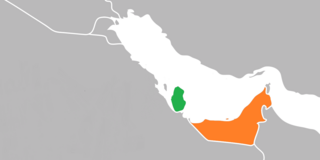
Qatar–United Arab Emirates relations are the relations between Qatar and the United Arab Emirates (UAE). The relationship between the two countries has been severed following the Qatar diplomatic crisis.
The Bidoon, or stateless, is a social class in countries of the Gulf Cooperation Council, particularly Kuwait, Saudi Arabia, and Iraq. They are considered by some regional governments, for instance Kuwait, as foreign nationals or illegal immigrants.
The GCC Standardization Organization (GSO) is a standards organization for the member states of the Gulf Cooperation Council and Yemen. It was established under the authority of the Gulf Cooperation Council. Its full official name is "the Standardization Organization of the Cooperation Council for the Arab States of the Gulf". It is headquartered in Riyadh and has a branch office in Jeddah. Where no GSO standard already exists, it reviews existing global standards and may adopt them. The GSO's Technical Council mandated the creation of a regional Metrology Organization to be called "GULFME". The GSO has also partnered with PepsiCo.
Science and Technology is Jordan's fastest-growing economic sector. This growth is occurring across multiple industries, including information and communications technology (ICTs), solar and wind energy and nuclear technology.
Migrant workers in the Gulf Cooperation Council region involves the prevalence of migrant workers in the Kingdom of Bahrain, the State of Kuwait, the Sultanate of Oman, the State of Qatar, the Kingdom of Saudi Arabia and the United Arab Emirates (UAE). Together, these six countries form the Gulf Cooperation Council (GCC), established in 1981. The GCC cooperates on issues related to economy and politics, and the subject of migrant workers constitutes a substantial part of the council's collaboration. All of the GCC countries are dependent on migrant labor to bolster and stimulate economic growth and development, as the GCC countries possess an abundance of capital while the domestic labor capacity is low. Although migrant workers in the Persian Gulf region amount to no more than 10% of all migrants worldwide, they constitute a significant part of the populations of their host countries.
The Qatar diplomatic crisis began on 5 June 2017, when Saudi Arabia, the United Arab Emirates, Bahrain and Egypt severed diplomatic relations with Qatar and banned Qatar-registered airplanes and ships from utilising their airspace and sea routes along with Saudi Arabia blocking Qatar’s only land crossing. They were later joined by Jordan and were supported by the Maldives, Mauritania, Senegal, Djibouti, the Comoros, Yemen, and the Tobruk-based government in Libya.

Saudi Arabia–Qatar relations refers to the current and historical relationship between the Kingdom of Saudi Arabia and the State of Qatar. Prior to 2017, the two countries maintained cordial ties. Qatar was mainly subservient to Saudi Arabia in matters relating to foreign policy. Hamad bin Khalifa Al Thani's assumption of power saw Qatar reclaim its sovereignty in foreign affairs, often diverging from Saudi Arabia on many geopolitical issues. In 1996, the Qatari government launched Al Jazeera in a bid to consolidate soft power. One of the most watched news stations in the Arab world, Al Jazeera proved to be a wedge in the two's bilateral relations as it routinely criticized Saudi Arabia's ruler. The network also provided a platform for Islamist groups which are considered a threat to Saudi Arabia's monarchy.

The Qatar–Saudi Arabia diplomatic conflict, sometimes referred to as the Second Arab Cold War, is the ongoing struggle for regional influence between Qatar and Saudi Arabia (KSA), both of which are members of the Gulf Cooperation Council (GCC). Qatar–Saudi Arabia relations have been especially strained since the beginning of the Arab Spring, that left a power vacuum both states sought to fill, with Qatar being supportive of the revolutionary wave and Saudi Arabia opposing it. Both states are allies of the United States, and have avoided direct conflict with one another.
The Arab-Israeli alliance against Iran or Israeli–Sunni Coalition, also known as the Israeli–Sunni Alliance is an anti-Iranian unofficial coordination group in Western Asia, nurtured by the United States. The coordination is taking place in light of the mutual regional security interests of Israel and mostly Sunni Arab States led by Saudi Arabia, and their standoff against Iranian interests across the Middle East - the Iran–Israel proxy conflict and the Iran–Saudi Arabia proxy conflict. The Arab states participating in the coordination group are the core of the Gulf Cooperation Council. Those include Saudi Arabia, United Arab Emirates and Oman.

