
Black snake may refer to:
Black snake may refer to:


The corn snake, sometimes called red rat snake, is a species of North American rat snake in the family Colubridae. The species subdues its small prey by constriction. It is found throughout the southeastern and central United States. Though superficially resembling the venomous copperhead and often killed as a result of this mistaken identity, the corn snake lacks functional venom and is harmless. The corn snake is beneficial to humans because it helps to control populations of wild rodent pests that damage crops and spread disease.

Pantherophis obsoletus, also known commonly as the western rat snake, black rat snake, pilot black snake, or simply black snake, is a nonvenomous species of snake in the family Colubridae. The species is native to central North America. There are no subspecies that are recognized as being valid. Its color variations include the Texas rat snake. Along with other snakes of the eastern United States, like the eastern indigo snake and the eastern racer, it is called “black snake”.

Belize is a country with a rich variety of wildlife, due to its unique position between North and South America, and a wide range of climates and habitats for plant and animal life. Belize's low human population, and approximately 8,867 square miles (22,970 km2) of undistributed land, provides an ideal home for more than 5000 species of plants, and vast numbers species of animals — with several hundred vertebrates including armadillos, snakes, and monkeys.
False coral may refer to many species of snakes, including:
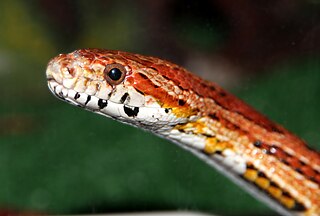
Pantherophis is a genus of nonvenomous colubrid snakes endemic to central and eastern regions of North America. It consists of the North American ratsnakes, the foxsnakes, and the cornsnakes. The genus, which contains 10 recognized species, first appeared in the fossil record in the Middle Miocene around 16.3 million years ago. They are a large terrestrial snake genus that lack subocular scales. Originally classified in the genus Elaphe, phylogenetic studies have found this taxon to be closely related to Pituophis. As with all snakes Pantherophis is an obligate faunivore with a diet that consists of small mammals, birds, reptiles and amphibians, and even insects. While many species conservation status is categorized as "least concern", many local populations in some species have declined where some places have them listed as federally protected. The corn snake is a popular pet reptile, due to the availability of captive-bred animals, their low maintenance and calm disposition, and the variety of color morphs. There are other species of Pantherophis that are in the pet trade, though are not as popular as the corn snake.

Pantherophis vulpinus, commonly known as the foxsnake or the eastern fox snake, is a species of nonvenomous rat snake in the family Colubridae. The species is native to North America.

Pantherophis vulpinus, commonly known as the eastern foxsnake or eastern fox snake, is a species of rat snake in the family Colubridae. The species is nonvenomous and is endemic to the eastern Great Lakes region of the United States, as well as adjacent western Ontario in Canada. Pantherophis gloydi is sometimes considered a distinct species and sometimes considered a junior synonym of the species Pantherophis vulpinus.
Chicken snake may refer to:
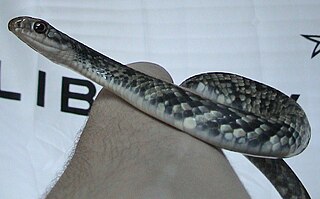
The eastern racer, or North American racer, is a species of nonvenomous snake in the family Colubridae. The species is endemic to North America and Central America. Eleven subspecies, including the nominotypical subspecies, are recognized, which as a group are commonly referred to as the eastern racers. The species is monotypic in the genus Coluber.
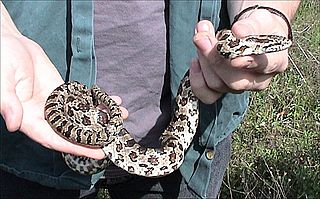
Lampropeltis calligaster is a species of kingsnake known commonly as the prairie kingsnake or yellow-bellied kingsnake.

The Texas rat snake is a subspecies of the black rat snake, a nonvenomous colubrid. It is found in the United States, primarily within the state of Texas, but its range extends into Louisiana, Arkansas and Oklahoma. It intergrades with other subspecies of Elaphe obsoleta, so exact range boundaries are impossible to distinguish. The epithet lindheimeri is to honor the German-American naturalist Ferdinand Jacob Lindheimer, who collected the first specimen in New Braunfels, Texas.

The Colubrinae are a subfamily of the family Colubridae of snakes. It includes numerous genera, and although taxonomic sources often disagree on the exact number, The Reptile Database lists 717 species in 92 genera as of September 2019. It is the second largest subfamily of colubrids, after Dipsadinae. Many of the most commonly known snakes are members of this subfamily, including rat snakes, king snakes, milk snakes, vine snakes, and indigo snakes.
Pine snake may refer to:
Bastard rattlesnake may refer to:
Hog-nosed rattler may refer to:
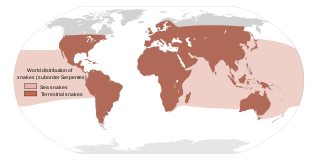
Most snakebites are caused by non-venomous snakes. Of the roughly 3,700 known species of snake found worldwide, only 15% are considered dangerous to humans. Snakes are found on every continent except Antarctica. There are two major families of venomous snakes, Elapidae and Viperidae. 325 species in 61 genera are recognized in the family Elapidae and 224 species in 22 genera are recognized in the family Viperidae, In addition, the most diverse and widely distributed snake family, the colubrids, has approximately 700 venomous species, but only five genera—boomslangs, twig snakes, keelback snakes, green snakes, and slender snakes—have caused human fatalities.
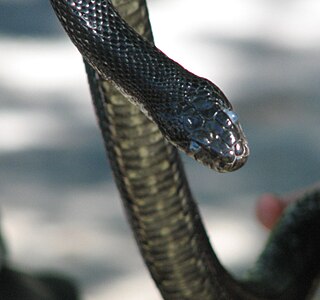
Pantherophis alleghaniensis, commonly called the eastern rat snake, is a species of nonvenomous snake in the family Colubridae. The species is endemic to North America.
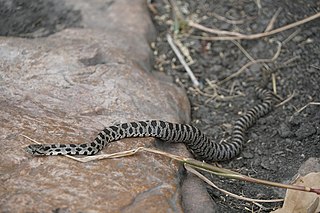
Pantherophis ramspotti, commonly known as the western fox snake, is a species of rat snake in the family Colubridae. The species is native to the upper midwestern United States, west of the Mississippi river. It is nonvenomous.