
Moscow Institute of Physics and Technology, is a public research university located in Moscow Oblast, Russia. It prepares specialists in theoretical and applied physics, applied mathematics and related disciplines.
The Joint Institute for Nuclear Research, in Dubna, Moscow Oblast, Russia, is an international research center for nuclear sciences, with 5,500 staff members including 1,200 researchers holding over 1,000 Ph.Ds from eighteen countries. Most scientists are scientists of the Russian Federation.

Nikolay Nikolayevich Bogolyubov was a Soviet, Ukrainian and Russian mathematician and theoretical physicist known for a significant contribution to quantum field theory, classical and quantum statistical mechanics, and the theory of dynamical systems; he was the recipient of the 1992 Dirac Medal.

Alexander Leonidovich Kuzemsky is a Russian theoretical physicist.
The Bogoliubov Prize for young scientists is an award offered to young researchers in theoretical physics by the Joint Institute for Nuclear Research (JINR), an international intergovernmental organization located in Dubna, Russia. The award is issued in memory of the physicist and mathematician Nikolay Bogoliubov.
Sergio Ferrara is an Italian physicist working on theoretical physics of elementary particles and mathematical physics. He is renowned for the discovery of theories introducing supersymmetry as a symmetry of elementary particles and of supergravity, the first significant extension of Einstein's general relativity, based on the principle of "local supersymmetry". He is an emeritus staff member at CERN and a professor emeritus at the University of California, Los Angeles.
Dmitry Nikolayevich Zubarev was a Soviet and Russian theoretical physicist known for his contributions to statistical mechanics, non-equilibrium thermodynamics, plasma physics, theory of turbulence, and to the development of the double-time Green function's formalism.
Sergei Vladimirovich Tyablikov was a Soviet theoretical physicist known for his significant contributions to statistical mechanics, solid-state physics, and for the development of the double-time Green function's formalism.
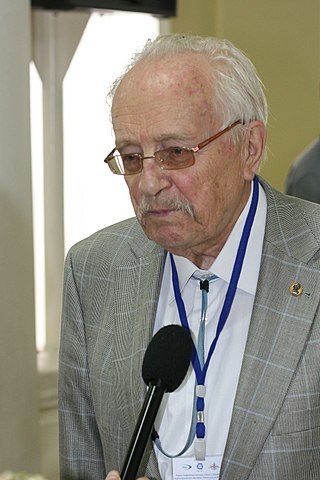
Dmitry Vasil'evich Shirkov was a Russian theoretical physicist, known for his contribution to quantum field theory and to the development of the renormalization group method.
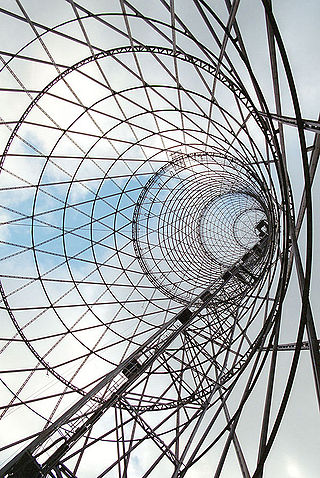
Science and technology in Russia have developed rapidly since the Age of Enlightenment, when Peter the Great founded the Russian Academy of Sciences and Saint Petersburg State University and polymath Mikhail Lomonosov founded the Moscow State University, establishing a strong native tradition in learning and innovation.

Anatoly Alekseyevich Logunov was a Soviet and Russian theoretical physicist, academician of the USSR Academy of Sciences and Russian Academy of Sciences. He was awarded the Bogolyubov Prize in 1996.

Boris Vladimirovich Struminsky was a Russian and Ukrainian physicist known for his contribution to theoretical elementary particle physics.

Eduard Alekseevich Kuraev — Soviet and Russian theoretical physicist. Doctor of Physical and Mathematical Sciences (1971).
The Bruno Pontecorvo Prize is an award for elementary particle physics, established in 1995 by the JINR in Dubna to commemorate Bruno Pontecorvo. The prize is mainly given for neutrino physics, which was Pontecorvo's principal research field, and usually to a single scientist. It is offered internationally every year.

Valery Anatolyevich Rubakov was a Russian theoretical physicist. His scientific interests included quantum field theory, elementary particle physics, and cosmology.
Valentin Nikolayevich Klimov was a Russian theoretical physicist and mathematician. He was a co-developer of the RDS-37 and worked on statistical mechanics, plasmas and nuclear reactors.

Andrej Borisovich Arbuzov is a Russian theoretical physicist. His scientific interests include quantum field theory, elementary particle physics, and cosmology. He is affiliated with the Joint Institute for Nuclear Research as a group leader in the Bogoliubov Laboratory of Theoretical Physics. He is a Doctor of Sciences in physical-mathematical sciences (2011), professor of the Russian Academy of Sciences (2016).

Viktor Anatolievich Matveev is a Russian theoretical physicist, director of the Joint Institute for Nuclear Research (2012-2020) and member of the Russian Academy of Sciences who has made fundamental contributions to areas of Particle physics, Theoretical Physics Mathematical Physics, Quantum field theory and High energy physics.

