
Aage Niels Bohr was a Danish nuclear physicist who shared the Nobel Prize in Physics in 1975 with Ben Roy Mottelson and James Rainwater "for the discovery of the connection between collective motion and particle motion in atomic nuclei and the development of the theory of the structure of the atomic nucleus based on this connection". Starting from Rainwater's concept of an irregular-shaped liquid drop model of the nucleus, Bohr and Mottelson developed a detailed theory that was in close agreement with experiments.

Niels Henrik David Bohr was a Danish physicist who made foundational contributions to understanding atomic structure and quantum theory, for which he received the Nobel Prize in Physics in 1922. Bohr was also a philosopher and a promoter of scientific research.

Max Born was a German-British physicist and mathematician who was instrumental in the development of quantum mechanics. He also made contributions to solid-state physics and optics and supervised the work of a number of notable physicists in the 1920s and 1930s. Born won the 1954 Nobel Prize in Physics for his "fundamental research in quantum mechanics, especially in the statistical interpretation of the wave function".
In atomic physics, the Bohr magneton is a physical constant and the natural unit for expressing the magnetic moment of an electron caused by its orbital or spin angular momentum. In SI units, the Bohr magneton is defined as

The University of Copenhagen is a prestigious public research university in Copenhagen, Denmark. Founded in 1479, the University of Copenhagen is the second-oldest university in Scandinavia after Uppsala University.

Christian Harald Lauritz Peter Emil Bohr (1855–1911) was a Danish physician, father of the physicist and Nobel laureate Niels Bohr, as well as the mathematician and football player Harald Bohr and grandfather of another physicist and Nobel laureate Aage Bohr. He married Ellen Adler in 1881.

George Charles de Hevesy was a Hungarian radiochemist and Nobel Prize in Chemistry laureate, recognized in 1943 for his key role in the development of radioactive tracers to study chemical processes such as in the metabolism of animals. He also co-discovered the element hafnium.

James Franck was a German physicist who won the 1925 Nobel Prize for Physics with Gustav Hertz "for their discovery of the laws governing the impact of an electron upon an atom". He completed his doctorate in 1906 and his habilitation in 1911 at the Frederick William University in Berlin, where he lectured and taught until 1918, having reached the position of professor extraordinarius. He served as a volunteer in the German Army during World War I. He was seriously injured in 1917 in a gas attack and was awarded the Iron Cross 1st Class.
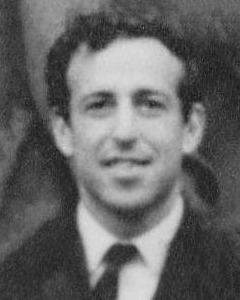
Ben Roy Mottelson was an American-Danish nuclear physicist. He won the 1975 Nobel Prize in Physics for his work on the non-spherical geometry of atomic nuclei.
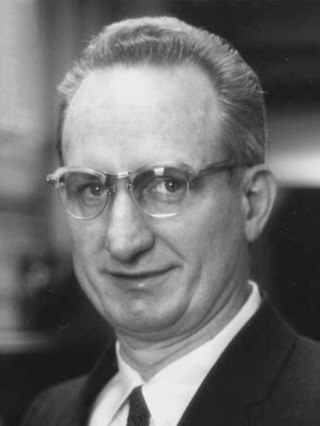
Leo James Rainwater was an American physicist who shared the Nobel Prize in Physics in 1975 for his part in determining the asymmetrical shapes of certain atomic nuclei.

Val Logsdon Fitch was an American nuclear physicist who, with co-researcher James Cronin, was awarded the 1980 Nobel Prize in Physics for a 1964 experiment using the Alternating Gradient Synchrotron at Brookhaven National Laboratory that proved that certain subatomic reactions do not adhere to fundamental symmetry principles. Specifically, they proved, by examining the decay of K-mesons, that a reaction run in reverse does not retrace the path of the original reaction, which showed that the reactions of subatomic particles are not indifferent to time. Thus the phenomenon of CP violation was discovered. This demolished the faith that physicists had that natural laws were governed by symmetry.
Niels is a male given name, equivalent to Nicholas, which is common in Denmark, Belgium, Norway (formerly) and the Netherlands. The Norwegian and Swedish variant is Nils. The name is a developed short form of Nicholas or Greek Nicolaos, after Saint Nicholas. Its pet form is Nisse, and female variants are Nielsine, Nielsina, and Nielsa.
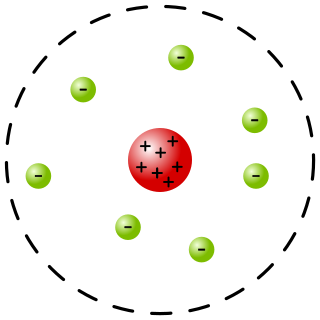
The Rutherford model was devised by the New Zealand-born physicist Ernest Rutherford to describe an atom. Rutherford directed the Geiger–Marsden experiment in 1909, which suggested, upon Rutherford's 1911 analysis, that J. J. Thomson's plum pudding model of the atom was incorrect. Rutherford's new model for the atom, based on the experimental results, contained new features of a relatively high central charge concentrated into a very small volume in comparison to the rest of the atom and with this central volume containing most of the atom's mass. This region would be known as the atomic nucleus.
Events from the year 1922 in Denmark.
The Bohr family is a Danish family of scientists, scholars and amateur sportsmen. The most famous members are Niels Bohr, physicist and winner of the Nobel Prize in Physics in 1922, Aage Bohr, son of Niels, also a physicist and in 1975 also received the Nobel Prize, Harald Bohr, mathematician and brother of Niels, etc.

John Simpson is a British nuclear physicist. He is known for his work in gamma-ray spectroscopy and detector design. He was Head of Technology, Division of Technology Department. and was Head of the Nuclear Physics Group at STFC Daresbury Laboratory. He is a visiting professor of physics at the University of Liverpool.
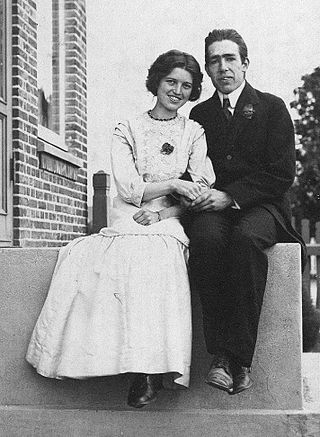
Margrethe Nørlund Bohr was the Danish wife of and collaborator, editor and transcriber for physicist Niels Bohr who received the Nobel Prize. She also influenced her son, Nobel Prize winner Aage Bohr.
This page is based on this
Wikipedia article Text is available under the
CC BY-SA 4.0 license; additional terms may apply.
Images, videos and audio are available under their respective licenses.

