Mission
Our mission is to overcome and dismantle the barriers that keep children from having meaningful and loving relationships with both parents after parental separation.
We do this by providing:
1. Advocacy and Awareness: We advocate for the rights of children to maintain meaningful relationships with both parents and wider families after parental separation, while raising awareness about the impact of parental conflict on their wellbeing.
2. Support Services: We provide families with resources, guidance and emotional support to navigate separation in a way that prioritises the needs of children and promotes their resilience and stability.
3. Education and Training: We equip parents, carers and professionals with the knowledge and tools needed to develop healthy co-parenting relationships and minimise the negative effects of parental separation on children.
4. Policy and Collaboration: We work with policymakers, legal systems and community organisations to promote fair practices and frameworks that protect children’s rights and support their holistic development in separated families.
Statement
Since 1974, Both Parents Matter has been dedicated to ensuring that every child can maintain meaningful and loving relationships with both parents and their wider family after separation.
Our charity is built on the values of positive co-parenting; advocacy, compassion, and collaboration. Working with policymakers, legal systems, and community partners, we aim to change societal attitudes toward co-parenting and create lasting change in family law — we help build stronger families, healthier communities, and a more efficient support system for separated families.
At Both Parents Matter, we are committed to building a society where all children can thrive, regardless of family circumstances.
History and Organisation
On October 12th, 2024, the members of Families Need Fathers ("FNF") voted 91% in favour of the Special Resolution to change the charity's name to "Both Parents Matter"
Families Need Fathers was founded in May 1974 by child psychiatrist Alick Elithorn and financial consultant Keith Parkin as an organisation to campaign for equal parenting time after divorce, and for increased contact between a child and its non-custodial parent. The organisation became a registered charity in 1979, and was able to hire staff in 1992. As the organisation grew in the 1990s, previous employees founded several new organisations with similar missions, such as Parents Forever Scotland, the Association of Shared Parenting, Dads After Divorce, and Fathers4Justice.
In 2008, FNF launched projects under the slogan "Both Parents Matter" and this strapline was added to the charity's logo in 2013. By 2010, the organisation had 51 branches across the United Kingdom and a network of 300 volunteers. It has since continued to advocate for shared parenting in the media, the House of Commons and the family justice establishment, while continuing its work as a social care organisation.
The Current CEO is Sam Morfey and the current chair is Paul O'Callaghan. [1]
In 2009 guidance produced by Families Need Fathers came under criticism for giving the impression that they might have emanated from, or were approved by, the Department for Children, Schools and Families (DCSF ) or Cafcass.
- ↑ "Home". Both Parents Matter. Retrieved 2025-02-03.
Child custody, conservatorship and guardianship describe the legal and practical relationship between a parent and the parent's child, such as the right of the parent to make decisions for the child, and the parent's duty to care for the child.
Shared parenting, shared residence, joint residence, shared custody, joint physical custody, equal parenting time (EPT) is a child custody arrangement after divorce or separation, in which both parents share the responsibility of raising their child(ren), with equal or close to equal parenting time. A regime of shared parenting is based on the idea that children have the right to and benefit from a close relationship with both their parents, and that no child should be separated from a parent.
The fathers' rights movement is a social movement whose members are primarily interested in issues related to family law, including child custody and child support, that affect fathers and their children. Many of its members are fathers who desire to share the parenting of their children equally with their children's mothers—either after divorce or marital separation. The movement includes men as well as women, often the second wives of divorced fathers or other family members of men who have had some engagement with family law. Most Fathers' rights advocates argue for formal gender equality.

The fathers' rights movement in the United Kingdom consists of a large number of diverse pressure groups, ranging from charities and self-help groups to civil disobedience activists in the United Kingdom, who started to obtain wide publicity in 2003. Studies show the majority of the UK population support the need for change and protection of fathers rights to meet the responsibility through 50:50 contact. The movement's origin can be traced to 1974 when Families Need Fathers (FNF) was founded. At the local level, many activists spend much time providing support for newly separated fathers, most of whom are highly distraught. Although some have been accused of being sexist by some commentators, these groups also campaign for better treatment for excluded mothers, women in second marriages, other step-parents and grandparents – all of whom suffer discrimination in respect of contact with their (grand) child(ren).
Parental alienation is a theorized process through which a child becomes estranged from one parent as the result of the psychological manipulation of another parent. The child's estrangement may manifest itself as fear, disrespect or hostility toward the distant parent, and may extend to additional relatives or parties. The child's estrangement is disproportionate to any acts or conduct attributable to the alienated parent. Parental alienation can occur in any family unit, but is claimed to occur most often within the context of family separation, particularly when legal proceedings are involved, although the participation of professionals such as lawyers, judges and psychologists may also contribute to conflict.
The fathers' rights movement in Italy is dedicated to achieving equal parental rights and obligations and shared parenting of children after divorce or separation. It consists of a number of diverse organizations, ranging from social charities and self-help groups to civil disobedience activists. At the local level, organizations offer support to newly separated fathers, many of whom are highly distraught.
Joint custody is a court order whereby custody of a child is awarded to both parties. In the United States, there are two forms of joint custody, joint physical custody and joint legal custody. In joint physical custody, the lodging and care of the child is shared according to a court-ordered parenting schedule with equal or close to equal parenting time. In joint legal custody, both parents share the ability to make decisions about the child, regarding e.g. education, medical care and religion, and both can access their children's educational and health records.
Child custody is a legal term regarding guardianship which is used to describe the legal and practical relationship between a parent or guardian and a child in that person's care. Child custody consists of legal custody, which is the right to make decisions about the child, and physical custody, which is the right and duty to house, provide and care for the child. Married parents normally have joint legal and physical custody of their children. Decisions about child custody typically arise in proceedings involving divorce, annulment, separation, adoption or parental death. In most jurisdictions child custody is determined in accordance with the best interests of the child standard.
Australian family law is principally found in the federal Family Law Act 1975 and the Federal Circuit and Family Court of Australia Rules 2021 as well as in other laws and the common law and laws of equity, which affect the family and the relationship between those people, including when those relationships end. Most family law is practised in the Federal Circuit and Family Court of Australia and the Family Court of Western Australia. Australia recognises marriages entered into overseas as well as divorces obtained overseas if they were effected in accordance with the laws of that country. Australian marriage and "matrimonial causes" are recognised by sections 51(xxi) and (xxii) of the Constitution of Australia and internationally by marriage law and conventions, such as the Hague Convention on Marriages (1978).
The Family Law Act 1975(Cth) is an Act of the Parliament of Australia. It has 15 parts and is the primary piece of legislation dealing with divorce, parenting arrangements between separated parents (whether married or not), property separation, and financial maintenance involving children or divorced or separated de facto partners: in Australia. It also covers family violence. It came into effect on 5 January 1976, repealing the Matrimonial Causes Act 1961, which had been largely based on fault. On the first day of its enactment, 200 applications for divorce were filed in the Melbourne registry office of the Family Court of Australia, and 80 were filed in Adelaide, while only 32 were filed in Sydney.

The National Parents Organization (NPO) is a 501(c)(3) non-profit charitable and educational organization in the United States that promotes shared parenting. The organization focuses on family court reform, research, and public education with the goal to make shared parenting the general norm for separated parenting.

The tender years doctrine is a legal principle in family law since the late 19th century. In common law, it presumes that during a child's "tender" years, the mother should have custody of the child. The doctrine often arises in divorce proceedings.
Co-parenting involves parents who together take on the socialization, care, and upbringing of children for whom they share equal responsibility. The co-parent relationship differs from an intimate relationship between adults in that it focuses solely on the child. The equivalent term in evolutionary biology is bi-parental care, where parental investment is provided by both the mother and father.
The fathers' rights movement has simultaneously evolved in many countries, advocating for shared parenting after divorce or separation, and the right of children and fathers to have close and meaningful relationships. This article provides details about the fathers' rights movement in specific countries.
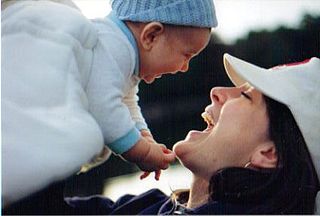
Maternal deprivation is a scientific term summarising the early work of psychiatrist and psychoanalyst John Bowlby on the effects of separating infants and young children from their mother. Although the effect of loss of the mother on the developing child had been considered earlier by Freud and other theorists, Bowlby's work on delinquent and affectionless children and the effects of hospital and institutional care led to his being commissioned to write the World Health Organization's report on the mental health of homeless children in post-war Europe whilst he was head of the Department for Children and Parents at the Tavistock Clinic in London after World War II. The result was the monograph Maternal Care and Mental Health published in 1951, which sets out the maternal deprivation hypothesis.
The Children's Rights Council (CRC) is a non-profit organization dedicated to help divorced, separated and never married parents to remain active in their child’s life. The organization focuses on children’s rights advocacy for shared parenting, the prevention of child abuse and alternative dispute resolution. CRC also run parental access centers where children can spend supervised time with their non-custodial parents and where transfers between parents can occur in a monitored environment. The organization was founded in 1985 by David L Levy, and it is headquartered in Landover, Maryland, in the Washington, D.C. metropolitan area.
A gatekeeper parent, in legal setting, is a parent who appoints themself the power to decide what relationship is acceptable between the other parent and the child(ren). The term is broad and may include power dynamics within a marriage or may describe the behaviors of divorced or never married parents.
Primary parent or primary carer is the parent who has most parenting time with the children after separation. The other parent is then known as the secondary parent – arguably less pejorative than terms like single parent or Parent With Care.

Families Need Fathers - Both Parents Matter (FNF), founded in 1974, is a registered charitable social care organization in the United Kingdom that offers information, advice, and support to parents whose children's relationship with them is under threat during or after divorce or separation, or who have been alienated or estranged from their children. FNF also advocates for shared parenting, more time for children with their non-resident parent, and stronger court actions when a resident parent defies court orders requiring them to allow their children a relationship with the other parent. The organization's goal is that children of divorce or separation should not lose the love and care of one of their parents.
Child displacement is the complete removal or separation of children from their parents and immediate family or settings in which they have initially been reared. Displaced children includes varying categories of children who experience separation from their families and social settings due to several varied reasons. These populations include children separated from their parents, refugees, children sent to boarding schools, internally displaced persons or IDPs, and asylum seekers. Thus child displacement refers to a broad range of factors due to which children are removed from their parents and social setting. This include persecution, war, armed conflict and disruption and separation for varied reasons.
