Issues and Campaign
Before Brandenburg, the SPD had lost many state elections, what was connected to Gerhard Schröder's Agenda 2010 policy, which was a reaction to the problems of constantly high unemployment in Germany. The establishing of a lower welfare payment (called Hartz IV after an expert who had invented it) for people unemployed for more than a year had driven many voters to the left Party of Democratic Socialism (PDS) party in the east, to the new-founded WASG in the west or away from the elections at all. Since 2003 the CDU had won more and more states, whereas the SPD suffered a string of heavy defeats.

Gerhard Fritz Kurt Schröder is a German politician, and served as Chancellor of Germany from 1998 to 2005, during which his most important political project was the Agenda 2010. As a member of the Social Democratic Party of Germany (SPD), he led a coalition government of the SPD and the Greens.
The Agenda 2010 is a series of reforms planned and executed by the German government, a Social-Democrats/Greens coalition at that time, which aimed to reform the German welfare system and labour relations. The declared objective of Agenda 2010 was to promote economic growth and thus reduce unemployment.

The Party of Democratic Socialism was a democratic socialist political party in Germany active between 1989 and 2007. It was the legal successor to the Socialist Unity Party of Germany (SED), which ruled the German Democratic Republic as a one-party state until 1990. From 1990 through to 2005, the PDS had been seen as the left-wing "party of the East". While it achieved minimal support in western Germany, it regularly won 15% to 25% of the vote in the eastern new states of Germany, entering coalition governments in the federal states of Mecklenburg-Vorpommern and Berlin.
In Brandenburg, both minister-president Matthias Platzeck (SPD) and his partner Jörg Schönbohm (CDU) supported the labour reforms. Against this campaigned the PDS and the far-right German People's Union (DVU), which had gained seats in the Landtag in 1999 for the first time.

Matthias Platzeck is a German politician. He was Minister President of Brandenburg from 2002 to 2013 and party chairman of the SPD from November 2005 to April 2006.

Jörg Schönbohm was a German politician (CDU) and a retired Lieutenant General. He was the first commander of the Bundeswehr Eastern Command in 1990, which supervised the absorption of the East German National People's Army into the Federal German armed forces. In 1991 he became the Inspector of the Army, the highest-ranking officer in the German Army; he was retired in 1992 to become Undersecretary for Security Policy in the Federal Ministry of Defence. From 1996 to 1998 Schönbohm was Senator of the Interior for the city of Berlin, and from 1999 to 2009 he held the same office as Interior Minister for the state of Brandenburg.

The German People's Union was a political party in Germany. It was founded by publisher Gerhard Frey as an informal association in 1971 and established as a party in 1987. Financially, it was largely dependent on Frey. In 2011, it merged with the National Democratic Party of Germany (NPD).
This page is based on this
Wikipedia article Text is available under the
CC BY-SA 4.0 license; additional terms may apply.
Images, videos and audio are available under their respective licenses.
The Christian Social Union in Bavaria is a Christian-democratic and conservative political party in Germany. The CSU operates only in Bavaria while its larger counterpart, the Christian Democratic Union (CDU), operates in the other fifteen states of Germany. It differs from the CDU by being somewhat more conservative in social matters. The CSU is considered an effective successor of the Weimar-era Catholic Bavarian People's Party (BVP).

Klaus Wowereit is a German politician, member of the SPD, and was the Governing Mayor of Berlin from 21 October 2001 to 11 December 2014. In 2001 state elections his party won a plurality of the votes, 29.7%. He served as President of the Bundesrat in 2001/02. His SPD-led coalition was re-elected in the 2006 elections; after the 2011 elections the SPD's coalition partner changed from the Left to the Christian Democratic Union. He was also sometimes mentioned as a possible SPD candidate for the Chancellorship of Germany (Kanzlerkandidatur), but that never materialized.
The Saxony state election of 2004, was conducted on 19 September 2004, to elect members to the Landtag of Saxony.
The Saxony-Anhalt state election, 2002, was conducted on 21 April 2002, to elect members to the Landtag of Saxony-Anhalt.

Federal elections were held in Germany on 18 September 2005 to elect the members of the 16th Bundestag. This became necessary after a motion of confidence in Chancellor Gerhard Schröder failed on 1 July. Following the defeat of Schröder's Social Democratic Party (SPD) in a state election, Schröder asked his supporters to abstain from the Bundestag motion, knowing the motion would fail and thus triggering an early federal election.

Harald Ringstorff is a German politician of the Social Democratic Party (SPD) and was the 3rd Minister President of the state of Mecklenburg-Vorpommern. He headed a coalition government of the SPD and PDS from 1998 until 2006, and subsequently headed a coalition between the SPD and CDU. He was the 61st President of the Bundesrat in 2006/07.
The Left, also commonly referred to as the Left Party, is a democratic socialist political party in Germany. It is considered to be left-wing populist by some researchers. The party was founded in 2007 as the result of the merger of the Party of Democratic Socialism (PDS) and the Electoral Alternative for Labour and Social Justice (WASG). Through the PDS, the party is the direct descendant of the ruling party of the former East Germany (GDR), the Socialist Unity Party of Germany (SED).
The state election to elect members of the Landtag of Hesse was held in the German state of Hesse on 27 January 2008.

Andrea Ypsilanti is a German politician.
The Politics of Hesse takes place within a framework of a federal parliamentary representative democratic republic, where the Federal Government of Germany exercises sovereign rights with certain powers reserved to the states of Germany including Hesse. The state has a multi-party system where, as in most other states of former Western Germany and the federal level, the two main parties are the centre-right Christian Democratic Union (CDU) and the centre-left Social Democratic Party of Germany (SPD).
The Politics of Brandenburg takes place within a framework of a federal parliamentary representative democratic republic, where the Federal Government of Germany exercises sovereign rights with certain powers reserved to the states of Germany including Brandenburg. The three main parties are the centre leftist Social Democratic Party of Germany (SPD), the leftist Left Party and the centre rightist Christian Democratic Union.

The Landtag of Hesse is the Parliament of the State of Hesse in the Federal Republic of Germany. It convenes in the Stadtschloss, Wiesbaden. As a Legislature it is responsible for passing laws at the state level and enacting the budget. Its most important function is to elect and control the state government. The constitution of the State of Hesse describes the role of the Landtag in §§ 75 to 99.
State elections were held in Brandenburg on 27 September 2009, the same day as the German federal elections and the Schleswig-Holstein state elections. The elections determined control of the Landtag of Brandenburg.
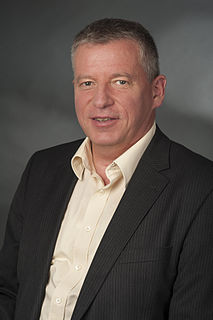
Thomas Nord is a German politician and Member of the German Federal Parliament.

The North Rhine-Westphalia state election, 2012 was a snap election held on 13 May 2012, to elect members to the Landtag of the German state of North Rhine-Westphalia, after the former Landtag was dissolved on 14 March 2012. The red-green minority government led by Minister-President Hannelore Kraft was returned with a 19-seat majority and were able to continue governing the state.

Dietmar Woidke is a German politician of the Social Democratic Party of Germany. Since August 2013, Woidke has served as Minister President of Brandenburg. He is married.

The Mecklenburg-Vorpommern State Elections, 2016 were held on 4 September 2016, to elect members to the 7th Landtag of Mecklenburg-Vorpommern. All 71 seats in the Landtag were contested and around 1.3 million voters were eligible to cast ballots. Postal voting began in August ahead of the September 4 polling day. State elections in Mecklenburg-Vorpommern use the Hare-Niemeyer method of proportional representation to allocate seats in the Landtag.

Anita Tack is a German politician who is a member of Die Linke. From 2009 to 2014, she was the Minister of the Environment, Health, and Consumer Protection for the state of Brandenburg. Since 1994, she has been a member of the Landtag of Brandenburg.

Ralf Christoffers is a German politician who has served in the Landtag of Brandenburg since 1994 and as Minister of Economic Affairs and European Affairs of Brandenburg in the Cabinet of Ministers-President Matthias Platzeck and Dietmar Woidke from 2009 to 2014.


