
Fish farming or pisciculture involves commercial breeding of fish, most often for food, in fish tanks or artificial enclosures such as fish ponds. It is a particular type of aquaculture, which is the controlled cultivation and harvesting of aquatic animals such as fish, crustaceans, molluscs and so on, in natural or pseudo-natural environments. A facility that releases juvenile fish into the wild for recreational fishing or to supplement a species' natural numbers is generally referred to as a fish hatchery. Worldwide, the most important fish species produced in fish farming are carp, catfish, salmon and tilapia.

The European eel is a species of eel. They are critically endangered due to overfishing by fisheries on coasts for human consumption and parasites.
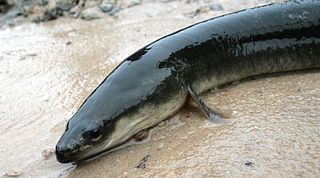
The American eel is a facultative catadromous fish found on the eastern coast of North America. Freshwater eels are fish belonging to the elopomorph superorder, a group of phylogenetically ancient teleosts. The American eel has a slender, supple, snake-like body that is covered with a mucus layer, which makes the eel appear to be naked and slimy despite the presence of minute scales. A long dorsal fin runs from the middle of the back and is continuous with a similar ventral fin. Pelvic fins are absent, and relatively small pectoral fins can be found near the midline, followed by the head and gill covers. Variations exist in coloration, from olive green, brown shading to greenish-yellow and light gray or white on the belly. Eels from clear water are often lighter than those from dark, tannic acid streams.
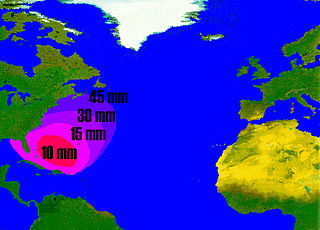
Eels are any of several long, thin, bony fishes of the order Anguilliformes. They have a catadromous life cycle, that is: at different stages of development migrating between inland waterways and the deep ocean. Because fishermen never caught anything they recognized as young eels, the life cycle of the eel was a mystery for a very long period of scientific history that continues into the present day. Of significant interest is the search for the spawning grounds for the various species of eels and identifying impacts to population decline in each stage of the life cycle.
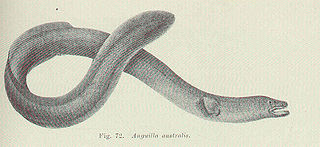
The short-finned eel, also known as the shortfin eel, is one of the 15 species of eel in the family Anguillidae. It is native to the lakes, dams and coastal rivers of south-eastern Australia, New Zealand, and much of the South Pacific, including New Caledonia, Norfolk Island, Lord Howe Island, Tahiti, and Fiji.

Aquaponics is a food production system that couples aquaculture with hydroponics whereby the nutrient-rich aquaculture water is fed to hydroponically grown plants.
The Anguillidae are a family of ray-finned fish that contains the freshwater eels. Eighteen of the 19 extant species and six subspecies in this family are in the genus Anguilla, and all are elongated fish of snake-like bodies, with long dorsal, caudal and anal fins forming a continuous fringe. They are catadromous, spending their adult lives in freshwater, but migrating to the ocean to spawn.

The New Zealand longfin eel, also known as ōrea, is a species of freshwater eel that is endemic to New Zealand. It is the largest freshwater eel in New Zealand and the only endemic species – the other eels found in New Zealand are the native shortfin eel, also found in Australia, and the naturally introduced Australian longfin eel. Longfin eels are long-lived, migrating to the Pacific Ocean near Tonga to breed at the end of their lives. They are good climbers as juveniles and so are found in streams and lakes a long way inland. An important traditional food source for Māori, who name them ōrea, longfin eel numbers are declining and they are classified as endangered, but over one hundred tonnes are still commercially fished each year.

The speckled longfin eel, Australian long-finned eel or marbled eel is one of 15 species of eel in the family Anguillidae. It has a long snake-like cylindrical body with its dorsal, tail and anal fins joined to form one long fin. It usually has a brownish green or olive green back and sides with small darker spots or blotches all over its body. Its underside is paler. It has a small gill opening on each side of its wide head, with thick lips. It is Australia's largest freshwater eel, and the female usually grows much larger than the male. It is also known as the spotted eel.

The Japanese eel is a species of anguillid eel found in Japan, Korea, Taiwan, China, and Vietnam, as well as the northern Philippines. There are three main species under the Anguilla genus, and all three share very similar characteristics. These species are so similar that it is believed that they spawned from the same species and then experienced a separation due to different environments in the ocean. Like all the eels of the genus Anguilla and the family Anguillidae, it is catadromous, meaning it spawns in the sea but lives parts of its life in freshwater. Raised in aquaculture ponds in most countries, the Japanese eel makes up 95% of the commercially sold eel in Japan, the other 5% is shipped over by air to the country from Europe. This food in Japan is called unagi; they are an essential part of the food culture, with many restaurants serving grilled eel called kabayaki. However, presumably due to a combination of overfishing and habitat loss or changing water conditions in the ocean interfering with spawning and the transport of their leptocephali this species is endangered.

Coarse fishing is a phrase commonly used in Britain and Ireland. It refers to the angling for rough fish, which are fish species traditionally considered undesirable as food or game fish. Freshwater game fish are all salmonids, particularly salmon, trout and char. Generally, coarse fish are freshwater fish that are not salmonids, though there is often disagreement over whether grayling should be classified as game fish or a coarse fish.
This page is a list of fishing topics.

Eels are ray-finned fish belonging to the order Anguilliformes, which consists of eight suborders, 20 families, 164 genera, and about 1000 species. Eels undergo considerable development from the early larval stage to the eventual adult stage and are usually predators.
The Invisible Circus is a theatre and circus troupe based in Bristol in the United Kingdom. Set up in the 1990s, the group collaborates with Artspace Lifespace to make site-specific performances.
The following outline is provided as an overview of and topical guide to fisheries:
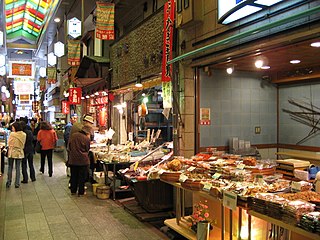
Eels are elongated fish, ranging in length from five centimetres (2 in) to four metres (13 ft). Adults range in weight from 30 grams to over 25 kilograms. They possess no pelvic fins, and many species also lack pectoral fins. The dorsal and anal fins are fused with the caudal or tail fin, forming a single ribbon running along much of the length of the animal. Most eels live in the shallow waters of the ocean and burrow into sand, mud, or amongst rocks. A majority of eel species are nocturnal and thus are rarely seen. Sometimes, they are seen living together in holes, or "eel pits". Some species of eels live in deeper water on the continental shelves and over the slopes deep as 4,000 metres (13,000 ft). Only members of the family Anguillidae regularly inhabit fresh water, but they too return to the sea to breed.

Fish go through various life stages between fertilization and adulthood. The life of a fish start as spawned eggs which hatch into immotile larvae. These larval hatchlings are not yet capable of feeding themselves and carry a yolk sac which provides stored nutrition. Before the yolk sac completely disappears, the young fish must mature enough to be able to forage independently. When they have developed to the point where they are capable of feeding by themselves, the fish are called fry. When, in addition, they have developed scales and working fins, the transition to a juvenile fish is complete and it is called a fingerling, so called as they are typically about the size of human fingers. The juvenile stage lasts until the fish is fully grown, sexually mature and interacting with other adult fish.
Mahindra Lifespace Developers Ltd. is an Indian real estate and infrastructure development company headquartered in Mumbai, India. The company was founded in 1994 and is part of the Mahindra Group. The company is engaged in residential developments under the Mahindra Lifespaces and Happinest brands; and integrated cities and industrial clusters under the ‘Mahindra World City’ and ‘ORIGINS by Mahindra World City’ brands. The company has developed properties in Mumbai, Pune, Nagpur, Ahmedabad, Delhi NCR, Jaipur, Hyderabad, Chennai, and Bengaluru.
The Integrated Floating Cage Aquageoponics System (IFCAS) was developed as an aquaculture-horticulture based on the concept of integrated farming system approach firstly in Bangladesh in 2013 to produce fish and vegetables in floating condition where waste materials (fish feces and unused feed) from fish culture dissolved in the pond water and settled on the bottom mud are used for vegetables production. Of the newly adopted term aquageoponics, aqua, geo and ponics means water, mud/soil and cultivation, respectively. In fact, aquageoponics is a new version of traditional aquaponics where soil is used as a medium instead of conventional media such as hydroton, pebbles, and sponges.

Freshwater eel poaching and smuggling have emerged in recent years as a direct response to the sustained popularity of eels as food combined with the eels' low population, endangered status, and subsequent protections. Freshwater eel are elongated fish in the Anguillidae family of ray-finned fish. The three most commonly consumed eel species are the Japanese eel, European eel, and American eel.


