See also
 | This disambiguation page lists articles about distinct geographical locations with the same name. If an internal link led you here, you may wish to change the link to point directly to the intended article. |
Buchenwald is the German for "beechwood forest". It may also refer to:
| | This disambiguation page lists articles about distinct geographical locations with the same name. If an internal link led you here, you may wish to change the link to point directly to the intended article. |

Buchenwald was a Nazi concentration camp established on Ettersberg hill near Weimar, Germany, in July 1937. It was one of the first and the largest of the concentration camps within Germany's 1937 borders. Many actual or suspected communists were among the first internees.
Karl-Otto Koch was a mid-ranking commander in the Schutzstaffel (SS) of Nazi Germany who was the first commandant of the Nazi concentration camps at Buchenwald and Sachsenhausen. From September 1941 until August 1942, he served as the first commandant of the Majdanek concentration camp in occupied Poland, stealing vast amounts of valuables and money from murdered Jews. His wife, Ilse Koch, also took part in the crimes at Buchenwald and Majdanek.
Halle may refer to:
Greiz is a Kreis (district) in the east of Thuringia, Germany. Neighboring districts are Saale-Holzland, Saale-Orla, district-free city Gera, the Burgenlandkreis in Saxony-Anhalt, Altenburger Land, and the two Saxon districts Zwickauer Land and Vogtlandkreis.

Ilse Koch was married to Karl-Otto Koch, commandant of the Nazi concentration camps Buchenwald (1937–1941) and Majdanek (1941–1943). In 1947, she became one of the first prominent Nazis tried by the U.S. military.

Ohrdruf was a German forced labor and concentration camp located near Ohrdruf, south of Gotha, in Thuringia, Germany. It was part of the Buchenwald concentration camp network.

Mittelbau-Dora was a Nazi concentration camp located near Nordhausen in Thuringia, Germany. It was established in late summer 1943 as a subcamp of Buchenwald concentration camp, supplying slave labour from many Eastern countries occupied by Germany, for extending the nearby tunnels in the Kohnstein and for manufacturing the V-2 rocket and the V-1 flying bomb. In the summer of 1944, Mittelbau became an independent concentration camp with numerous subcamps of its own. In 1945, most of the surviving inmates were evacuated by the SS. On 11 April 1945, US troops freed the remaining prisoners.

Richard Baer was a German SS officer who, among other assignments, was the commandant of Auschwitz I concentration camp from May 1944 to February 1945, and right after, from February to April 1945, commandant of Mittelbau-Dora concentration camp. Following the war, Baer lived under an assumed name to avoid prosecution but was recognized and arrested in December 1960. He died in detention before he could stand trial.

Bruno Apitz was a German writer and a survivor of the Buchenwald concentration camp.

Identification of inmates in German concentration camps was performed mostly with identification numbers marked on clothing, or later, tattooed on the skin. More specialized identification was done with German concentration camp badges on the clothing and also with armbands.

During World War II, the Danish government chose to cooperate with the Nazi occupation force. Even though this applied to the Danish police as well, many were reluctant to cooperate. As a result, a large number of members of the Danish police force were deported to Nazi concentration camps in Germany. The Gestapo established the collaborationist HIPO Corps to replace them.

Hinzert was a Concentration camp in Nazi Germany, in what is now Rhineland-Palatinate, 30 kilometres (19 mi) from the border with Luxembourg.
The number of deaths in the Buchenwald concentration camp is estimated to have been 56,545, a mortality rate of 20% averaged over all prisoners transferred to the camp between its founding in 1937 and its liberation in 1945. Deaths were due both to the harsh conditions of life in the camp and also to the executions carried out by camp overseers.
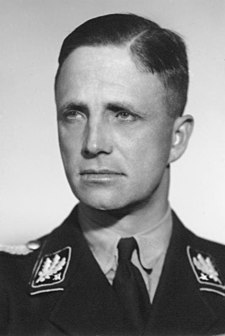
Josias, Hereditary Prince of Waldeck and Pyrmont was the heir apparent to the throne of the Principality of Waldeck and Pyrmont and a general in the SS. From 1946 until his death, he was the head of the Princely House of Waldeck and Pyrmont. After World War II, he was sentenced to life in prison at the Buchenwald Trial for his part in the "common plan" to violate the Laws and Usages of War in connection with prisoners of war held at Buchenwald concentration camp, but was released after serving about three years in prison.

Netzer Sereni is a kibbutz in central Israel. Located in the Shephelah between Be'er Ya'akov and Ness Ziona, it falls under the jurisdiction of Gezer Regional Council. In 2019 it had a population of 882.

Phillip John Lamason, was a pilot in the Royal New Zealand Air Force (RNZAF) during the Second World War, who rose to prominence as the senior officer in charge of 168 Allied airmen taken to Buchenwald concentration camp, Germany, in August 1944. Raised in Napier, he joined the RNZAF in September 1940, and by April 1942 was a pilot officer serving with the Royal Air Force in Europe. On 8 June 1944, Lamason was in command of a Lancaster heavy bomber that was shot down during a raid on railway marshalling yards near Paris. Bailing out, he was picked up by members of the French Resistance and hidden at various locations for seven weeks. While attempting to reach Spain along the Comet line, Lamason was betrayed by an double agent within the Resistance and seized by the Gestapo.
Genickschussanlage is the official name of a facility used for surprise executions in Nazi Germany. The victim was placed, under a pretext, in a position where a shot could be fired into the back of their neck from the neighbouring room. For that purpose, the facilities were partly disguised as height measuring devices or medicinal instruments. The facilities are mostly known from concentration camps, where they were not only used to carry out official death sentences but also to carry out inconspicuous murder of larger groups of victims.

The Buchenwald Trial or United States of America vs. Josias Prince of Waldeck et al. was a war crime trial conducted by the United States Army as a court-martial in Dachau, then part of the American occupation zone. It took place from April 11 to August 14, 1947 in the internment camp of Dachau, where the former Dachau concentration camp had been located until late April 1945. In this trial, 31 people were indicted for war crimes related to the Buchenwald concentration camp and its satellite camps, all of whom were convicted. The Buchenwald Trial was part of the Dachau trials, which were held between 1945 and 1948.

Goethe Oak, is a name given to a number of oak trees in Germany that are referred to in this way because they allegedly bear some sort of connection to the poet Johann Wolfgang von Goethe.