Related Research Articles

The Mongols are an East Asian ethnic group native to Mongolia, Inner Mongolia in China, and the Buryatia Republic of the Russian Federation. The Mongols are the principal member of the large family of Mongolic peoples. The Oirats in Western Mongolia as well as the Buryats and Kalmyks of Russia are classified either as distinct ethno-linguistic groups or subgroups of Mongols.

The Kalmyks are a Mongolic ethnic group living mainly in Russia, whose ancestors migrated from Dzungaria. They created the Kalmyk Khanate from 1635 to 1779 in the south of the European part of Russia territory. Today they form a majority in Kalmykia, located in the Kalmyk Steppe, on the western shore of the Caspian Sea.

Oirats or Oirds, also formerly Eluts and Eleuths, are the westernmost group of the Mongols whose ancestral home is in the Altai region of Siberia, Xinjiang and western Mongolia.
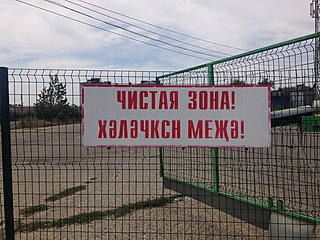
Kalmyk Oirat, commonly known as the Kalmyk language, is a variety of the Oirat language, natively spoken by the Kalmyk people of Kalmykia, a federal subject of Russia. In Russia, it is the standard form of the Oirat language, which belongs to the Mongolic language family. The Kalmyk people of the Northwest Caspian Sea of Russia claim descent from the Oirats from Eurasia, who have also historically settled in Mongolia and Northwest China. According to UNESCO, the language is "Definitely endangered". According to the Russian census of 2010, there are 80,500 speakers of an ethnic population consisting of 183,000 people.

Kalmykia, officially the Republic of Kalmykia, is a republic of Russia, located in the North Caucasus region of Southern Russia. The republic is part of the Southern Federal District, and borders Dagestan to the south and Stavropol Krai to the southwest; Volgograd Oblast to the northwest and north and Astrakhan Oblast to the north and east; Rostov Oblast to the west and the Caspian Sea to the east. Kalmykia is the only region in Europe where Buddhism is the predominant religion.
The Dörbet is the second largest subgroup of Mongol people in modern Mongolia and was formerly one of the major tribes of the Four Oirat confederation in the 15th-18th centuries. In early times, the Dörbets and the Öold were ruled by collateral branches of the Choros lineage. The Dörbets are distributed among the western provinces of Mongolia, Kalmykia and in a small portion in Heilongjiang, China. In modern-day Mongolia, the Dörbets are centered in Uvs Province.
The Khoshut are one of the four major tribes of the Oirat people. They established the Khoshut Khanate in the area of Tibet in 1642–1717.
The music of Kalmykia, a national republic within Russia, has roots in the musical culture of the Oirats. Traditional instruments include the dombra, which is used to accompany dance music. The state folk ensemble Tulpan was formed in 1937 to promote traditional Kalmyk music.
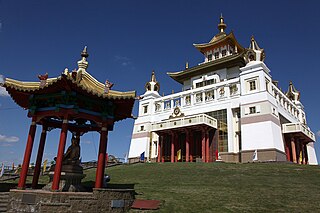
The Kalmyk people are the only people of Europe whose national religion is Buddhism. In 2016, 53.4% of the population surveyed identified themselves as Buddhist. They live in Kalmykia, a federal subject of the Russian Federation located in southwestern Russia. The border faces Dagestan to the south, Stavropol Krai to the southwest, Rostov Oblast to the west, Volgograd Oblast to the northwest and Astrakhan Oblast to the east. The Caspian Sea borders Kalmykia to the southeast.
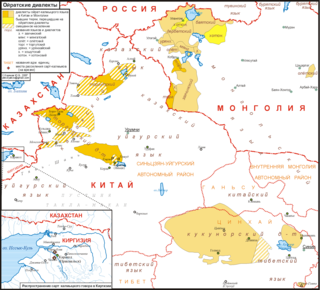
Oirat is a Mongolic language spoken by the descendants of Oirat Mongols, now forming parts of Mongols in China, Kalmyks in Russia and Mongolians. Largely mutually intelligible to other core Central Mongolic languages, scholars differ as to whether they regard Oirat as a distinct language or a major dialect of the Mongolian language. Oirat-speaking areas are scattered across the far west of Mongolia, the northwest of China and Russia's Caspian coast, where its major variety is Kalmyk. In China, it is spoken mainly in Xinjiang, but also among the Deed Mongol of Qinghai and Subei County in Gansu.

The Clear Script is an alphabet created in 1648 by the Oirat Buddhist monk Zaya Pandita for the Oirat language. It was developed on the basis of the Mongolian script with the goal of distinguishing all sounds in the spoken language, and to make it easier to transcribe Sanskrit and the Tibetic languages.

Erdne Ombadykow, also known as Telo Tulku Rinpoche, is the Tibetan Buddhist spiritual leader of the Kalmyk people. He received his formal training as a bhikṣu in India and was recognized by the 14th Dalai Lama as the current reincarnation of mahasiddha Tilopa.
The Torghut, are one of the four major subgroups of the Four Oirats. The Torghut nobles traced their descent to the Mongol Keraite ruler Toghrul, and many Torghuts descended from the Keraites.
Torgut, also spelled Torghud, is a dialect of the Oirat language spoken in Xinjiang, in western Mongolia and in eastern Kalmykia. Thus, it has more speakers than any other variety of Oirat. It is better researched than any other Oirat variety spoken in China.
The Buzava or Buzava Kalmyks are the ethnic Kalmyk people centered in the western Republic of Kalmykia, in the present day Southern Federal District of Russia.

The Four Oirat ; also Oirads and formerly Eleuths, alternatively known as the Alliance of the Four Oirat Tribes or the Oirat Confederation, was the confederation of the Oirat tribes which marked the rise of the Western Mongols in the history of the Mongolian Plateau.

The Kalmyk Khanate was an Oirat khanate on the Eurasian steppe. It extended over modern Kalmykia and surrounding areas in the North Caucasus, including Stavropol and Astrakhan. During their independence, the Kalmyks both raided and allied with Russia in turn, engaging in numerous military expeditions against the Crimean Tatars, the Ottoman Empire, neighboring Muslim tribes, and the highlanders of the North Caucasus. The Khanate was annexed by the Russian Empire in 1771.
The Sart Kalmyks are an ethnic group of the Oirats, who live in Issyk Kul Province, Kyrgyzstan. Their population is estimated to be c. 12,000. They are descendants of the Ööled tribes, who moved to the territory of the Russian Empire after the failure of the Dungan revolt, some part inhabited the area during the rule of the Zunghar Khanate. They used to speak Sart Kalmyk, a dialect of the Oirat language, but have largely switched to the Kyrgyz language by now. As a result of the long co-inhabitance with Kyrgyz people their incorporation into Kyrgyz nation occurred, and now the Kyrgyzs consider them to be one of their tribes. Today majority of them identify themselves as Kyrgyz. They belong to the Muslim faith.
Vladimir Okonovich Karuev, better known by his Kalmyk name Okna Tsahan Zam, is a Kalmyk folk singer, known for his throat singing and as a performer of the Kalmyk national epic Jangar.
The Oirat-Kalmyk People's Congress, also known as the Chuulhn in Kalmyk Oirat Mongolian, is an unregistered organization claiming to represent the Kalmyk people of Russia.