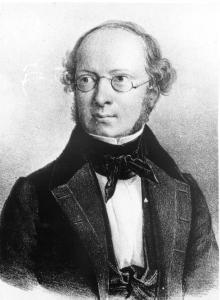
Alexander Georg von Bunge was a Russian botanist. He is best remembered for scientific expeditions into Asia and especially Siberia.

A Burschenschaft is one of the traditional Studentenverbindungen of Germany, Austria, and Chile . Burschenschaften were founded in the 19th century as associations of university students inspired by liberal and nationalistic ideas. They were significantly involved in the March Revolution and the unification of Germany. After the formation of the German Empire in 1871, they faced a crisis, as their main political objective had been realized. So-called Reformburschenschaften were established, but these were dissolved by the Nazi regime in 1935/6. In West Germany, the Burschenschaften were re-established in the 1950s, but they faced a renewed crisis in the 1960s and 1970s, as the mainstream political outlook of the German student movement of that period swerved to the radical left. Roughly 160 Burschenschaften exist today in Germany, Austria and Chile.

Friedrich Wilhelm Rembert Graf von Berg was a Baltic German nobleman, statesman, diplomat and general who served in the Imperial Russian Army. Berg was a count of the Austrian Empire and Grand Duchy of Finland and the 5th last man to be promoted General-Field Marshal in the history of the Russian Empire. He served as the Governor-General of Finland from 1854 to 1861 and the last Viceroy of the Kingdom of Poland from 1863 to 1874.
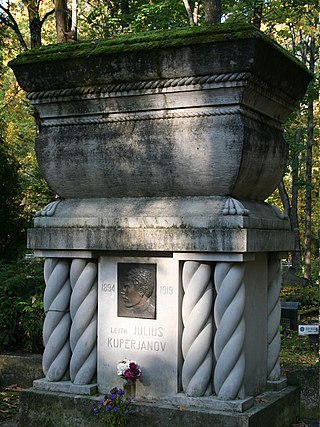
The Raadi cemetery, is the oldest and largest burial ground in Tartu, Estonia, dating back to 1773. Many prominent historical figures are buried there. It is also the largest Baltic German cemetery in Estonia after the destruction of Kopli cemetery in Tallinn. Until 1841, it was the only cemetery in the town.
Arnim is a German surname, often preceded by the nobiliary particle "von", meaning "of". Notable people with the surname include:

The Struve family were a Baltic German noble family of Eastphalian origin and originated in Magdeburg, the family produced five generations of astronomers from the 18th to 20th centuries. Members of the family were also prominent in chemistry, government and diplomacy.

The Alter Südfriedhof also known as "Alter Südlicher Friedhof" is a cemetery in Munich, Germany. It was founded by Duke Albrecht V as a plague cemetery in 1563 about half a kilometer south of the Sendlinger Gate between Thalkirchner and Pestalozzistraße.
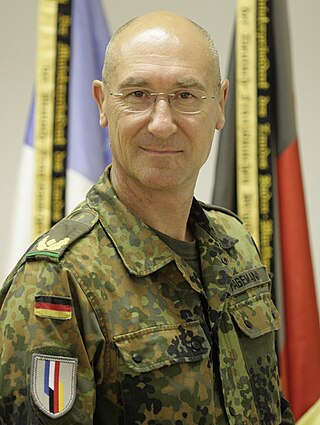
General of the Infantry is a former rank of the German army. It is currently an appointment or position given to an OF-8 rank officer, who is responsible for particular affairs of training and equipment of the Bundeswehr infantry.
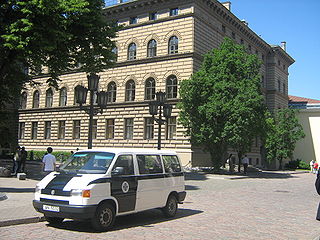
The Livonian Knighthood was a fiefdom that existed in Livonia. It was formed in 1561 by Baltic German nobles and disbanded in 1917 in Estonia, and in 1920 in Latvia. Like other Baltic knighthoods, the Livonian also had semi-autonomous privileged status in the Russian Empire.

Gustav Piers Alexander von Bunge was a German physiologist known for work in the field of nutrition physiology. He was the son of botanist Alexander von Bunge (1803–1890).

Friedrich Georg von Bunge was a Baltic German legal historian. He was the older brother of botanist Alexander Bunge (1803-1890).

Alexander von Bunge was a Baltic German physician, zoologist and Arctic explorer in the employ of Russia. He was the son of botanist Alexander Georg von Bunge (1803–1890).
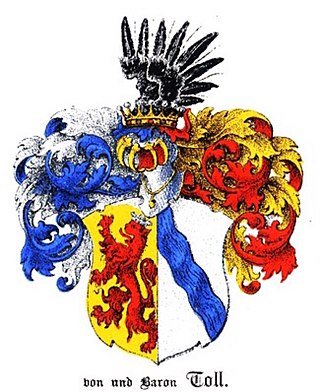
Toll was a Baltic German noble family of possible Hollandish origin. According to legend, the family's name originated from a castle near Leiden. The family held Swedish and Russian baronial and comital titles, Austrian baronial titles, Prussian, Oldenburgish, Finnish untitled noble status and also possibly belonged to Dutch nobility.
This page is based on this
Wikipedia article Text is available under the
CC BY-SA 4.0 license; additional terms may apply.
Images, videos and audio are available under their respective licenses.
