
South Africa occupies the southern tip of Africa, its coastline stretching more than 2,850 kilometres from the desert border with Namibia on the Atlantic (western) coast southwards around the tip of Africa and then northeast to the border with Mozambique on the Indian Ocean. The low-lying coastal zone is narrow for much of that distance, soon giving way to a mountainous escarpment that separates the coast from the high inland plateau. In some places, notably the province of KwaZulu-Natal in the east, a greater distance separates the coast from the escarpment. Although most of the country is classified as semi-arid, it has considerable variation in climate as well as topography. The total land area is 1,220,813 km2 (471,359 sq mi). It has the 23rd largest Exclusive Economic Zone of 1,535,538 km2 (592,875 sq mi).
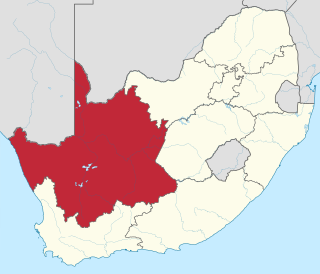
The Northern Cape is the largest and most sparsely populated province of South Africa. It was created in 1994 when the Cape Province was split up. Its capital is Kimberley. It includes the Kalahari Gemsbok National Park, part of the Kgalagadi Transfrontier Park and an international park shared with Botswana. It also includes the Augrabies Falls and the diamond mining regions in Kimberley and Alexander Bay.
Buffalo River may refer to:

The Karoo is a semi-desert natural region of South Africa. No exact definition of what constitutes the Karoo is available, so its extent is also not precisely defined. The Karoo is partly defined by its topography, geology and climate, and above all, its low rainfall, arid air, cloudless skies, and extremes of heat and cold. The Karoo also hosted a well-preserved ecosystem hundreds of million years ago which is now represented by many fossils.

The Cape to Cairo Road or Pan-African Highway, sometimes called the Great North Road in sub-Saharan Africa, was a proposed road that would stretch the length of Africa, from Cape Town to Cairo, through the Cape to Cairo Red Line of British colonies. The proposal was similar to the Cape to Cairo Railway, another proposed infrastructure project through the same colonies. Neither were completed before British colonial rule ended in the colonies.

Bushmanland was a bantustan in South West Africa, intended by the apartheid government to be a self-governing homeland for the San people. Despite this, a government was not established in the region.

Loeriesfontein is a small town in the Northern Cape of South Africa. It falls within what is known as the Hantam region.
The paradise toad is a species of toad in the family Bufonidae found in Richtersveld, Bushmanland and Namaqualand regions in western South Africa and adjacent Namibia.

Trimenia is a genus of butterflies in the family Lycaenidae which is endemic to the dryer, western parts of southern Africa. Their orange wings are bounded by dusky brown borders and fringed by chequered termens. The wing undersides are spangled with silvery or shiny markings. They fly in summer but stay close to their colonies, the numbers of which may fluctuate significantly depending on the conditions of the particular season. They may be found along the rocky ledges of hills or escarpments, in dry river beds, wetlands, fynbos, including coastal dune fynbos, succulent or Nama Karoo, or the gravelly or sandy flats found in Namaqualand and Bushmanland.

Pofadder is a very small town in the Northern Cape province of South Africa. In spite of its small size it is an important local centre in the region known in South Africa as Bushmanland. The surrounding districts are arid, sparsely populated, rugged and picturesque. There is little in the way of cropping and local farmers run sheep or goats for a living. As a tourist destination it is not sufficiently spectacular to rival the spring flowers of the coastal regions of Namaqualand, but it has its attractions for biologists and conservationists and those with an interest in its remarkable diversity of often-tiny xerophytes and animal life.

Vaalputs is the only South African radioactive waste-disposal facility, called the Vaalputs Radioactive Waste Disposal Facility, operated by NECSA. The facility is located about 100 km south-east of Springbok, in the Northern Cape. It covers an area of approximately 10,000 hectare, measuring 16,5 km from east to west and 6,5 km from north to south at its narrowest point.
The concept of the Northern Cape as a distinct geo-political region of South Africa coalesced in the 1940s when a "Northern Cape and Adjoining Areas Regional Development Association" was formed and the first map featuring the name "Northern Cape" was published. The geographic spread to which the term applied was not fixed until 1994, however, when it attained precise definition as the Northern Cape Province, one of South Africa's nine post-apartheid provinces. Since then there have been boundary adjustments to include parts of the former Bophuthatswana adjacent to Kuruman and Hartswater. Vryburg and Mafikeng, in the north eastern extremity of the former Cape Province - and hence regarded as part of the pre-1994 "Northern Cape" - are excluded, being part, now, of the North West Province in the North.
Bushmanland is an arid area south of the Orange River and west of Kenhardt and east of Springbok (Namaqualand) in the Northern Cape, South Africa.

The Kamiesberg or Kamiesberge, is a mountain range of jumbled granite inselbergs or bornhardts dotted over sandy plains and centered on Kamieskroon in Namaqualand in South Africa. This range is very like the Matopos of Zimbabwe in appearance. It stretches for about 140 km (60 mi) from Garies in the south to Springbok in the north and forms a plateau between the Sandveld of the Cape West Coast and Bushmanland in the east, with the Hardveld of the mountainous central Kamiesberg escarpment in the midst.
Trimenia macmasteri is a butterfly of the family Lycaenidae. It is found in South Africa, where it is found from Beaufort West to the Roggeveld escarpment in the Western Cape.

Ghaamsberg is a mountain in South Africa. situated just east of Aggeneys, in the Namakwa District Municipality of the Northern Cape province, 33 km to the south of the border with Namibia. Its summit is 1148 metres above sea level.

Steinkopf is a town in Namakwa District Municipality in the Northern Cape province of South Africa.
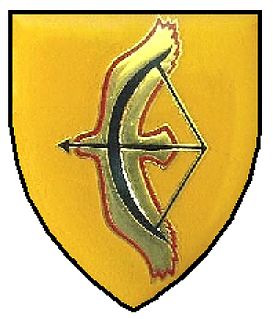
36 Battalion was a light infantry battalion in the South African Army and in later years became part of the SWATF.
The Bundu Farm site is a kidney shape depression of land located in the Bushmanland region of Northern Cape, South Africa. The excavations at this site during 1998-2003 had unearthed a sequence of archaeological remains including Earlier, Middle and Later Stone Age assemblages and preserved fauna. These discoveries give an insight into the occupation of the Bushmanland prehistoric people and possible connection of cultures and traditions between the central interior and the West coast of South Africa.

