
In organic chemistry, an alkane, or paraffin, is an acyclic saturated hydrocarbon. In other words, an alkane consists of hydrogen and carbon atoms arranged in a tree structure in which all the carbon–carbon bonds are single. Alkanes have the general chemical formula CnH2n+2. The alkanes range in complexity from the simplest case of methane, where n = 1, to arbitrarily large and complex molecules, like pentacontane or 6-ethyl-2-methyl-5-(1-methylethyl) octane, an isomer of tetradecane.
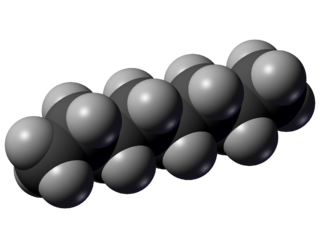
Octane is a hydrocarbon and an alkane with the chemical formula C8H18, and the condensed structural formula CH3(CH2)6CH3. Octane has many structural isomers that differ by the location of branching in the carbon chain. One of these isomers, 2,2,4-trimethylpentane (commonly called iso-octane), is used as one of the standard values in the octane rating scale.
In organic chemistry, an alkyl group is an alkane missing one hydrogen. The term alkyl is intentionally unspecific to include many possible substitutions. An acyclic alkyl has the general formula of −CnH2n+1. A cycloalkyl group is derived from a cycloalkane by removal of a hydrogen atom from a ring and has the general formula −CnH2n−1. Typically an alkyl is a part of a larger molecule. In structural formulae, the symbol R is used to designate a generic (unspecified) alkyl group. The smallest alkyl group is methyl, with the formula −CH3.

Ethyl butyrate, also known as ethyl butanoate, or butyric ether, is an ester with the chemical formula CH3CH2CH2COOCH2CH3. It is soluble in propylene glycol, paraffin oil, and kerosene. It has a fruity odor, similar to pineapple, and is a key ingredient used as a flavor enhancer in processed orange juices. It also occurs naturally in many fruits, albeit at lower concentrations.

2-Methylheptane is a colourless liquid, chemical compound which is part of the branched alkane family and is isomeric to octane Where a methyl group has been added to the second carbon in heptane. Its structural formula is (CH3)2CH(CH2)4CH3.

2,2-Dimethylbutane, trivially known as neohexane, is an organic compound with formula C6H14 or (H3C-)3-C-CH2-CH3. It is therefore an alkane, indeed the most compact and branched of the hexane isomers — the only one with a quaternary carbon and a butane (C4) backbone.
Octane is an alkane with the chemical formula C8H18.
The molecular formula C5H10O2 (molar mass: 102.13 g/mol) may refer to:
The molecular formula C6H12 may refer to following structural isomers:
The molecular formula C6H12O may refer to:
The molecular formula C6H14 (molar mass: 86.17 g/mol) may refer to:
The molecular formula C6H14O may refer to:
3-Methylpentane is a branched alkane with the molecular formula C6H14. It is a structural isomer of hexane composed of a methyl group bonded to the third carbon atom in a pentane chain. It is of similar structure to the isomeric 2-methylpentane, which has the methyl group located on the second carbon of the pentane chain.

2,3,3-Trimethylpentane is a chemical compound in the family of hydrocarbons which has a formula of C8H18. It is an isomer of octane. It has a role as a human metabolite, a bacterial metabolite and a mammalian metabolite. It is an alkane and a volatile organic compound.
The molecular formula C7H16O may refer to:
The molecular formula C8H14 (molar mass: 110.20 g/mol) may refer to:
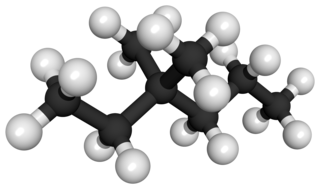
3,3-Dimethylhexane is a colourless, odourless liquid, chemical compound in the family of hydrocarbons which has a formula of C8H18. It is an isomer of octane, where two methylene hydrogens at the third position in a hexane molecule have been replaced with two methyl groups.
This page is based on this
Wikipedia article Text is available under the
CC BY-SA 4.0 license; additional terms may apply.
Images, videos and audio are available under their respective licenses.
