Related Research Articles

The United States Army (USA) is the land service branch of the United States Armed Forces. It is one of the eight U.S. uniformed services, and is designated as the Army of the United States in the U.S. Constitution. As the oldest and most senior branch of the U.S. military in order of precedence, the modern U.S. Army has its roots in the Continental Army, which was formed 14 June 1775 to fight the American Revolutionary War (1775–1783)—before the United States was established as a country. After the Revolutionary War, the Congress of the Confederation created the United States Army on 3 June 1784 to replace the disbanded Continental Army. The United States Army considers itself to be a continuation of the Continental Army, and thus considers its institutional inception to be the origin of that armed force in 1775.

The United States Military Academy (USMA), also known as West Point or simply Army, is a United States service academy in West Point, New York. It was originally established as a fort, since it sits on strategic high ground overlooking the Hudson River with a scenic view, 50 miles (80 km) north of New York City. It is the oldest of the five American service academies and educates cadets for commissioning into the United States Army.

A platoon is a military unit typically composed of two or more squads, sections, or patrols. Platoon organization varies depending on the country and the branch, but a platoon generally comprises 50 people, although specific platoons may range from 10 to 100 people. A platoon is typically the smallest military unit led by a commissioned officer. The platoon leader is usually a junior officer—a second or first lieutenant or an equivalent rank. The officer is usually assisted by a platoon sergeant.

A non-commissioned officer (NCO) is a military officer who has not pursued a commission. Non-commissioned officers usually earn their position of authority by promotion through the enlisted ranks. In contrast, commissioned officers usually enter directly from a military academy, officer candidate school (OCS), or officer training school (OTS) after receiving a post-secondary degree.

Sergeant is a rank in many uniformed organizations, principally military and policing forces. The alternative spelling, serjeant, is used in The Rifles and other units that draw their heritage from the British light infantry. Its origin is the Latin serviens, 'one who serves', through the French term sergeant.
Corporal is a military rank in use in some form by many militaries and by some police forces or other uniformed organizations. Within NATO, each member nation's corresponding military rank of corporal is combined under the NATO-standard rank scale code OR-3 or OR-4. However, there are often differences in how each nation employs corporals. Some militaries do not have corporals, but may instead have a junior sergeant.

Established 1 July 1973, the United States Army Training and Doctrine Command (TRADOC) is a major command of the United States Army headquartered at Fort Eustis, Virginia. It is charged with overseeing training of Army forces and the development of operational doctrine. TRADOC operates 37 schools and centers at 27 different locations. TRADOC schools conduct 1,304 courses and 108 language courses. The 1,304 courses include 516,000 seats for 443,231 soldiers; 36,145 other-service personnel; 8,314 international soldiers; and 28,310 civilians.
The Naval Education and Training Command (NETC) is an enterprise level shore command of the United States Navy with more than 19,000 military and staff personnel at more than 1,640 subordinate activities, sites, districts, stations, and detachments throughout the world. As the owner of the Force Development Pillar within MyNavy HR, NETC has full ownership of the entire “Street to Fleet” process, recruiting civilians, and through world-class training, transforming them into combat-ready warfighters ready to meet the current and future needs of fleet customers.

Air University is a professional military education university system of the United States Air Force. It is accredited by the Commission on Colleges of the Southern Association of Colleges and Schools to award master's degrees.

The U.S. Army Combined Arms Center (USACAC) is located at Fort Leavenworth and provides leadership and supervision for leader development and professional military and civilian education; institutional and collective training; functional training; training support; battle command; doctrine; lessons learned and specified areas the Commanding General, United States Army Training and Doctrine Command (TRADOC) designates in order to serve as a catalyst for change and to support developing relevant and ready expeditionary land formations with campaign qualities in support of the joint force commander.

The Penn State Army Reserve Officers' Training Corps is the ROTC department at The Pennsylvania State University. It is the largest branch of the ROTC program at the school, which also has Naval ROTC and Air Force ROTC. The Penn State ROTC Battalion is one of the 41 participating battalions in the 2nd Reserve Officers' Training Corps Brigade, also known as the Freedom Brigade. The brigade is headquartered at Fort Dix, NJ, and comprises ROTC programs in the North Eastern United States including CT, MA, ME, NH, NJ, NY, PA, RI, and VT.

The structure of the United States Army is complex, and can be interpreted in several different ways: active/reserve, operational/administrative, and branches/functional areas.
First sergeant is typically a senior non-commissioned officer rank, used in many countries. In NATO armed forces the rank is on OR8 level.
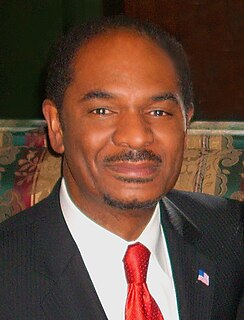
Robert "Rob" L. Gordon III is a cross-sector leader in the government, military, academic, nonprofit and high tech sectors. Gordon was appointed the Deputy Under Secretary of Defense for Military Community and Family Policy on July 19, 2010, serving under U.S. President Barack Obama. In the Defense Department he was responsible for defense-wide policy, program execution and oversight of global community support programs to care for, support, and empower 2 million Service members, 1.2 million military spouses, 2 million children, and over 2 million military families worldwide. He oversaw the Department of Defense school system (DoDEA) that serves approximately 90,000 students in 194 schools in 14 districts located in 12 foreign countries, seven states, Guam, and Puerto Rico. He oversaw voluntary education for over half a million active duty military service members; defense resale for over 500 commissaries and exchanges; military spouse education and career advancement for 1.2 million military spouses; child development and youth activities programs; state liaison initiatives; family assistance and non-medical counseling services; and collaborated with Congressional leaders, White House leaders, business and non profit sectors, chambers of commerce, academic communities, and a multitude of federal and state agencies to strengthen the resilience and well-being of the military community.
Leadership training in the Boy Scouts of America includes training on how to administer the Scouting program, outdoor skills training for adults and youth, and leadership development courses for adults and youth. Some of these courses like Youth Protection Training are mandatory. Most of the courses are offered by the local council, while a few are hosted at the national level, currently at Philmont Training Center in New Mexico. They are available to members of all of the Boy Scout programs, including Cub Scouts, Boy Scouts, Explorer Posts, and Venturing Crews.

To reinforce the Army profession and its Ethic, the Army Chief of Staff (CSA) established the Army Center of Excellence for the Professional Military Ethic (ACPME) in May 2008. Located at West Point, New York, the wellspring of professional soldier values for more than 200 years, the ACPME was re-designated as the Center for the Army Profession and Ethic (CAPE) and realigned to fall under the command and control of the United States Army Training and Doctrine Command (TRADOC) and its Combined Arms Center (CAC) in August 2010. CAPE's objectives were to assess the state of Army as a profession and its members as professionals; to study and define through doctrine and strategic messaging the Army Profession; capture and promulgate the moral principles of the Army Ethic, Army culture, and organizational climates; inspire trusted Army professionals to live up to their sacred oaths, increase Army members’ understanding and internalization of what it means for Soldiers and Army Civilians to be members of an honored profession; accelerate professional and character development in individuals, units, and Army culture through training, education, and leader development. AR 600-100 Army Profession and Leadership specified 12 tasks for CAPE to serve the Army in leader development, critical thinking and ethical decision making based upon the moral principles of the Army Ethic. Army Doctrine Publication (ADP) 1 and Army Doctrine Reference Publication (ADRP) 1. CAPE, as the AR 5-22 Army Force Modernization Proponent for the Army Profession, Character Development, and the Army Ethic was the US Army and lead responsible for Doctrine, Organization, Training, Materiel, Leadership and Education, Personnel and Facilities (DOTMLPF) initiatives to reinforce the Army Profession of Arms, Army Ethic, and culture. In September 2019, CAPE was merged with the Center for Army Leadership at Fort Leavenworth, KS to form the Center for the Army Profession and Leadership. About CAPE,</ref>

The Army Reserve Officers' Training Corps (AROTC) is the United States Army component of the Reserve Officers' Training Corps. It is the largest Reserve Officers' Training Corps (ROTC) program which is a group of college and university-based officer training programs for training commissioned officers for the United States Army and its reserves components: the Army Reserves and the Army National Guard. There are 30,000+ Army ROTC cadets enrolled in 274 ROTC programs at major universities throughout the United States.

The Junior Reserve Officers' Training Corps is a federal program sponsored by the United States Armed Forces in high schools and also in some middle schools across the United States and at US military bases across the world. The program was originally created as part of the National Defense Act of 1916 and later expanded under the 1964 ROTC Vitalization Act.
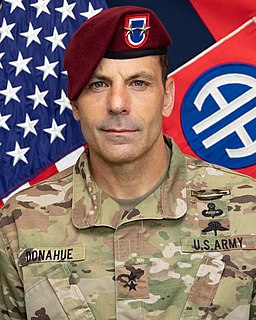
Christopher Todd Donahue is a United States Army major general who currently serves as commanding general of the 82nd Airborne Division at Fort Bragg, North Carolina. Throughout his career, Donahue served in staff and command positions for both United States Army and Special Operations units.
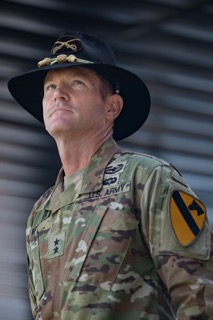
John Buchanan Richardson IV is a United States Army major general who has been the commanding officer of the 1st Cavalry Division since July 21, 2021. He previously served as the Deputy Commanding General of the III Corps from September 2, 2020, to July 2021. Before that, he served as the Deputy Chief of Staff for Operations, Plans, and Training of the United States Army Forces Command. Richardson is a 1991 graduate of the United States Military Academy.
References
- ↑ Weinberger, David. "Sometimes the entire team should call the shots", Harvard Business Review. 3 December 2010. Available at Economist Intelligence Unit
- ↑ Center for the Advancement of Leader Development and Organizational Learning: WPAOG Leaders' Conference, August 2010 [pdf]
- ↑ "Center for Junior Officers website". The Center for Junior Officers. 17 September 2021. Archived from the original on 17 September 2021.