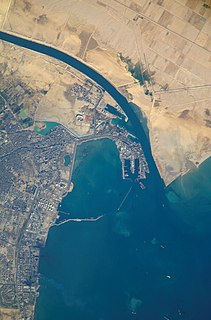
The Suez Canal is an artificial sea-level waterway in Egypt, connecting the Mediterranean Sea to the Red Sea through the Isthmus of Suez. It is often considered to define the border between Africa and Asia. Constructed by the Suez Canal Company between 1859 and 1869, it officially opened on 17 November 1869. The canal offers watercraft a more direct route between the North Atlantic and northern Indian oceans via the Mediterranean and Red seas, thus avoiding the South Atlantic and southern Indian oceans and reducing the journey distance from the Arabian Sea to London, for example, by approximately 8,900 kilometres (5,500 mi). It extends from the northern terminus of Port Said to the southern terminus of Port Tewfik at the city of Suez. Its length is 193.30 km (120.11 mi) including its northern and southern access-channels. In 2012, 17,225 vessels traversed the canal.
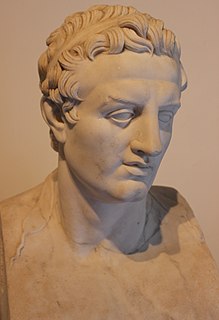
Ptolemy III Euergetes was the third king of the Ptolemaic dynasty in Egypt from 246 to 222 BC. The Ptolemaic Kingdom reached the height of its power during his reign.

Abu Qir, formerly also spelled Abukir or Aboukir, is a town on the Mediterranean coast of Egypt, near the ruins of ancient Canopus and 23 kilometers (14 mi) northeast of Alexandria by rail. It is located on Abu Qir Peninsula, with Abu Qir Bay to the east.

Tanis is a city in the north-eastern Nile Delta of Egypt. It is located on the Tanitic branch of the Nile which has long since silted up.

HMS Canopus was a pre-dreadnought battleship of the British Royal Navy and the lead ship of the Canopus class. Intended for service in Asia, Canopus and her sister ships were smaller and faster than the preceding Majestic-class battleships, but retained the same battery of four 12-inch (305 mm) guns. She also carried thinner armour, but incorporated new Krupp steel, which was more effective than the Harvey armour used in the Majestics. Canopus was laid down in January 1897, launched in October that year, and commissioned into the fleet in December 1899.

The Canopus class was a group of six pre-dreadnought battleships of the British Royal Navy built in the late 1890s. The ships were designed by the Director of Naval Construction, William White, for use on the China Station. The class comprised Canopus, the lead ship, and Glory, Albion, Ocean, Goliath, and Vengeance. The class was armed with a main battery of four BL 12 inch Mk VIII naval guns and a secondary battery of twelve QF 6-inch guns. Compared to the preceding Majestic-class battleships, the Canopus class was smaller, faster, and less heavily armoured, though they adopted new, stronger Krupp armour, which was more effective than the Harvey steel used in the Majestics. In addition to the Krupp steel, the ships also adopted several other changes, including water-tube boilers, in-line funnels, and a full-length armoured belt.

USS Simon Lake (AS-33) was the lead ship of her class of submarine tenders in the United States Navy, named for Simon Lake, a pioneering designer of early submarines.
ProCoder is a video-encoding and transcoding software initially developed by the Canopus Corporation, now Thomson SA.
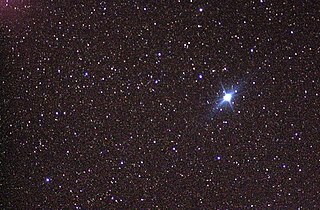
Canopus is the brightest star in the southern constellation of Carina, and is located near the western edge of the constellation around 310 light-years from the Sun. Its proper name is generally considered to originate from the mythological Canopus, who was a navigator for Menelaus, king of Sparta. Canopus has the Bayer designation α Carinae, which is Latinised to Alpha Carinae and abbreviated Alpha Car or α Car. It is the second-brightest star in the night sky, after Sirius. Canopus' visual apparent magnitude is −0.74, and it has an absolute magnitude of −5.71.

Canopus, also known as Canobus, was an Ancient Egyptian coastal town, located in the Nile Delta. Its site is in the eastern outskirts of modern-day Alexandria, around 25 kilometers (16 mi) from the center of that city. Canopus was located on the western bank at the mouth of the westernmost branch of the Delta – known as the Canopic or Heracleotic branch. It belonged to the seventh Egyptian Nome, known as Menelaites, and later as Canopites, after it. It was the principal port in Egypt for Greek trade before the foundation of Alexandria, along with Naucratis and Heracleion. Its ruins lie near the present Egyptian town of Abu Qir.
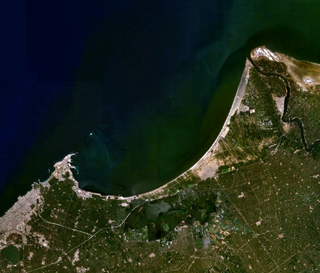
The Abū Qīr Bay is a spacious bay on the Mediterranean Sea near Alexandria in Egypt, lying between the Rosetta mouth of the Nile and the town of Abu Qir. The ancient cities of Canopus, Heracleion and Menouthis lie submerged beneath the waters of the bay. In 1798 it was the site of the Battle of the Nile, a naval battle fought between the British Royal Navy and the Navy of the French First Republic. The bay contains a natural gas field, discovered in the 1970s.
The Decree of Canopus is a trilingual inscription in three scripts, which dates from the Ptolemaic period of Ancient Egypt. It was written in three writing systems: Egyptian hieroglyphs, demotic, and Greek, on several ancient Egyptian memorial stones, or steles. The inscription is a record of a great assembly of priests held at Canopus, Egypt, in 238 BCE. Their decree honoured Pharaoh Ptolemy III Euergetes; Queen Berenice, his wife; and Princess Berenice.

The Egyptian Navy, also known as the Egyptian Naval Force, is the maritime branch of the Egyptian Armed Forces. It is the largest navy in the Middle East and Africa, and is the sixth largest in the world measured by the number of vessels. The navy's missions include protection of more than 2,000 kilometers of coastline of the Mediterranean Sea and the Red Sea, defense of approaches to the Suez Canal, and support for army operations. The majority of the modern Egyptian Navy was created with the help of the Soviet Union in the 1960s. The navy received ships in the 1980s from China and other, western, sources. In 1989, the Egyptian Navy had 18,000 personnel as well as 2,000 personnel in the Coast Guard.

USS Canopus (AS-34) was a Simon Lake-class submarine tender of the United States Navy, operational from 1965 to 1994.
Franck Goddio is an French underwater archaeologist who, in 2000, discovered the city of Thonis-Heracleion 7 km off the Egyptian shore in Aboukir Bay. He led the excavation of the submerged site of Eastern Canopus and of Antirhodos in the ancient harbour of Alexandria. He has also excavated ships in the waters of the Philippines, significantly the Spanish Galleon San Diego.
The Ptolemaic Decrees were a series of decrees by synods of ancient Egyptian priests. They were issued in the Ptolemaic Kingdom, which controlled Egypt from 305 BC to 30 BC. In each decree, the benefactions of the reigning pharaoh, especially towards the priesthood, are recognised, and religious honours are decreed for him.

USS Canopus (AS-9) was a submarine tender in the United States Navy, named for the star Canopus.
Heracleion, also known by its Egyptian name Thonis and sometimes called Thonis-Heracleion, was an ancient Egyptian city located near the Canopic Mouth of the Nile, about 32 km northeast of Alexandria. Its ruins are located in Abu Qir Bay, currently 2.5 km off the coast, under 10 m (30 ft) of water. A stele found on the site indicates that it was one single city known by both its Egyptian and Greek names. Its legendary beginnings go back to as early as the 12th century BC, and it is mentioned by ancient Greek historians. Its importance grew particularly during the waning days of the Pharaohs.

HMS Canopus was an 84-gun third rate ship of the line of the British Royal Navy. She had previously served with the French Navy as the Tonnant-classFranklin, but was captured after less than a year in service by the British fleet under Rear Admiral Horatio Nelson at the Battle of the Nile in 1798. Having served for less than six months for the French from her completion in March 1798 to her capture in August that year, she would eventually serve for 89 years for the British.
Canopus or Kanopos was a town of ancient Thrace, inhabited during Roman times.

