Related Research Articles
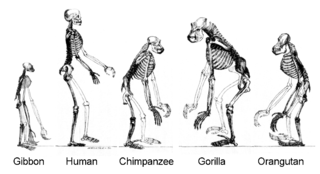
Human evolution is the evolutionary process within the history of primates that led to the emergence of Homo sapiens as a distinct species of the hominid family, which includes all the great apes. This process involved the gradual development of traits such as human bipedalism, dexterity, and complex language, as well as interbreeding with other hominins, indicating that human evolution was not linear but weblike. The study of the origins of humans, also called anthropogeny, anthropogenesis, or anthropogony, involves several scientific disciplines, including physical and evolutionary anthropology, paleontology, and genetics.
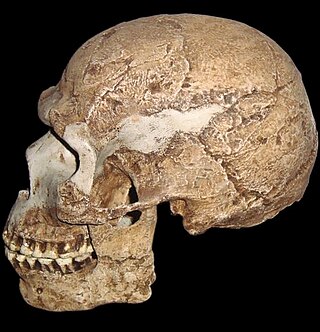
Early modern human (EMH), or anatomically modern human (AMH), are terms used to distinguish Homo sapiens that are anatomically consistent with the range of phenotypes seen in contemporary humans, from extinct archaic human species. This distinction is useful especially for times and regions where anatomically modern and archaic humans co-existed, for example, in Paleolithic Europe. Among the oldest known remains of Homo sapiens are those found at the Omo-Kibish I archaeological site in south-western Ethiopia, dating to about 233,000 to 196,000 years ago, the Florisbad site in South Africa, dating to about 259,000 years ago, and the Jebel Irhoud site in Morocco, dated about 315,000 years ago.
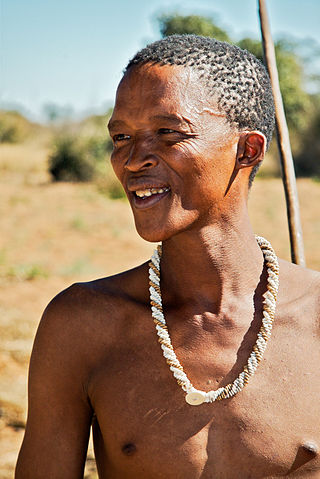
KhoisanKOY-sahn, or Khoe-Sān, is a catch-all term for the indigenous peoples of Southern Africa who traditionally speak non-Bantu languages, combining the Khoekhoen and the Sān peoples. Khoisan populations traditionally speak click languages and are considered to be the historical (pre-Bantu) communities throughout Southern Africa, remaining predominant until European colonisation in areas climatically unfavorable to Bantu (sorghum-based) agriculture, such as the Cape region, through to Namibia, where Khoekhoe populations of Nama and Damara people are prevalent groups, and Botswana. Considerable mingling with Bantu-speaking groups is evidenced by prevalence of click phonemes in many especially Xhosa Southern African Bantu languages.
Archaeogenetics is the study of ancient DNA using various molecular genetic methods and DNA resources. This form of genetic analysis can be applied to human, animal, and plant specimens. Ancient DNA can be extracted from various fossilized specimens including bones, eggshells, and artificially preserved tissues in human and animal specimens. In plants, ancient DNA can be extracted from seeds and tissue. Archaeogenetics provides us with genetic evidence of ancient population group migrations, domestication events, and plant and animal evolution. The ancient DNA cross referenced with the DNA of relative modern genetic populations allows researchers to run comparison studies that provide a more complete analysis when ancient DNA is compromised.

Behavioral modernity is a suite of behavioral and cognitive traits that distinguishes current Homo sapiens from other anatomically modern humans, hominins, and primates. Most scholars agree that modern human behavior can be characterized by abstract thinking, planning depth, symbolic behavior, music and dance, exploitation of large game, and blade technology, among others. Underlying these behaviors and technological innovations are cognitive and cultural foundations that have been documented experimentally and ethnographically by evolutionary and cultural anthropologists. These human universal patterns include cumulative cultural adaptation, social norms, language, and extensive help and cooperation beyond close kin.

The Nordic Stone Age refers to the Stone Age of Scandinavia. During the Weichselian glaciation, almost all of Scandinavia was buried beneath a thick permanent ice cover, thus, the Stone Age came rather late to this region. As the climate slowly warmed up by the end of the ice age, nomadic hunters from central Europe sporadically visited the region. However, it was not until around 12,000 BCE that permanent, but nomadic, habitation in the region took root.
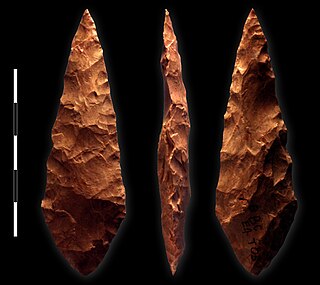
The Middle Stone Age was a period of African prehistory between the Early Stone Age and the Late Stone Age. It is generally considered to have begun around 280,000 years ago and ended around 50–25,000 years ago. The beginnings of particular MSA stone tools have their origins as far back as 550–500,000 years ago and as such some researchers consider this to be the beginnings of the MSA. The MSA is often mistakenly understood to be synonymous with the Middle Paleolithic of Europe, especially due to their roughly contemporaneous time span; however, the Middle Paleolithic of Europe represents an entirely different hominin population, Homo neanderthalensis, than the MSA of Africa, which did not have Neanderthal populations. Additionally, current archaeological research in Africa has yielded much evidence to suggest that modern human behavior and cognition was beginning to develop much earlier in Africa during the MSA than it was in Europe during the Middle Paleolithic. The MSA is associated with both anatomically modern humans as well as archaic Homo sapiens, sometimes referred to as Homo helmei. Early physical evidence comes from the Gademotta Formation in Ethiopia, the Kapthurin Formation in Kenya and Kathu Pan in South Africa.
Haplogroup L0 is a human mitochondrial DNA (mtDNA) haplogroup.
The Kostyonki–Borshchyovo archaeological complex is an area where numerous Upper Paleolithic archaeological sites have been found, located around the villages of Kostyonki and Borshchyovo. The area is found on the western (right) bank of the Don River in Khokholsky District, Voronezh Oblast, Russia, some 25 km south of the city of Voronezh. The 26 Paleolithic sites of the area are numbered Kostenki 1–21 and Borshchevo 1–5.
The Prehistory of South Africa lasts from the Middle Stone Age until the 17th century. Southern Africa was first reached by Homo sapiens before 130,000 years ago, possibly before 260,000 years ago. The region remained in the Late Stone Age until the first traces of pastoralism were introduced about 2,000 years ago. The Bantu migration reached the area now South Africa around the first decade of the 3rd century, over 1800 years ago. Early Bantu kingdoms were established by the 11th century. First European contact dates to 1488, but European colonization began in the 17th century.

Human habitation of present-day Sweden began c. 12000 BC. The earliest known people belonged to the Bromme culture of the Late Palaeolithic, spreading from the south at the close of the Last Glacial Period. Neolithic farming culture became established in the southern regions around 4000 BC, but much later further north. About 1700 BC the Nordic Bronze Age began in the southern regions, based on imported metals; this was succeeded about 500 BC by the Iron Age, for which local ore deposits were exploited. Cemeteries are known mainly from 200 BC onward.

Peștera Muierilor, or Peștera Muierii, is an elaborate cave system located in the Baia de Fier commune, Gorj County, Romania. It contains abundant cave bear remains, as well as a human skull. The skull is radiocarbon dated to 30,150 ± 800, indication an absolute age between 40,000 and 30,000 BP. It was uncovered in 1952. Alongside similar remains found in Cioclovina Cave, they are among the most ancient early modern humans in Romanian prehistory.
Himla (Himladevi) Soodyall is a South African geneticist involved in finding some of the oldest human genetic lines, mainly focusing on Sub-Saharan Africa. Her work on DNA has pointed to southern Africa as the most likely geographic region of origin of the human species.

The African Pygmies are a group of ethnicities native to Central Africa, mostly the Congo Basin, traditionally subsisting on a forager and hunter-gatherer lifestyle. They are divided into three roughly geographic groups:
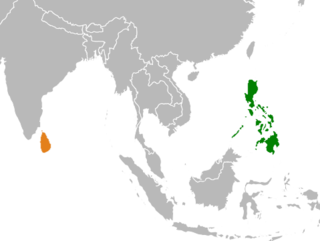
The Philippines–Sri Lanka relations refers to the bilateral relationship between the Republic of the Philippines and the Democratic Socialist Republic of Sri Lanka

Southeast Africa, or Southeastern Africa, is an African region that is intermediate between East Africa and Southern Africa. It comprises the countries Botswana, Eswatini, Kenya, Lesotho, Malawi, Mozambique, Namibia, Rwanda, South Africa, Tanzania, Uganda, Zambia and Zimbabwe in the mainland, with the island-nations of Madagascar, Mauritius, Comoros, and Seychelles also included.

Sudan has a native Coptic minority, although many Copts in Sudan are descended from more recent Coptic immigrants from Egypt. Copts in Sudan live mostly in northern cities, including Al Obeid, Atbara, Dongola, Khartoum, Omdurman, Port Sudan, and Wad Medani. They number between 400,000-500,000, or slightly over 1% of the Sudanese population. Due to their advanced education, their role in the life of the country has been more significant than their numbers suggest.

The term Eurasian backflow, or Eurasian back-migrations, has been used to describe several pre-Neolithic and Neolithic migration events of humans from western Eurasia back to Africa.

In archaeogenetics, the term Scandinavian Hunter-Gatherer (SHG) is the name given to a distinct ancestral component that represents descent from Mesolithic hunter-gatherers of Scandinavia. Genetic studies suggest that the SHGs were a mix of Western Hunter-Gatherers (WHGs) initially populating Scandinavia from the south during the Holocene, and Eastern Hunter-Gatherers (EHGs), who later entered Scandinavia from the north along the Norwegian coast. During the Neolithic, they admixed further with Early European Farmers (EEFs) and Western Steppe Herders (WSHs). Genetic continuity has been detected between the SHGs and members of the Pitted Ware culture (PWC), and to a certain degree, between SHGs and modern northern Europeans. The Sámi, on the other hand, have been found to be completely unrelated to the PWC.
The genetic history of Southern Africa encompasses the genetic history of the people of Southern Africa. The Sahara served as a trans-regional passageway and place of dwelling for people in Africa during various humid phases and periods throughout the history of Africa.
References
- ↑ "Carina Schlebusch - Uppsala University, Sweden". katalog.uu.se. Retrieved 2 October 2017.
- ↑ Schlebusch, Carina M.; Malmström, Helena; Günther, Torsten; Sjödin, Per; Coutinho, Alexandra; Edlund, Hanna; Munters, Arielle R.; Steyn, Maryna; Soodyall, Himla; Lombard, Marlize; Jakobsson, Mattias (5 June 2017). "Ancient genomes from southern Africa pushes modern human divergence beyond 260,000 years ago". bioRxiv 10.1101/145409 .
- ↑ Schlebusch, Carina M.; Malmström, Helena; Günther, Torsten; Sjödin, Per; Coutinho, Alexandra; Edlund, Hanna; Munters, Arielle R.; Vicente, Mário; Steyn, Maryna; Soodyall, Himla; Lombard, Marlize; Jakobsson, Mattias (28 September 2017). "Southern African ancient genomes estimate modern human divergence to 350,000 to 260,000 years ago". Science. 358 (6363): 652–655. Bibcode:2017Sci...358..652S. doi: 10.1126/science.aao6266 . PMID 28971970.
- ↑ "Modern humans emerged more than 300,000 years ago new study suggests". ScienceDaily.com. Retrieved 2 October 2017.
| International | |
|---|---|
| Academics | |
| Other | |

 | This article about a biologist is a stub. You can help Wikipedia by expanding it. |