Related Research Articles

Carlo Saraceni was an Italian early-Baroque painter, whose reputation as a "first-class painter of the second rank" was improved with the publication of a modern monograph in 1968.
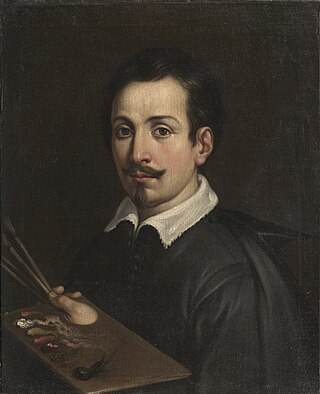
Guido Reni was an Italian painter of the Baroque period, although his works showed a classical manner, similar to Simon Vouet, Nicolas Poussin, and Philippe de Champaigne. He painted primarily religious works, but also mythological and allegorical subjects. Active in Rome, Naples, and his native Bologna, he became the dominant figure in the Bolognese School that emerged under the influence of the Carracci.

Guillaume Courtois or italianized as Guglielmo Cortese, called Il Borgognone or Le Bourguignon, was a Franc-comtois-Italian painter, draughtsman and etcher. He was mainly active in Rome as a history and staffage painter and enjoyed high-level patronage. He was the brother of the painters Jacques Courtois and Jean-François Courtois.

Sant'Ambrogio e Carlo al Corso is a basilica church in Rome, Italy, facing onto the central part of the Via del Corso. The apse of the church faces across the street, the Mausoleum of Augustus on Via di Ripetta.

Giovanni Lanfranco was an Italian painter of the Baroque period.

Santa Maria dei Miracoli and Santa Maria di Montesanto are two churches in Rome.
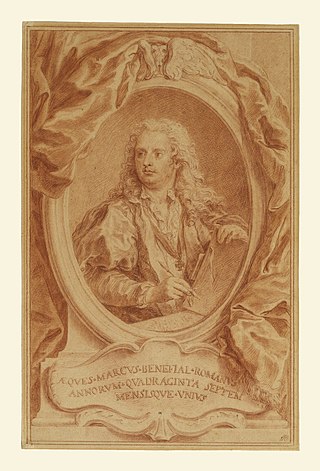
Marco Benefial was an Italian, proto-Neoclassical painter, mainly active in Rome. Benefial is best known for his repudiation of 18th century decorative Rococo styles pre-eminent in the Rome dominated by Carlo Maratta pupils. His paintings portrayed tangible human figures, with complex treatment of space, and luminous, warm colors. Along with the altarpieces and frescoes, he also painted many portraits. Because he partnered with some inferior artists who subsequently received credit, some of his paintings have been frequently misidentified.

San Nicola in Carcere is an ancient titular church and minor basilica in Rome near the Forum Boarium in rione Ripa. It is constructed in the remains of the three temples of the Forum Holitorium and is one of the traditional stational churches of Lent. The parish was suppressed in 1931 and it is now served by the Clerics Regular of the Mother of God from the nearby Santa Maria in Campitelli.

Agostino Masucci was an Italian painter of the late-Baroque or Rococo period.

The Basilica of Saint Nicholas of Tolentino is a Roman Catholic church and minor basilica that is part of the Augustinian monastery in the hill-town of Tolentino, province of Macerata, Marche, central Italy. The church is a former cathedral of the Roman Catholic Diocese of Tolentino, suppressed in 1586.

Genazzano FCJ College is a Roman Catholic, day and boarding school for girls, located in Kew, an eastern suburb of Melbourne, Victoria, Australia.

Luigi Pellegrini Scaramuccia (1616–1680) was an Italian painter and artist biographer of the Baroque period. He was a pupil, along with Giovanni Domenico Cerrini of the painter Guido Reni.

Giuseppe Peroni was an Italian painter of the Baroque period.
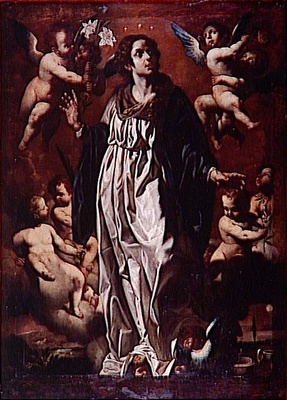
Paolo Domenico Finoglia, or Finoglio, was an Italian painter of the early-Baroque period, active mainly in South Italy, including Naples and towns in Apulia.
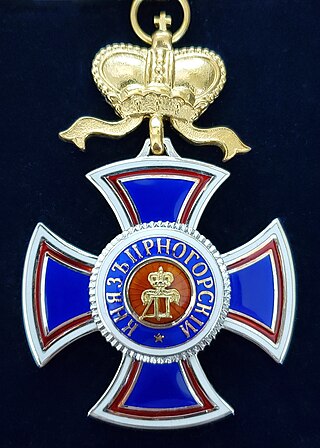
The Order of Prince Danilo I is an order, formerly of the Principality and later Kingdom, of Montenegro; it is currently a dynastic order granted by the head of the House of Petrović-Njegoš, Crown Prince Nicholas. It is awarded to prominent champions of the preservation of Montenegrin independence and for other humanitarian, scientific, artistic and pro-social achievements as defined by statute.
Carlo Rosa was an Italian painter.
Giuseppe Lucatelli (1751-1828) was an Italian painter and architect, active in a Neoclassical style.

Prospero Piatti was an Italian painter known for depiction of Neo-Pompeian and sacred subjects.
Andrea Pasqualino Marini was an Italian painter active in the Marche region in a late-Baroque style.

Oliviero Leonardi was an Italian art painter and sculptor based in Rome. He was known for his ceramic paintings on steel plates enamelled in ovens at 900 degrees Celsius. His artistic research focused on, among other subjects, cosmogony.
References

- ↑ Garollo, Gottardo (1907). Ulrico Hoepli (ed.). Dizionario biografico universale. Editore Libraio della Real Casa, Milan. p. 139.
- ↑ Pro Loco Genazzano Archived 2013-01-19 at the Wayback Machine site.
- ↑ Genazzano website Archived 2014-02-01 at the Wayback Machine .
- ↑ Guida metodica di Roma e suoi contorni: divisa in quattro parti. by Giuseppe Melchiorri, page 398.
 | This article about an Italian painter born in the 17th century is a stub. You can help Wikipedia by expanding it. |