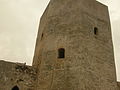
The Castello della Colombaia (also known as Torre Peliade or Castello di Mare) is an ancient coastal fortress situated on a small island approximately 600 metres west of the modern Port of Trapani in western Sicily.[1]
The castle long served as the principal fortification controlling maritime access to the city. Its position complemented the wider defensive system of late medieval and early modern Trapani, including the northern seaward walls of the Mura di Tramontana, the landward Bastione dell'Impossibile, and the inland citadel of the Castello di Terra.[2]
History
Tradition attributes the earliest fortification on the site to the Carthaginian general Hamilcar Barca, who is said to have built a tower known as the Peliade in 260 BC.[1] In antiquity the harbour of Drepanum served as the coastal port of nearby Eryx and grew in strategic importance under Carthage, which helps explain the persistence of traditions linking the site to Carthaginian activity.[3] The tower was later abandoned during the Roman period, when the islet came to be known as the “Colombaia”.[1][2]
The fortress was substantially rebuilt in 1320 under King Frederick III of Aragon, when the distinctive octagonal tower was constructed as part of a wider programme to strengthen Trapani’s seaward defences.[1] In the following centuries the complex underwent further modifications under Aragonese and Spanish rule, including the enlargement of the enclosure and the adaptation of its interior spaces to accommodate garrisons and artillery, reflecting its continuing role in the defence of the harbour.[2]
From 1821 the fortress was converted into a state prison, a function it retained until its closure in 1965.[1] Following its decommissioning the structure was abandoned and fell into disrepair, though it was recognised for its historical significance and placed under protection as a cultural monument. Limited stabilisation works were undertaken in the late 20th century, and proposals for restoration and adaptive reuse have continued into the 21st century.[1]
Architecture
The complex is one of the most distinctive examples of medieval military architecture in Sicily, consisting of an irregular enclosure arranged around a central courtyard.[1] Its most prominent feature is the octagonal tower, constructed in 1320 and rising above the perimeter walls, which follow an ellipsoidal plan adapted to the shape of the islet. The seaward front is reinforced by a pointed bastion, while access between the different levels of the fortress is provided by a series of characteristic stone stairways built along the inner faces of the walls.[1]
The tower and perimeter structures are built primarily of local limestone, employing a combination of ashlar blocks and rubble masonry typical of medieval fortifications. Internally, the complex contains a sequence of vaulted rooms and service spaces opening onto the courtyard, together with upper-level chambers accessible by narrow stairways integrated into the thickness of the walls. These interior elements reflect successive construction phases, with medieval fabric later adapted for early modern defensive requirements.[1]
Conservation and modern use
The Castello della Colombaia has been unused since its closure as a prison in 1965 and has long suffered from structural decay and exposure to marine conditions. A 2018 assessment by the Agenzia del Demanio described the monument as requiring substantial consolidation and restoration, although its masonry remains largely intact.[1]
In 2024 regional authorities announced the start of restoration works funded through the PNRR Cultura programme, with the intervention intended to stabilise the structure and enable future cultural use.[4]
Various architectural studies have proposed future uses for the island and its structures, including reopening the Colombaia for cultural functions and integrating the islet into a wider regenerated waterfront through improved public access. These proposals remain conceptual and have not been formally adopted.[5][6]
This page is based on this Wikipedia article Text is available under the CC BY-SA 4.0 license; additional terms may apply. Images, videos and audio are available under their respective licenses.