
Catherine of Aragon was Queen of England as the first wife of King Henry VIII from their marriage on 11 June 1509 until its annulment on 23 May 1533. Born in Spain, she was Princess of Wales while married to Henry's elder brother, Arthur, Prince of Wales, for a short period before his death.

Caterina di Jacopo di Benincasa, known as Catherine of Siena, was an Italian mystic and pious laywoman who engaged in papal and Italian politics through extensive letter-writing and advocacy. Canonized in 1461, she is revered as a saint and as a Doctor of the Church due to her extensive theological authorship. She is also considered to have influenced Italian literature.

Anne Boleyn was Queen of England from 1533 to 1536, as the second wife of King Henry VIII. The circumstances of her marriage and execution by beheading for treason, made her a key figure in the political and religious upheaval that marked the start of the English Reformation.

Catherine de' Medici was an Italian (Florentine) noblewoman born into the Medici family. She was Queen of France from 1547 to 1559 by marriage to King Henry II and the mother of French kings Francis II, Charles IX, and Henry III. The years during which her sons reigned have been called "the age of Catherine de' Medici" since she had extensive, if at times varying, influence on the political life of France.

His Majesty's Home Civil Service, also known as His Majesty's Civil Service, the Home Civil Service, or colloquially as the Civil Service, is the permanent bureaucracy or secretariat of Crown employees that supports His Majesty's Government, which is led by a cabinet of ministers chosen by the prime minister of the United Kingdom of Great Britain and Northern Ireland.
St. Catherine or St. Katherine may refer to a number of saints named Catherine, or:
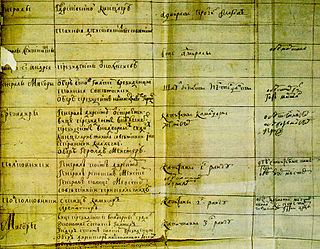
The Table of Ranks was a formal list of positions and ranks in the military, government, and court of Imperial Russia. Peter the Great introduced the system in 1722 while engaged in a struggle with the existing hereditary nobility, or boyars. The Table of Ranks was formally abolished on 11 November 1917 by the newly established Bolshevik government. During the Vladimir Putin presidency a similar formalized structure has been reintroduced into many governmental departments, combined with formal uniforms and insignia: Local Government, Diplomatic Service, Prosecution Service, Investigative Committee.
Mawer has sometimes been described as a British occupational surname related to another British surname "Mower". However there is no reliable citation or clear origin for this. One argument against a speculated connection with the name "Mower" is that in the days when clerks (amanuenses) wrote what they heard from the illiterate public, they differentiated between Mawer and Mower, i.e. they were probably pronounced differently, even in areas where the same dialect was spoken.

The Parable of the Unforgiving Servant is a parable of Jesus which appears in the Gospel of Matthew. According to Matthew 18:21–35 it is important to forgive others as we are forgiven by God, as illustrated by the negative example of the unforgiving servant.
Heseltine is an English surname, and may refer to:
A servant is a person working within an employer's household.

The Cabinet Secretary is the top-most executive official and senior-most civil servant of the Government of India. The Cabinet Secretary is the ex-officio head of the Civil Services Board, the Cabinet Secretariat, the Indian Administrative Service (IAS), and all Civil Services of India work under the rules of business of the government.
Gurjit Singh may refer to:
Indian civil servants includes five principal sub-categories of officials:
Catherine Bell may refer to:
On 24 April 2014, journalist Oliver Duggan, in the Liverpool Echo, reported that users of computers that used IP addresses registered to the Government Secure Intranet had added derogatory and offensive material to Wikipedia articles, particularly the article about the Hillsborough disaster. The vandalism was quickly re-reported by other media, and subsequent reports highlighted other acts of vandalism, on various articles, originated by computers using those IP addresses. After an investigation by The Daily Telegraph and Wikipediocracy, the person behind the edits was identified as a civil servant within the UK government and was dismissed.
Chief Secretary may refer to:
Events from the year 1796 in Russia.
Events from the year 1786 in Russia
This page is based on this
Wikipedia article Text is available under the
CC BY-SA 4.0 license; additional terms may apply.
Images, videos and audio are available under their respective licenses.
