
Chaco may refer to:
Chaco may refer to:

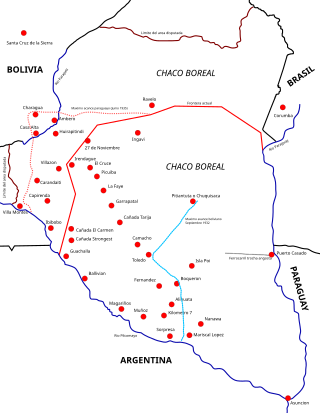
The Chaco War was fought from 1932 to 1935 between Bolivia and Paraguay, over the control of the northern part of the Gran Chaco region of South America, which was thought to be rich in oil. The war is also referred to as La Guerra de la Sed in literary circles since it was fought in the semi-arid Chaco. The bloodiest interstate military conflict fought in South America in the 20th century, it was fought between two of its poorest countries, both of which had lost territory to neighbours in 19th-century wars.

Asunción is the capital and the largest city of Paraguay. The city stands on the eastern bank of the Paraguay River, almost at the confluence of this river with the Pilcomayo River. The Paraguay River and the Bay of Asunción in the northwest separate the city from the Occidental Region of Paraguay and from Argentina in the south part of the city. The rest of the city is surrounded by the Central Department.
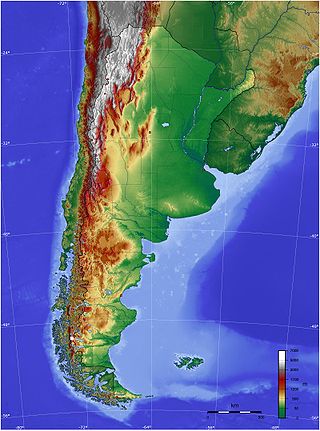
The geography of Argentina is heavily diverse, consisting of the Andes Mountains, pampas, and various rivers and lakes. Bordered by the Andes in the west and the South Atlantic Ocean to the east, its neighbouring countries are Chile to the west, Bolivia and Paraguay to the north, and Brazil and Uruguay to the northeast.
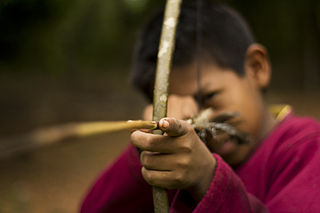
Guarani is a group of culturally-related indigenous peoples of South America. They are distinguished from the related Tupi by their use of the Guarani language. The traditional range of the Guarani people is in what is now Paraguay between the Paraná River and lower Paraguay River, the Misiones Province of Argentina, southern Brazil once as far east as Rio de Janeiro, and parts of Uruguay and Bolivia.

Tarija is a department in Bolivia. It is located in south-eastern Bolivia bordering with Argentina to the south and Paraguay to the east. According to the 2012 census, it has a population of 482,196 inhabitants. It has an area of 37,623 km2 (14,526 sq mi). The city of Tarija is the capital of the department.
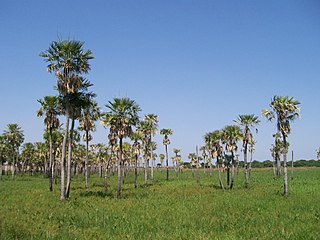
Chaco, officially the Province of Chaco, is one of the 23 provinces in Argentina. Its capital and largest city, is Resistencia. It is located in the north-east of the country.

Santa Cruz is the largest of the nine constituent departments of Bolivia, occupying about one-third (33.74%) of the country's territory. With an area of 370,621 km2 (143,098 sq mi), it is slightly smaller than Japan or the US state of Montana. It is located in the eastern part of the country, sharing borders in the north and east with Brazil and with Paraguay in the south.

Presidente Hayes is a department in Paraguay. The capital is the city of Villa Hayes. The department was named after U.S. President Rutherford B. Hayes, who awarded the territory to Paraguay while arbitrating a boundary dispute between Paraguay and Argentina after the Paraguayan War.
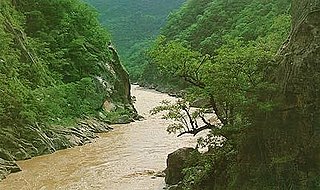
Pilcomayo is a river in central South America. At 1,100 kilometres (680 mi) long, it is the longest western tributary of the Paraguay River. Its drainage basin is 270,000 square kilometres (100,000 sq mi) in area, and its mean discharge is 200 cubic metres per second (7,100 cu ft/s).
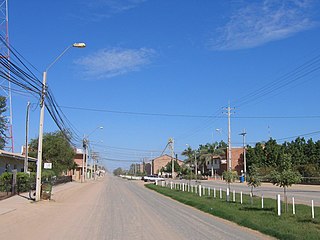
Filadelfia is the capital of Boquerón Department in the Gran Chaco of western Paraguay. It is the centre of the Fernheim Colony. The city lies about 450 kilometres (280 mi) northwest of the capital Asunción. With a population of about 20,000, it is the largest town in the 400 kilometer radius, and accounts for almost a third of the departmental population.

The Gran Chaco or Dry Chaco is a sparsely populated, hot and semiarid lowland natural region of the Río de la Plata basin, divided among eastern Bolivia, western Paraguay, northern Argentina, and a portion of the Brazilian states of Mato Grosso and Mato Grosso do Sul, where it is connected with the Pantanal region. This land is sometimes called the Chaco Plain.
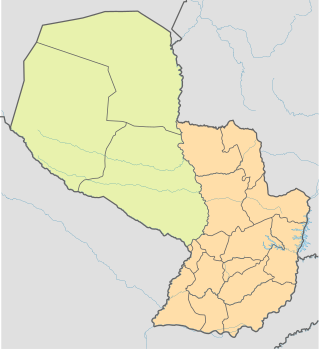
The Paraguayan Chaco or Región Occidental is a semi-arid region in Paraguay, with a very low population density. The area is being rapidly deforested. Consisting of more than 60% of Paraguay's land area, but with less than 3% of the population, the Chaco is one of the most sparsely inhabited areas in South America.

The Bermejo River is a river in South America that flows from Bolivia to the Paraguay River in Argentina. The river is generally called Bermejo in spite of its different names along its way, but it also has its own Native American names; in Wichí it is called Teuco, and in Guaraní it is called Ypitá. In the plains of Argentina's Gran Chaco the Bermejo forms wetlands and splits into two branches. The southern branch is the bed of the old Bermejo River, now an intermittent stream called Río Bermejito. The northern branch is now the main stem of the Bermejo and is called the Teuco River, Bermejo Nuevo, or simply the Bermejo River. The two branches rejoin at 25°39′S60°11′W, near Villa Río Bermejito, forming the Lower Bermejo River.

Cordillera is a province in the Santa Cruz Department, Bolivia. Its capital is Lagunillas.
Villa Hayes is a city in Paraguay, and is the capital of Presidente Hayes Department.

Gran Chaco is a province in the eastern parts of the Bolivian department Tarija. The province voted to become an autonomous region on 6 December 2009.
The Mbayá or Mbyá are an indigenous people of South America which formerly ranged on both sides of the Paraguay River, on the north and northwestern Paraguay frontier, eastern Bolivia, and in the adjacent province of Mato Grosso do Sul, Brazil. They have also been called Caduveo. In the 16th century the Mbayá were called Guaycuru, a name later used generically for all the nomadic and semi-nomadic indigenous peoples of the Gran Chaco. The Kadiwéu people of Brazil are the surviving branch of the Mbayá.
The Gran Chaco is a plain of about 1.000.000 km2. It covers parts of Bolivia, Paraguay, Brazil and Argentina.

Chané is the collective name for the southernmost Arawakan-speaking peoples. They lived in the plains of the northern Gran Chaco and in the foothills of the Andes in Paraguay, Brazil, Bolivia, and Argentina. The historical Chané are divided into two principal groups: the Chané proper who lived in eastern Bolivia, and the Guaná who lived in Paraguay and adjacent Brazil. Twenty-first century survivors of the Chané are the Izoceno people of Bolivia and 3,034 descendants reported in Argentina by the 2010 census. Survivors of the Guaná are the Tereno and the Kinikinao both of Mato Grosso do Sul province in Brazil.
Below is the timeline of Paraguayan history.