Watts is plural for watt, the unit of power.
Chapel Hill or Chapelhill may refer to:

Corsham is a historic market town and civil parish in west Wiltshire, England. It is at the south-western edge of the Cotswolds, just off the A4 national route, 28 miles (45 km) southwest of Swindon, 20 miles (32 km) east of Bristol, 8 miles (13 km) northeast of Bath and 4 miles (6 km) southwest of Chippenham.
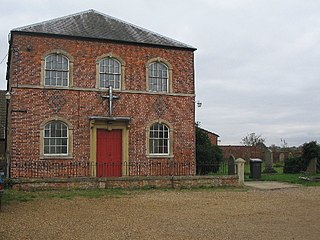
Southwick is a semi-rural village and civil parish 3 miles (4.8 km) south-west of the county town of Trowbridge, Wiltshire, England. It is separated from the south-west fringe of Trowbridge only by the Southwick Country Park, which consists of 380 acres (150 ha) of open fields. The majority of the village lies south of the A361, which runs through the village, linking Trowbridge with Frome.

Southport railway station serves the town of Southport, Merseyside, England. The station is the terminal of the electricified Southport branch of the Northern Line of the electric Merseyrail network and the diesel-operated Manchester-Southport Line. It is the fourth busiest station on the Merseyrail network. The station and services to Liverpool and Hunts Cross are operated by Merseyrail, with Manchester services operated by Northern Trains.
Wesley Chapel may refer to:
A chapel a Christian place of prayer and worship that is usually relatively small.
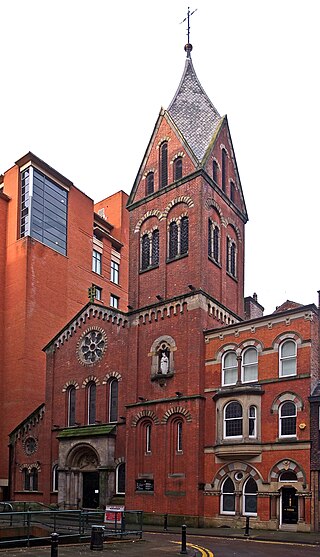
The Hidden Gem, officially St Mary's Catholic Church, is a church on Mulberry Street, Manchester, England. The parish dates back to 1794, with devotion to St Mary, Our Lady of the Assumption, and the present church, rebuilt in 1848, is a Grade II*-listed building which includes the Diocesan Shrine of Our Lady of Manchester.

Middlesex Hospital was a teaching hospital located in the Fitzrovia area of London, England. First opened as the Middlesex Infirmary in 1745 on Windmill Street, it was moved in 1757 to Mortimer Street where it remained until it was finally closed in 2005. Its staff and services were transferred to various sites within the University College London Hospitals NHS Trust. The Middlesex Hospital Medical School, with a history dating back to 1746, merged with the medical school of University College London in 1987.

The Chapel of the Three Kings of Cologne is a church in Colston Street, near the top of Christmas Steps, Bristol, England. It has been designated as a Grade II* listed building.

Brook Street Chapel, is in the town of Knutsford, Cheshire, England. It is recorded in the National Heritage List for England as a designated Grade I listed building. The chapel was built in soon after the passing of the Toleration Act 1688. It is built in red brick with a stone-flagged roof in two storeys with two external staircases. Inside is a gallery on three sides and a pulpit on a long wall. The pulpit dates from the late 17th or early 18th century and the pews from 1859.

Christ Church is a Church of England parish church in Somerset Street, Chester, Cheshire, England. It is in the Archdeaconry of Chester and the Deanery of Chester. Its benefice is combined with that of St Michael, Plas Newton. It is a Grade II listed building.

The Upper Brook Street Chapel, also known as the Islamic Academy, the Unitarian Chapel and the Welsh Baptist Chapel, is a former chapel with an attached Sunday School on the east side of Upper Brook Street, Chorlton-on-Medlock, Greater Manchester, England. It is said to be the first neogothic Nonconformist chapel, having been constructed for the British Unitarians between 1837 and 1839, at the very beginning of the reign of Queen Victoria. It was designed by Sir Charles Barry, later architect of the Palace of Westminster.

Elmsted is a village and civil parish in the Folkestone and Hythe District of Kent, England. It is located west of Stone Street, the Roman road which today takes traffic between Canterbury and Lympne. Within the parish are the settlements of Bodsham, North Leigh and Evington. There are six elected members of the Parish Council.

Ramsden is a village and civil parish about 3+1⁄2 miles (5.6 km) north of Witney in West Oxfordshire. The 2011 Census recorded the parish's population as 342.

The building formerly known as Godalming Congregational Church was the Congregational chapel serving the ancient town of Godalming, in the English county of Surrey, between 1868 and 1977. It superseded an earlier chapel, which became Godalming's Salvation Army hall, and served a congregation which could trace its origins to the early 18th century. The "imposing suite of buildings", on a major corner site next to the Town Bridge over the River Wey, included a schoolroom and a manse, and the chapel had a landmark spire until just before its closure in 1977. At that time the congregation transferred to the nearby Methodist chapel, which became a joint Methodist and United Reformed church with the name Godalming United Church. The former chapel then became an auction gallery before being converted into a restaurant; then in 2018 the premises were let to the Cotswold Company to be converted into a furniture and home accessories showroom. In 1991 the former chapel was listed at Grade II for its architectural and historical importance.
Alfred Hill Thompson, ARIBA was an English architect in the Gothic Revival and Arts and Crafts styles, who specialised in small schools and chapels in the Yorkshire area. In partnership with Isaac Thomas Shutt he co-designed the Church of All Saints, Harlow Hill, completed in 1871.

The octagonal Chapel of St Mary at Smith Gate is a former chapel in Oxford, England, now part of Hertford College. It is located on Catte Street, opposite the Clarendon Building.
