The calculus of variations is a field of mathematical analysis that uses variations, which are small changes in functions and functionals, to find maxima and minima of functionals: mappings from a set of functions to the real numbers. Functionals are often expressed as definite integrals involving functions and their derivatives. Functions that maximize or minimize functionals may be found using the Euler–Lagrange equation of the calculus of variations.

In mathematics, an autonomous system or autonomous differential equation is a system of ordinary differential equations which does not explicitly depend on the independent variable. When the variable is time, they are also called time-invariant systems.
In mathematics, a linear differential equation is a differential equation that is defined by a linear polynomial in the unknown function and its derivatives, that is an equation of the form

In mathematics, separation of variables is any of several methods for solving ordinary and partial differential equations, in which algebra allows one to rewrite an equation so that each of two variables occurs on a different side of the equation.
In mathematical analysis, Clairaut's equation is a differential equation of the form
In mathematics and its applications, classical Sturm–Liouville theory is the theory of real second-order linear ordinary differential equations of the form:
In mathematical physics, the WKB approximation or WKB method is a method for finding approximate solutions to linear differential equations with spatially varying coefficients. It is typically used for a semiclassical calculation in quantum mechanics in which the wavefunction is recast as an exponential function, semiclassically expanded, and then either the amplitude or the phase is taken to be changing slowly.
In mathematics, variation of parameters, also known as variation of constants, is a general method to solve inhomogeneous linear ordinary differential equations.

In mathematics, a differential equation is an equation that relates one or more unknown functions and their derivatives. In applications, the functions generally represent physical quantities, the derivatives represent their rates of change, and the differential equation defines a relationship between the two. Such relations are common; therefore, differential equations play a prominent role in many disciplines including engineering, physics, economics, and biology.
In mathematics, an ordinary differential equation is called a Bernoulli differential equation if it is of the form
In mathematics, an integrating factor is a function that is chosen to facilitate the solving of a given equation involving differentials. It is commonly used to solve ordinary differential equations, but is also used within multivariable calculus when multiplying through by an integrating factor allows an inexact differential to be made into an exact differential. This is especially useful in thermodynamics where temperature becomes the integrating factor that makes entropy an exact differential.
In mathematics, an exact differential equation or total differential equation is a certain kind of ordinary differential equation which is widely used in physics and engineering.
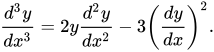
In mathematics, Painlevé transcendents are solutions to certain nonlinear second-order ordinary differential equations in the complex plane with the Painlevé property, but which are not generally solvable in terms of elementary functions. They were discovered by Émile Picard (1889), Paul Painlevé , Richard Fuchs (1905), and Bertrand Gambier (1910).
In applied mathematics, in particular the context of nonlinear system analysis, a phase plane is a visual display of certain characteristics of certain kinds of differential equations; a coordinate plane with axes being the values of the two state variables, say (x, y), or (q, p) etc. (any pair of variables). It is a two-dimensional case of the general n-dimensional phase space.
Hilbert's nineteenth problem is one of the 23 Hilbert problems, set out in a list compiled in 1900 by David Hilbert. It asks whether the solutions of regular problems in the calculus of variations are always analytic. Informally, and perhaps less directly, since Hilbert's concept of a "regular variational problem" identifies precisely a variational problem whose Euler–Lagrange equation is an elliptic partial differential equation with analytic coefficients, Hilbert's nineteenth problem, despite its seemingly technical statement, simply asks whether, in this class of partial differential equations, any solution function inherits the relatively simple and well understood structure from the solved equation. Hilbert's nineteenth problem was solved independently in the late 1950s by Ennio De Giorgi and John Forbes Nash, Jr.
In mathematics, constraint counting is counting the number of constraints in order to compare it with the number of variables, parameters, etc. that are free to be determined, the idea being that in most cases the number of independent choices that can be made is the excess of the latter over the former.
A differential equation can be homogeneous in either of two respects.
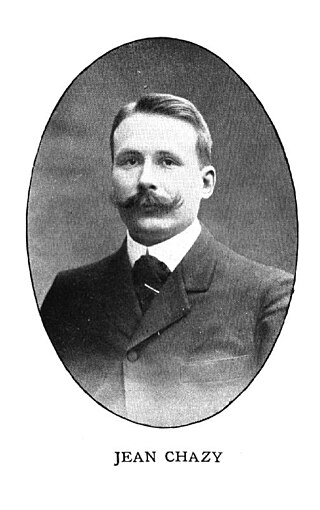
Jean François Chazy was a French mathematician and astronomer.
In the study of differential equations, the Loewy decomposition breaks every linear ordinary differential equation (ODE) into what are called largest completely reducible components. It was introduced by Alfred Loewy.
In mathematics, Malmquist's theorem, is the name of any of the three theorems proved by Axel Johannes Malmquist. These theorems restrict the forms of first order algebraic differential equations which have transcendental meromorphic or algebroid solutions.