Biologically, a child is a human being between the stages of birth and puberty. The legal definition of child generally refers to a minor, otherwise known as a person younger than the age of majority.
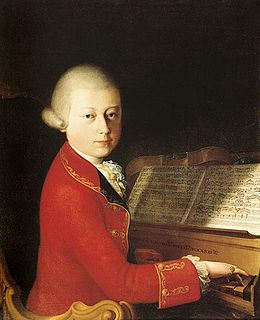
Childhood is the age span ranging from birth to adolescence. According to Piaget's theory of cognitive development, childhood consists of two stages: preoperational stage and concrete operational stage. In developmental psychology, childhood is divided up into the developmental stages of toddlerhood, early childhood, middle childhood, and adolescence. Various childhood factors could affect a person's attitude formation.
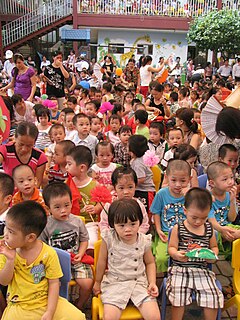
Kindergarten is a preschool educational approach based on playing, singing, practical activities such as drawing, and social interaction as part of the transition from home to school. Such institutions were originally created in the late 18th century in Bavaria and Strasbourg to serve children whose parents both worked outside home. The term was coined by the German Friedrich Fröbel, whose approach globally influenced early-years education. Today, the term is used in many countries to describe a variety of educational institutions and learning spaces for children ranging from two to seven years of age, based on a variety of teaching methods.

The Montessori Method of Education, developed by Maria Montessori, is a child-centered educational approach based on scientific observations of children. Montessori's method has been used for over 100 years in many parts of the world.
Education in Japan is compulsory at the elementary and lower secondary levels. Most students attend public schools through the lower secondary level, but private education is popular at the upper secondary and university levels. Education prior to elementary school is provided at kindergartens and day-care centers. Public and private day-care centers take children from under age 1 on up to 5 years old. The programmes for those children aged 3–5 resemble those at kindergartens. The educational approach at kindergartens varies greatly from unstructured environments that emphasize play to highly structured environments that are focused on having the child pass the entrance exam at a private elementary school. The academic year starts from April and ends in March, having summer vacation in August and winter vacation in the end of December to the beginning of January. Also, there are few days of holidays between academic years. The period of academic year is the same all through elementary level to higher educations nationwide.

A preschool, also known as nursery school, pre-primary school, playschool or kindergarten, is an educational establishment or learning space offering early childhood education to children before they begin compulsory education at primary school. It may be publicly or privately operated, and may be subsidized from public funds.
Children's rights are the human rights of children with particular attention to the rights of special protection and care afforded to minors. The 1989 Convention on the Rights of the Child (CRC) defines a child as "any human being below the age of eighteen years, unless under the law applicable to the child, majority is attained earlier." Children's rights includes their right to association with both parents, human identity as well as the basic needs for physical protection, food, universal state-paid education, health care, and criminal laws appropriate for the age and development of the child, equal protection of the child's civil rights, and freedom from discrimination on the basis of the child's race, gender, sexual orientation, gender identity, national origin, religion, disability, color, ethnicity, or other characteristics. Interpretations of children's rights range from allowing children the capacity for autonomous action to the enforcement of children being physically, mentally and emotionally free from abuse, though what constitutes "abuse" is a matter of debate. Other definitions include the rights to care and nurturing. There are no definitions of other terms used to describe young people such as "adolescents", "teenagers", or "youth" in international law, but the children's rights movement is considered distinct from the youth rights movement. The field of children's rights spans the fields of law, politics, religion, and morality.
Lutheran schools and education were a priority for Lutherans who migrated to the United States and Australia from Germany and Scandinavia. One of the first things they did was to create schools for their children. This strong educational tradition was handed down from Martin Luther himself.

Pre-kindergarten is a classroom-based preschool program for children below the age of five in the United States, Canada and Turkey. It may be delivered through a preschool or within a reception year in elementary school. Pre-kindergartens play an important role in early childhood education. They have existed in the US since 1922, normally run by private organizations. The U.S. Head Start program, the country's first federally funded pre-kindergarten program, was founded in 1967. This attempts to prepare children to succeed in school.
The National Association for the Education of Young Children (NAEYC) is a large nonprofit association in the United States representing early childhood education teachers, para-educators, center directors, trainers, college educators, families of young children, policy makers, and advocates. NAEYC is focused on improving the well-being of young children, with particular emphasis on the quality of educational and developmental services for children from birth through age 8.

Education in Botswana is provided by public schools and private schools. Education in Botswana is governed by Ministry of Education and Skills Development.
Educational stages are subdivisions of formal learning, typically covering early childhood education, primary education, secondary education and tertiary education. The United Nations Educational, Scientific and Cultural Organization (UNESCO) recognizes seven levels of education in its International Standard Classification of Education system. UNESCO's International Bureau of Education maintains a database of country-specific education systems and their stages.
Universal preschool is an international movement to use public funding to ensure high quality preschool (pre-k) is available to all families.
Blayney is a hamlet in Norfolk County, Ontario, Canada that is in between Pine Grove and Green's Corners.

Education in Cambodia is controlled by the state through the Ministry of Education in a national level and by the Department of Education at the provincial level. The Constitution of Cambodia establishes that the state shall protect and upgrade citizen's rights to quality education at all levels, guaranteeing that all citizens have equal opportunity to earn a living. The state shall adopt an education program "according to the principle of modern pedagogy including technology and foreign languages," as well as the state controls public and private schools and classrooms at all levels. The Cambodian education system includes pre-school, primary, general secondary, higher education and non-formal education. The education system includes the development of sport, information technology education, research development and technical education. School enrollment has increased during the 2000s in Cambodia. USAID data shows that in 2011 primary enrollment reached 96% of the child population, lower secondary school 34% and upper secondary 21%.
Education in Jamaica is primarily modeled on the British education system.
Education in Eswatini begins with pre-school education for infants, primary, secondary and high school education for general education and training (GET) - and universities and colleges at tertiary level.

North Little Rock School District (NLRSD) is a public school district headquartered in North Little Rock, Arkansas, United States.

Childhood in Medieval Scotland includes all aspects of childhood within the geographical area that became the Kingdom of Scotland, from the end of Roman power in Great Britain, until the Renaissance and Reformation in the sixteenth century.


