
John Smeaton was an English civil engineer responsible for the design of bridges, canals, harbours and lighthouses. He was also a capable mechanical engineer and an eminent physicist. Smeaton was the first self-proclaimed "civil engineer", and is often regarded as the "father of civil engineering". He pioneered the use of hydraulic lime in concrete, using pebbles and powdered brick as aggregate. Smeaton was associated with the Lunar Society.

Bamford is a village in the Peak District, Derbyshire, England, close to the River Derwent. To the north-east is Bamford Edge, and to the north-west the Ladybower, Derwent and Howden Reservoirs. At the 2011 census, it had a population of 1,241.

Frederick Travis Dibnah,, was an English steeplejack and television personality. Having a keen interest in mechanical engineering, he described himself as a "backstreet mechanic".

Sarehole Mill is a Grade II listed water mill, in an area once called Sarehole, on the River Cole in Hall Green, Birmingham, England. It is now run as a museum by the Birmingham Museums Trust. It is known for its association with J. R. R. Tolkien and is one of only two working water mills in Birmingham, with the other being New Hall Mill in Walmley, Sutton Coldfield.
A safety lamp is any of several types of lamp that provides illumination in places such as coal mines where the air may carry coal dust or a build-up of inflammable gases, which may explode if ignited, possibly by an electric spark. Until the development of effective electric lamps in the early 1900s, miners used flame lamps to provide illumination. Open flame lamps could ignite flammable gases which collected in mines, causing explosions; safety lamps were developed to enclose the flame to prevent it from igniting the explosive gases. Flame safety lamps have been replaced for lighting in mining with sealed explosion-proof electric lights, but continue to be used to detect gases.
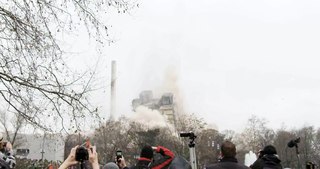
In the controlled demolition industry, building implosion is the strategic placing of explosive material and timing of its detonation so that a structure collapses on itself in a matter of seconds, minimizing the physical damage to its immediate surroundings. Despite its terminology, building implosion also includes the controlled demolition of other structures, like bridges, smokestacks, towers, and tunnels. This is typically done to save time and money of what would otherwise be an extensive demolition process with construction equipment, as well as to reduce construction workers exposure to infrastructure that is in severe disrepair.
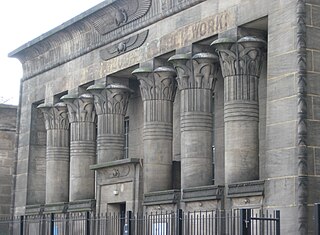
Temple Works is a former flax mill in Holbeck, Leeds, West Yorkshire, England. It was designed by the engineer James Coombe a former pupil of John Rennie; the painter David Roberts; and the architect Joseph Bonomi the Younger. It was built in the Egyptian Revival style for the industrialist John Marshall between 1836 and 1840 to contain a 240 horsepower double-beam engine by Benjamin Hick. Temple Works is the only Grade I listed building in Holbeck.

Michael Thomas Sadler was a British Tory Member of Parliament (MP) whose Evangelical Anglicanism and prior experience as a Poor Law administrator in Leeds led him to oppose Malthusian theories of population and their use to decry state provision for the poor.

Blyth Power Station refers to a pair of now demolished coal-fired power stations, which were located on the Northumberland coast in North East England. The two stations were built alongside each other on a site near Cambois in Northumberland, on the northern bank of the River Blyth, between its tidal estuary and the North Sea. The stations took their name from the town of Blyth on the opposite bank of the estuary. Blyth A Power Station was built and opened first but had a smaller generating capacity than its sister station, Blyth B Power Station, which was built to its west four years later. The power stations' four large chimneys were a landmark of the Northumberland skyline for over 40 years; the A Station's two chimneys each stood at 140 metres (460 ft); the B Station's two chimneys were taller, at 170 metres (560 ft) each.
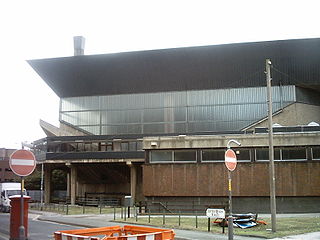
The Leeds International Pool often referred to as the Leeds International Baths, was a swimming facility in Leeds city centre, West Yorkshire, England. The pool was situated at the lower end of Westgate and was notable for its brutalist architecture. The pool was constructed in the 1960s and designed by architect John Poulson.

A "Scotch" marine boiler is a design of steam boiler best known for its use on ships.
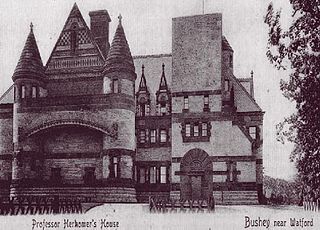
Lululaund was the Romanesque Revival-style house and studio of the Bavarian-born British artist Hubert von Herkomer, in Melbourne Road, Bushey, Hertfordshire. It was designed about 1886 and completed by 1894. The house was demolished in 1939.

Kirkstall Power Station was a coal-fired unit opened in 1930, serving the city of Leeds, West Yorkshire, England.

Imperial Mill, Blackburn is a cotton spinning mill at Wallace and Gorse Street in Greenbank, Blackburn, Lancashire, England. It was designed by P.S. Stott, built in 1901, on the banks of the Leeds and Liverpool Canal. It was taken over by the Lancashire Cotton Corporation in the 1929's and production finished in 1980.

The Weavers' Triangle is an area of Burnley in Lancashire, England consisting mostly of 19th-century industrial buildings at the western side of town centre clustered around the Leeds and Liverpool Canal. The area has significant historic interest as the cotton mills and associated buildings encapsulate the social and economic development of the town and its weaving industry. From the 1980s, the area has been the focus of major redevelopment efforts.

Wijnsermolen is a smock mill in Wyns, Friesland, Netherlands which is currently (2011) being restored to working order. The mill is listed as a Rijksmonument, number 35691.

The Television Centre, Newcastle upon Tyne, also known by the street name City Road, was home and headquarters of the ITV contractor for the North East region, Tyne Tees Television, between 1959 and 2005.

Demolition is the science and engineering in safely and efficiently tearing down buildings and other artificial structures. Demolition contrasts with deconstruction, which involves taking a building apart while carefully preserving valuable elements for reuse purposes.

Drummond Mill was a complex of industrial buildings on Lumb Lane, Manningham, Bradford, West Yorkshire. It contained originally a spinning mill, a warehouse, a spinning shed, and an engine house with chimney and was destroyed in a fire on 28 January 2016.
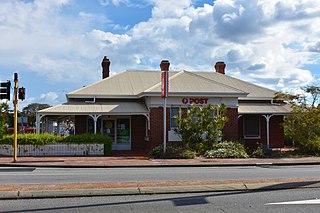
South Perth Post Office is a heritage-listed post office at 103 Mill Point Road, South Perth, Western Australia, Australia. It was added to the Australian Commonwealth Heritage List on 8 November 2011.
