Christianity and Justice

Last updated
Christianity and Justice
CJ.png
Abbreviation CJ
Established 1981;37 years ago (1981)
Type Socio-theological research
Location
Main organ
CJ Notebooks
Affiliations Jesuit, Catholic
Website CJ

Christianity and Justice (CJ) is a study center in Barcelona, Spain. [1] It was created by the Jesuits of Catalonia in 1981. It is dedicated to social and theological reflection. [2] It brings together an interdisciplinary team of more than 80 professors of social sciences and theology, and professionals and experts who are in direct contact with social realities. It is a part of the Lluís Espinal Foundation, [3] [4] a private and non-profit organization created in 1989 with the mission of promoting dialogue between the social sciences and theology.
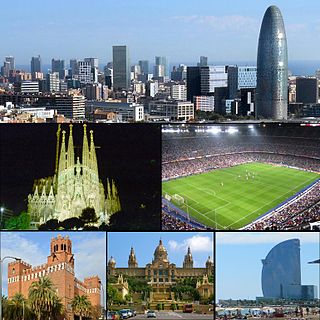
Barcelona City and municipality in Catalonia, Spain

Barcelona is a city in Spain. It is the capital and largest city of the autonomous community of Catalonia, as well as the second most populous municipality of Spain. With a population of 1.6 million within city limits, its urban area extends to numerous neighbouring municipalities within the Province of Barcelona and is home to around 4.8 million people, making it the sixth most populous urban area in the European Union after Paris, London, Madrid, the Ruhr area and Milan. It is one of the largest metropolises on the Mediterranean Sea, located on the coast between the mouths of the rivers Llobregat and Besòs, and bounded to the west by the Serra de Collserola mountain range, the tallest peak of which is 512 metres high.

Spain Kingdom in Southwest Europe

Spain, officially the Kingdom of Spain, is a country mostly located on the Iberian Peninsula in Europe. Its territory also includes two archipelagoes: the Canary Islands off the coast of Africa, and the Balearic Islands in the Mediterranean Sea. The African enclaves of Ceuta, Melilla, and Peñón de Vélez de la Gomera make Spain the only European country to have a physical border with an African country (Morocco). Several small islands in the Alboran Sea are also part of Spanish territory. The country's mainland is bordered to the south and east by the Mediterranean Sea except for a small land boundary with Gibraltar; to the north and northeast by France, Andorra, and the Bay of Biscay; and to the west and northwest by Portugal and the Atlantic Ocean.

Catalonia Autonomous area of northeastern Spain

Catalonia is an autonomous community in Spain on the northeastern corner of the Iberian Peninsula, designated as a nationality by its Statute of Autonomy. Catalonia consists of four provinces: Barcelona, Girona, Lleida, and Tarragona. The capital and largest city is Barcelona, the second-most populated municipality in Spain and the core of the sixth most populous urban area in the European Union. It comprises most of the territory of the former Principality of Catalonia. It is bordered by France (Occitanie) and Andorra to the north, the Mediterranean Sea to the east, and the Spanish autonomous communities of Aragon to the west and Valencia to the south. The official languages are Catalan, Spanish, and the Aranese dialect of Occitan.

Contents

The Center is part of the Catalan Federation of NGOs for Peace, Human Rights, and Development. It participates in the Catalan Social Forum, [5] the Catalan Forum of Theology and Liberation and the Christian Platform for immigrants. It is promoted by the Society of Jesus in Catalonia, in response to the priority task entrusted by Superior General Pedro Arrupe in the General Congregation 32 of the "service of faith and the promotion of justice" [6] advanced by the provincial of the Jesuits in Catalonia, Fr. Ignasi Salvat, S.J. [7]

Society of Jesus male religious congregation of the Catholic Church

The Society of Jesus is a scholarly religious congregation of the Catholic Church which originated in sixteenth-century Spain. The members are called Jesuits. The society is engaged in evangelization and apostolic ministry in 112 nations. Jesuits work in education, intellectual research, and cultural pursuits. Jesuits also give retreats, minister in hospitals and parishes, sponsor direct social ministries, and promote ecumenical dialogue.

Pedro Arrupe was a Spanish Basque Jesuit priest who served as the twenty-eighth Superior General of the Society of Jesus (1965–83). Stationed as novice master outside Hiroshima in 1945, he used his medical background as a first responder to the atomic bombing of Hiroshima. He led the Jesuits in the implementation of the Second Vatican Council, especially with regard to a faith that does justice and preferential option for the poor.

Activity

The objective of the center is to contribute to the resolution of the causes of global injustice through social and theological reflection that analyzes with rigour, denounces with commitment and proposes alternatives to advance towards a more humane and just world. It would foster a Church more at the service of the poor. It works in collaboration with other like-minded persons and organizations. The center operates through study and interdisciplinary reflection via internal seminars and working groups; courses, conferences, social networks and publishing. It has acted as a publisher for over 30 years, reaching more than 45,000 readers around the world.

Thought

Rafael Díaz-Salazar, a professor at the Faculty of Political Science and Sociology of the Complutense University of Madrid, describes the message of Christianity and Justice as: " Without a fight against injustice, faith in God is dead, though God be proclaimed everywhere."

Complutense University of Madrid university in Madrid, and one of the oldest universities in the world

The Complutense University of Madrid is a public research university located in Madrid, and one of the oldest universities in the world. The university enrolls over 86,000 students, being the 3rd largest non-distance European university by enrollment, and consistently ranking as one of the top universities in Spain. According to the Spanish newspaper El Mundo, the university is widely regarded as the most prestigious academic institution in Spain. It is located on a sprawling campus that occupies the entirety of the Ciudad Universitaria district of Madrid, with annexes in the district of Somosaguas in the neighboring city of Pozuelo de Alarcón.

One of the main cornerstones of theology of CJ is to see Christianity from the perspective of indignation against injustice and praise of the impoverished God who is always on the side of the excluded and the oppressed. [8] CJ's basic theological principles have been summarized by the priest and Basque theologian Javier Vitoria in the book Una agenollada y indulgenciatheology, which shows that the faith-justice option gives substantial form to the theological task.

Notable members

Among the more prominent members are Antoni Comín and Xavier Melloni  (ca ), and seminar member Llorenç Puig  (ca ).

Antoni Comín Catalan philosopher, politician and professor

Antoni Comín i Oliveres, known as Toni Comín, is a philosopher and Spanish politician from Catalonia. He is a former Conseller (Minister) of Health in the Catalan Government.

References

  1. Religió, Catalunya (2016-09-13). "Cristianisme i Justícia estrena Aula Virtual". CatalunyaReligió.cat (in Catalan). Retrieved 2017-10-25.
  2. "CCMA video" . Retrieved 24 October 2017.
  3. Domingo, Oriol. ««Dios toma partido por los pobres» Cristianisme i Justícia, impulsado por los jesuitas de Catalunya reafirma su compromiso al cumplir 25 años» (en castellà). La Vanguardia, 24-12-2006. [Consulta: 3 febrer 2017].
  4. A Jesuit University: Justice Exploring the Jesuit and ... - Boston College
  5. "Fòrum Social Català". Viquipèdia, l'enciclopèdia lliure (in Catalan). 2017-10-14.
  6. «Congregació General 32 Decret 4». [Consulta: 11 gener 2014].
  7. Religió, Catalunya (2011-06-24). "Mor el jesuïta Ignasi Salvat, exprovincial i fundador de Cristianisme i Justícia". CatalunyaReligió.cat (in Catalan). Retrieved 2017-10-25.
  8. Puig de la Bellacasa, José Maria ««Un Déu contra l'exclusió»». La Vanguardia, 06-11-2016.

Coordinates: 41°23′25.96″N2°10′18.58″E / 41.3905444°N 2.1718278°E / 41.3905444; 2.1718278

Geographic coordinate system Coordinate system

A geographic coordinate system is a coordinate system that enables every location on Earth to be specified by a set of numbers, letters or symbols. The coordinates are often chosen such that one of the numbers represents a vertical position and two or three of the numbers represent a horizontal position; alternatively, a geographic position may be expressed in a combined three-dimensional Cartesian vector. A common choice of coordinates is latitude, longitude and elevation. To specify a location on a plane requires a map projection.