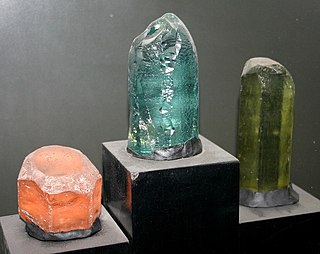
Beryl ( BERR-əl) is a mineral composed of beryllium aluminium silicate with the chemical formula Be3Al2Si6O18. Well-known varieties of beryl include emerald and aquamarine. Naturally occurring hexagonal crystals of beryl can be up to several meters in size, but terminated crystals are relatively rare. Pure beryl is colorless, but it is frequently tinted by impurities; possible colors are green, blue, yellow, pink, and red (the rarest). It is an ore source of beryllium.

In geology and mineralogy, a mineral or mineral species is, broadly speaking, a solid substance with a fairly well-defined chemical composition and a specific crystal structure that occurs naturally in pure form.

Topaz is a silicate mineral made of aluminum and fluorine with the chemical formula Al2SiO4(F, OH)2. It is used as a gemstone in jewelry and other adornments. Common topaz in its natural state is colorless, though trace element impurities can make it pale blue or golden brown to yellow-orange. Topaz is often treated with heat or radiation to make it a deep blue, reddish-orange, pale green, pink, or purple.
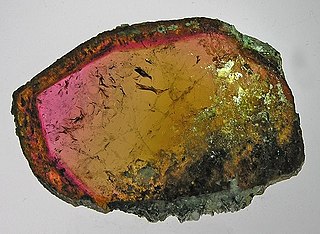
Tourmaline is a crystalline silicate mineral group in which boron is compounded with elements such as aluminium, iron, magnesium, sodium, lithium, or potassium. This gemstone comes in a wide variety of colors.
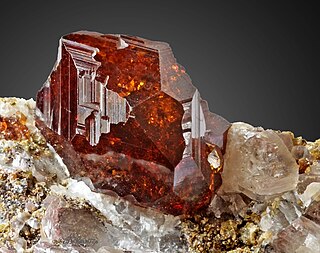
Garnets are a group of silicate minerals that have been used since the Bronze Age as gemstones and abrasives.

Prehnite is an inosilicate of calcium and aluminium with the formula: Ca2Al(AlSi3O10)(OH)2 with limited Fe3+ substitutes for aluminium in the structure. Prehnite crystallizes in the orthorhombic crystal system, and most often forms as stalactitic, botryoidal, reniform or globular aggregates, with only just the crests of small crystals showing any faces, which are almost always curved or composite. Very rarely will it form distinct, well-individualized crystals showing a square-like cross-section, including those found at the Jeffrey Mine in Asbestos, Quebec, Canada. Prehnite is brittle with an uneven fracture and a vitreous to pearly luster. Its hardness is 6.5, its specific gravity is 2.80–2.95 and its color varies from light green to yellow, but also colorless, blue, pink or white. In April 2000, rare orange prehnite was discovered in the Kalahari Manganese Fields, South Africa. Prehnite is mostly translucent, and rarely transparent.
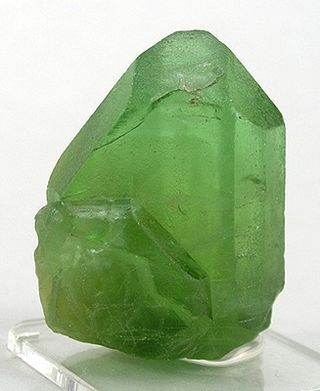
The mineral olivine is a magnesium iron silicate with the chemical formula (Mg,Fe)2SiO4. It is a type of nesosilicate or orthosilicate. The primary component of the Earth's upper mantle, it is a common mineral in Earth's subsurface, but weathers quickly on the surface. Olivine has many uses, such as the gemstone peridot, as well as industrial applications like metalworking processes.

Peridot, sometimes called chrysolite, is a yellow-green transparent variety of olivine. Peridot is one of the few gemstones that occur in only one color.

Microcline (KAlSi3O8) is an important igneous rock-forming tectosilicate mineral. It is a potassium-rich alkali feldspar. Microcline typically contains minor amounts of sodium. It is common in granite and pegmatites. Microcline forms during slow cooling of orthoclase; it is more stable at lower temperatures than orthoclase. Sanidine is a polymorph of alkali feldspar stable at yet higher temperature. Microcline may be clear, white, pale-yellow, brick-red, or green; it is generally characterized by cross-hatch twinning that forms as a result of the transformation of monoclinic orthoclase into triclinic microcline.

The mineral or gemstone chrysoberyl is an aluminate of beryllium with the formula BeAl2O4. The name chrysoberyl is derived from the Greek words χρυσός chrysos and βήρυλλος beryllos, meaning "a gold-white spar". Despite the similarity of their names, chrysoberyl and beryl are two completely different gemstones, although they both contain beryllium. Chrysoberyl is the third-hardest frequently encountered natural gemstone and lies at 8.5 on the Mohs scale of mineral hardness, between corundum (9) and topaz (8).
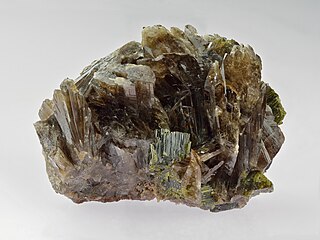
Axinite is a brown to violet-brown, or reddish-brown bladed group of minerals composed of calcium aluminium boro-silicate, (Ca,Fe,Mn)3Al2BO3Si4O12OH. Axinite is pyroelectric and piezoelectric.

Rhodochrosite is a manganese carbonate mineral with chemical composition MnCO3. In its pure form (rare), it is typically a rose-red colour, but it can also be shades of pink to pale brown. It streaks white, and its Mohs hardness varies between 3.5 and 4.5. Its specific gravity is between 3.45 and 3.6. The crystal system of rhodochrosite is trigonal, with a structure and cleavage in the carbonate rhombohedral system. The carbonate ions (CO2−
3) are arranged in a triangular planar configuration, and the manganese ions (Mn2+) are surrounded by six oxygen ions in an octahedral arrangement. The MnO6 octahedra and CO3 triangles are linked together to form a three-dimensional structure. Crystal twinning is often present. It can be confused with the manganese silicate rhodonite, but is distinctly softer. Rhodochrosite is formed by the oxidation of manganese ore, and is found in South Africa, China, and the Americas. It is one of the national symbols of Argentina and the state of Colorado.

Enstatite is a mineral; the magnesium endmember of the pyroxene silicate mineral series enstatite (MgSiO3) – ferrosilite (FeSiO3). The magnesium rich members of the solid solution series are common rock-forming minerals found in igneous and metamorphic rocks. The intermediate composition, (Mg,Fe)SiO
3, has historically been known as hypersthene, although this name has been formally abandoned and replaced by orthopyroxene. When determined petrographically or chemically the composition is given as relative proportions of enstatite (En) and ferrosilite (Fs) (e.g., En80Fs20).

Chrysoprase, chrysophrase or chrysoprasus is a gemstone variety of chalcedony that contains small quantities of nickel. Its color is normally apple-green, but varies from turquoise-like cyan to deep green. The darker varieties of chrysoprase are also referred to as prase.
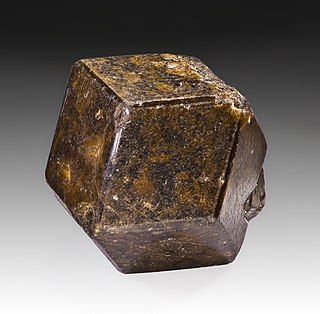
Andradite is a mineral species of the garnet group. It is a nesosilicate, with formula Ca3Fe2Si3O12.

Elbaite, a sodium, lithium, aluminium boro-silicate, with the chemical composition Na(Li1.5Al1.5)Al6Si6O18(BO3)3(OH)4, is a mineral species belonging to the six-member ring cyclosilicate tourmaline group.
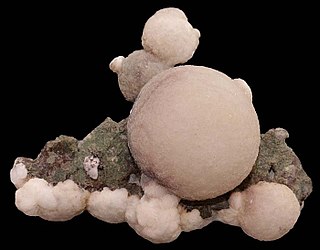
Thomsonite is the name of a series of tecto-silicate minerals of the zeolite group. Prior to 1997, thomsonite was recognized as a mineral species, but a reclassification in 1997 by the International Mineralogical Association changed it to a series name, with the mineral species being named thomsonite-Ca and thomsonite-Sr. Thomsonite-Ca, by far the more common of the two, is a hydrous sodium, calcium and aluminium silicate, NaCa2Al5Si5O20·6H2O. Strontium can substitute for the calcium and the appropriate species name depends on the dominant element. The species are visually indistinguishable and the series name thomsonite is used whenever testing has not been performed. Globally, thomsonite is one of the rarer zeolites.
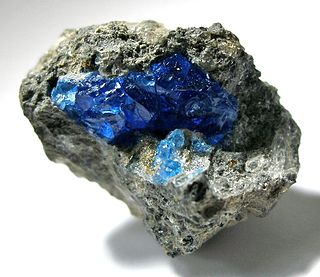
Hauyne or haüyne, also called hauynite or haüynite ,, old name Azure spar is a rare tectosilicate sulfate mineral with endmember formula Na3Ca(Si3Al3)O12(SO4). As much as 5 wt % K2O may be present, and also H2O and Cl. It is a feldspathoid and a member of the sodalite group. Hauyne was first described in 1807 from samples discovered in Vesuvian lavas in Monte Somma, Italy, and was named in 1807 by Brunn-Neergard for the French crystallographer René Just Haüy (1743–1822). It is sometimes used as a gemstone.

Aquamarine is a pale-blue to light-green variety of the beryl family, with its name relating to water and sea. The color of aquamarine can be changed by heat, with a goal to enhance its physical appearance. It is the birth stone of March.

