 Part of the plaza in 2006 | |||
| Type | Plaza | ||
|---|---|---|---|
| Location | Shinjuku, Tokyo, Japan | ||

Citizens' Plaza (or Citizen's Plaza) [1] is an urban plaza in Shinjuku, Tokyo, Japan. [2]
| Part of the plaza in 2006 | |||
| Type | Plaza | ||
|---|---|---|---|
| Location | Shinjuku, Tokyo, Japan | ||
Citizens' Plaza (or Citizen's Plaza) [1] is an urban plaza in Shinjuku, Tokyo, Japan. [2]
Artworks installed in the plaza include: [3]

Shinjuku is a special ward in Tokyo, Japan. It is a major commercial and administrative centre, housing the northern half of the busiest railway station in the world and the Tokyo Metropolitan Government Building, the administration centre for the government of Tokyo. As of 2018, the ward has an estimated population of 346,235, and a population density of 18,232 people per km2. The total area is 18.23 km2. Since the end of the Second World War, Shinjuku has been a major secondary center of Tokyo (fukutoshin), rivaling to the original city center in Marunouchi and Ginza. It literally means "New Inn Ward".

Shibuya is a special ward in Tokyo, Japan. As a major commercial and finance center, it houses two of the busiest railway stations in the world, Shinjuku Station and Shibuya Station.

Nakano is a special ward in Tokyo, Japan. The English translation of its Japanese self-designation is Nakano City.

Shinjuku Station is a major railway station in the Shinjuku and Shibuya wards in Tokyo, Japan. In Shinjuku, it is part of the Nishi-Shinjuku and Shinjuku districts. In Shibuya, it is located in the Yoyogi and Sendagaya districts. It is the world's busiest railway station.

Keio Corporation is a private railway operator in Tokyo, Japan, and the central firm of the Keio Group that is involved in transport, retail, real estate and other industries.

Kabukichō is an entertainment and red-light district in Shinjuku, Tokyo, Japan. Kabuki-chō is the location of many host and hostess clubs, love hotels, shops, restaurants, and nightclubs, and is often called the "Sleepless Town". Shinjuku Golden Gai, famous for its plethora of small bars, is part of Kabuki-cho.

Books Kinokuniya is a Japanese bookstore chain operated by Kinokuniya Company Ltd., founded in 1927, with its first store located in Shinjuku, Tokyo, Japan. Its name translates to "Bookstore of Kii Province". The company has its headquarters in Meguro, Tokyo.
Nishi-Shinjuku is a skyscraper business district in Shinjuku, Tokyo, Japan. This region was previously called Tsunohazu (角筈).
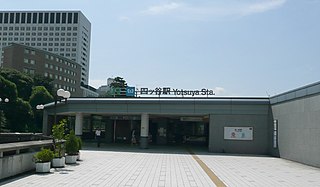
Yotsuya Station is a railway station in the Yotsuya district of Shinjuku, Tokyo, Japan, operated jointly by East Japan Railway Company and Tokyo Metro. Several parts of the station are also located in the Rokubancho and Kojimachi neighborhoods of Chiyoda ward.

Taisei Corporation is a Japanese corporation founded in 1873. Its main areas of business are building construction, civil engineering, and real estate development. Taisei's headquarters are located at Shinjuku Center Building in Nishi-Shinjuku, Shinjuku, Tokyo.

Tochōmae Station is a subway station on the Toei Ōedo Line in Shinjuku, Tokyo, Japan, operated by the Tokyo subway operator Toei Subway.

The Shinjuku Mitsui Building is a high-rise building in Nishi-Shinjuku, Shinjuku, Tokyo. It is owned by Mitsui Fudosan. It is one of the ten tallest buildings in Tokyo, and was the tallest building in Tokyo and Japan from September 1974 to March 1978, when Sunshine 60 was completed.

Keio Plaza Hotel is a chain of hotels in Japan, the largest of which is its flagship hotel in the Nishi-Shinjuku district in Shinjuku, Tokyo, Japan. The Keio Plaza Hotel was partially destroyed in the 1984 film The Return of Godzilla and the 1991 film Godzilla vs. King Ghidorah.
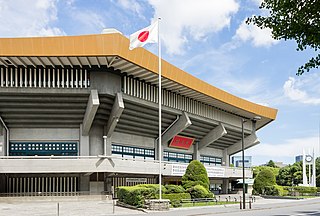
The Japan Music Awards for outstanding achievements in the Broadcast Music Producers Federation, was major music awards show held annually in Japan from 1969 to 1993. The 1988 awards ceremony was cancelled due to the deteriorating health of Emperor Shōwa.

Higashi-Fushimi Station is a passenger railway station located in then city of Nishitōkyō, Tokyo, Japan, operated by the private railway operator Seibu Railway.
Noriyoshi Shibata or Nori Shibata is a Japanese photographer who specializes in documenting Tibet and China.
Michio Yamauchi is a Japanese street photographer focusing in human photography based in Tokyo.
Slappy Cakes is a restaurant chain based out of Portland, Oregon and serving primarily breakfast food with locations in the United States and Singapore.

The folk guerrilla concerts were folk music concerts in Shinjuku station, Shinjuku, Tokyo, held by anti-Vietnam War activists in 1969. The people who participated in the concert were termed folk guerrillas. The concerts were organized by the anti-war group Beheiren. They began in February, and concerts continued up until July, when a fight with riot police led to the dispersal of the concerts and the arrests of musicians.
 Media related to Citizens' Plaza (Shinjuku) at Wikimedia Commons
  | This article about a Japanese building– or structure–related topic is a stub. You can help Wikipedia by expanding it. |
