In geology, felsic is a modifier describing igneous rocks that are relatively rich in elements that form feldspar and quartz. It is contrasted with mafic rocks, which are relatively richer in magnesium and iron. Felsic refers to silicate minerals, magma, and rocks which are enriched in the lighter elements such as silicon, oxygen, aluminium, sodium, and potassium. Felsic magma or lava is higher in viscosity than mafic magma/lava.

In geology and mineralogy, a mineral or mineral species is, broadly speaking, a solid chemical compound with a fairly well-defined chemical composition and a specific crystal structure that occurs naturally in pure form.

Sandstone is a clastic sedimentary rock composed mainly of sand-sized silicate grains. Sandstones comprise about 20–25% of all sedimentary rocks.

In chemistry, a silicate is any member of a family of polyatomic anions consisting of silicon and oxygen, usually with the general formula [SiO(4-2x)−
4−x]
n, where 0 ≤ x < 2. The family includes orthosilicate SiO4−4, metasilicate SiO2−3, and pyrosilicate Si2O6−7. The name is also used for any salt of such anions, such as sodium metasilicate; or any ester containing the corresponding chemical group, such as tetramethyl orthosilicate. The name "silicate" is sometimes extended to any anions containing silicon, even if they do not fit the general formula or contain other atoms besides oxygen; such as hexafluorosilicate [SiF6]2−.Most commonly, silicates are encountered as silicate minerals.

Amphibole is a group of inosilicate minerals, forming prism or needlelike crystals, composed of double chain SiO
4 tetrahedra, linked at the vertices and generally containing ions of iron and/or magnesium in their structures. Its IMA symbol is Amp. Amphiboles can be green, black, colorless, white, yellow, blue, or brown. The International Mineralogical Association currently classifies amphiboles as a mineral supergroup, within which are two groups and several subgroups.
Category 3 or Category III can refer to:

Mineral wool is any fibrous material formed by spinning or drawing molten mineral or rock materials such as slag and ceramics.

Rhodochrosite is a manganese carbonate mineral with chemical composition MnCO3. In its (rare) pure form, it is typically a rose-red colour, but can also be shades of pink to pale brown. It streaks white, and its Mohs hardness varies between 3.5 and 4.5. Its specific gravity is between 3.45 and 3.6. It crystallises in the trigonal system, and cleaves with rhombohedral carbonate cleavage in three directions. Crystal twinning often is present. It is often confused with the manganese silicate, rhodonite, but is distinctly softer. Rhodochrosite is formed by oxidation of manganese ore, and is found in South Africa, China and the Americas. It is officially listed as one of the National symbols of Argentina.
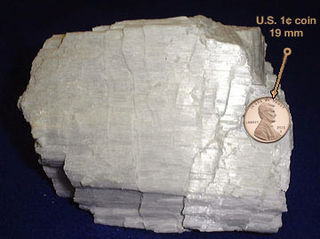
Wollastonite is a calcium inosilicate mineral (CaSiO3) that may contain small amounts of iron, magnesium, and manganese substituting for calcium. It is usually white. It forms when impure limestone or dolomite is subjected to high temperature and pressure, which sometimes occurs in the presence of silica-bearing fluids as in skarns or in contact with metamorphic rocks. Associated minerals include garnets, vesuvianite, diopside, tremolite, epidote, plagioclase feldspar, pyroxene and calcite. It is named after the English chemist and mineralogist William Hyde Wollaston (1766–1828).
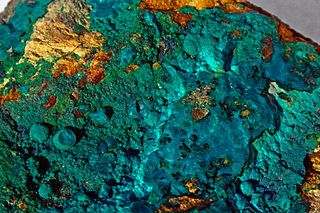
Silicate minerals are rock-forming minerals made up of silicate groups. They are the largest and most important class of minerals and make up approximately 90 percent of Earth's crust.

Heulandite is the name of a series of tecto-silicate minerals of the zeolite group. Prior to 1997, heulandite was recognized as a mineral species, but a reclassification in 1997 by the International Mineralogical Association changed it to a series name, with the mineral species being named:
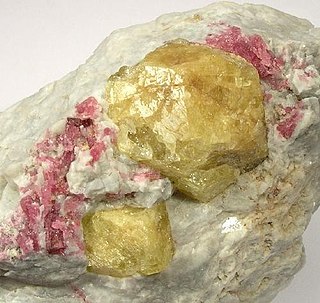
The borate minerals are minerals which contain a borate anion group. The borate (BO3) units may be polymerised similar to the SiO4 unit of the silicate mineral class. This results in B2O5, B3O6, B2O4 anions as well as more complex structures which include hydroxide or halogen anions. The [B(O,OH)4]− anion exists as well.

Clastic rocks are composed of fragments, or clasts, of pre-existing minerals and rock. A clast is a fragment of geological detritus, chunks, and smaller grains of rock broken off other rocks by physical weathering. Geologists use the term clastic to refer to sedimentary rocks and particles in sediment transport, whether in suspension or as bed load, and in sediment deposits.

Nickel–Strunz classification is a scheme for categorizing minerals based upon their chemical composition, introduced by German mineralogist Karl Hugo Strunz in his Mineralogische Tabellen (1941). The 4th and the 5th edition was also edited by Christel Tennyson (1966). It was followed by A.S. Povarennykh with a modified classification.
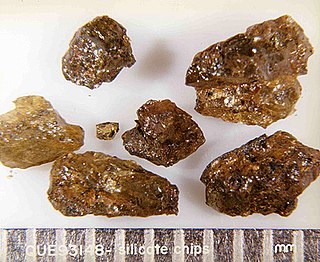
Lodranites are a small group of primitive achondrite meteorites that consists of meteoric iron and silicate minerals. Olivine and pyroxene make up most of the silicate minerals. Like all primitive achondrites lodranites share similarities with chondrites and achondrites.
Copper silicate may refer to any silicate of copper generally; more specifically:

Freudenbergite is a mineral that is named in honor of Wilhelm Freudenberg, palaeontologist at the University of Tübingen and the University of Göttingen, and curator for mineralogy and geology at the National Collections of Natural History in Karlsruhe. He studied Katzenbuckel rocks.
 Media related to Minerals by classification at Wikimedia Commons
