Colonia Malligasta | |
|---|---|
Municipality and village | |
| Country |  Argentina Argentina |
| Province | La Rioja Province |
| Time zone | UTC−3 (ART) |
| Climate | BWh |
Colonia Malligasta is a municipality and village in La Rioja Province in northwestern Argentina. [1]
Colonia Malligasta | |
|---|---|
Municipality and village | |
| Country | Argentina |
| Province | La Rioja Province |
| Time zone | UTC−3 (ART) |
| Climate | BWh |
Colonia Malligasta is a municipality and village in La Rioja Province in northwestern Argentina. [1]

The Arctic Archipelago, also known as the Canadian Arctic Archipelago, is an archipelago lying to the north of the Canadian continental mainland, excluding Greenland and Iceland.
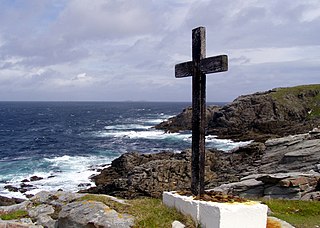
This is a list of the extreme points of Ireland – the points that are furthest north, south, east or west in Ireland. It includes the Republic of Ireland and Northern Ireland.

Marguerite Bay or Margaret Bay is an extensive bay on the west side of the Antarctic Peninsula, which is bounded on the north by Adelaide Island and on the south by Wordie Ice Shelf, George VI Sound and Alexander Island. The mainland coast on the Antarctic Peninsula is Fallières Coast. Islands within the bay include Pourquoi Pas Island, Horseshoe Island, Terminal Island, and Lagotellerie Island. Marguerite Bay was discovered in 1909 by the French Antarctic Expedition under Jean-Baptiste Charcot, who named the bay for his wife.
The Aviator Glacier is a major valley glacier in Antarctica that is over 60 nautical miles long and 5 nautical miles wide, descending generally southward from the plateau of Victoria Land along the west side of Mountaineer Range, and entering Lady Newnes Bay between Cape Sibbald and Hayes Head where it forms a floating tongue.
The Scott Mountains are a large number of isolated peaks lying south of Amundsen Bay in Enderby Land of East Antarctica, Antarctica. Discovered on 13 January 1930 by the British Australian New Zealand Antarctic Research Expedition (BANZARE) under Sir Douglas Mawson. He named the feature Scott Range after Captain Robert Falcon Scott, Royal Navy. The term mountains is considered more appropriate because of the isolation of its individual features.
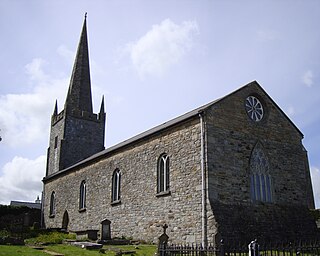
The Bishop of Killala is an episcopal title which takes its name after the village of Killala in County Mayo, Ireland. In the Roman Catholic Church it remains a separate title, but in the Church of Ireland it has been united with other bishoprics.
Fuentes de Carbajal is a municipality located in the province of León, Castile and León, Spain. According to the 2010 census (INE), the municipality had a population of 121 inhabitants.

Padilla de Arriba is a municipality and town located in the province of Burgos, Castile and León, Spain. According to the 2022 census (INE), the municipality has a population of 84 inhabitants.
Sapaga is a village in the Zorgho Department of Ganzourgou Province in central Burkina Faso. The village has a population of 3,316.

Bluie was the United States military code name for Greenland during World War II. It is remembered by the numbered sequence of base locations identified by the 1941 United States Coast Guard South Greenland Survey Expedition, and subsequently used in radio communications by airmen unfamiliar with pronunciation of the Greenlandic Inuit and Danish names of those locations. These were typically spoken BLUIE (direction) (number), with direction being east or west along the Greenland coast from Cape Farewell.
The Porthos Range is the second range south in the Prince Charles Mountains of Antarctica, extending for about 30 miles in an east-to-west direction between Scylla Glacier and Charybdis Glacier. First visited in December 1956 by the Australian National Antarctic Research Expeditions (ANARE) southern party under W.G. Bewsher (1956-57) and named after Porthos, a character in Alexandre Dumas, père's novel The Three Musketeers, the most popular book read on the southern journey.

Malligasta is a municipality and village in La Rioja Province in northwestern Argentina.
Stevenson Island is a small island 120 m (390 ft) high, lying at the east side of Colbeck Archipelago, 2 nautical miles (3.7 km) northeast of Cape Simpson. Discovered in February 1931 by the British Australian New Zealand Antarctic Research Expedition (BANZARE) under Mawson. He named it for Captain J.B. Stevenson, Royal Navy, a member of the Australian Aurora Committee, 1916–17.
Fullastern Rock is an isolated submerged rock lying in the middle of Johnston Passage 7 nautical miles (13 km) west-northwest of Cape Adriasola, Adelaide Island. The rock is potentially dangerous to ships and was so named when the RRS John Biscoe was compelled to go full astern to avoid this hazard.
Mount Mangin is a mountain, 2,040 metres (6,700 ft) high, standing 5 nautical miles (9 km) northeast of Mount Barre on Adelaide Island, Antarctica. It was discovered by the French Antarctic Expedition, 1908–10, and named by Jean-Baptiste Charcot for the noted French botanist Louis A. Mangin.
Saussure Glacier is a glacier flowing northeast from Tyndall Mountains, Arrowsmith Peninsula, into Lallemand Fjord, Loubet Coast. Photographed from the air by Falkland Islands and Dependencies Aerial Survey Expedition (FIDASE) in 1957. Named by the United Kingdom Antarctic Place-Names Committee (UK-APC) in association with the names of glaciologists grouped in the area after Horace-Bénédict de Saussure (1740–99), Genevan naturalist and physicist, who in 1787 was the first to recognize that erratic boulders had been moved great distances by ice.
Solus Island is an island off the Antarctic Peninsula, lying 3 nautical miles (6 km) south of the Guébriant Islands, tio the south-southeast of Cape Alexandra at the south end of Adelaide Island. The name appears as Islote Solitario, meaning 'solitary islet', on an Argentine government chart of 1957. The name indicates its isolated position. The name 'Solus Island' was adopted on British charts
Sorge Island is an island lying just south of The Gullet in Barlas Channel, close east of Adelaide Island. Mapped by Falkland Islands Dependencies Survey (FIDS) from surveys and air photos, 1948–59. Named by United Kingdom Antarctic Place-Names Committee (UK-APC) for Ernst F.W. Sorge, German glaciologist who made the first seismic soundings of the Greenland ice sheet, 1929–31, and developed a theory of the densification of firn.
29°11′S67°26′W / 29.183°S 67.433°W
 | This article about a place in La Rioja Province, Argentina is a stub. You can help Wikipedia by expanding it. |