
Christopher Columbus was an Italian explorer and navigator from the Republic of Genoa who completed four Spanish-based voyages across the Atlantic Ocean sponsored by the Catholic Monarchs, opening the way for the widespread European exploration and European colonization of the Americas. His expeditions were the first known European contact with the Caribbean and Central and South America.

Chicano or Chicana is an ethnic identity for Mexican Americans who have a non-Anglo self-image, embracing their Mexican Native ancestry. Chicano was originally a classist and racist slur used toward low-income Mexicans that was reclaimed in the 1940s among youth who belonged to the Pachuco and Pachuca subculture. In the 1960s, Chicano was widely reclaimed in the building of a movement toward political empowerment, ethnic solidarity, and pride in being of indigenous descent. Chicano developed its own meaning separate from Mexican American identity. Youth in barrios rejected cultural assimilation into the mainstream American culture and embraced their own identity and worldview as a form of empowerment and resistance. The community forged an independent political and cultural movement, sometimes working alongside the Black power movement.
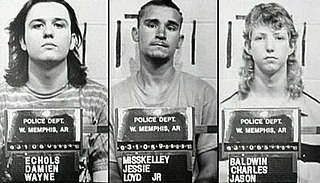
The West Memphis Three are three men convicted as teenagers in 1994 of the 1993 murders of three boys in West Memphis, Arkansas, United States. Damien Echols was sentenced to death, Jessie Misskelley Jr. to life imprisonment plus two 20-year sentences, and Jason Baldwin to life imprisonment. During the trial, the prosecution asserted that the juveniles killed the children as part of a Satanic ritual.
Jury nullification (US/UK), jury equity (UK), or a perverse verdict (UK) occurs when the jury in a criminal trial gives a not guilty verdict regardless of whether they believe a defendant has broken the law. The jury's reasons may include the belief that the law itself is unjust, that the prosecutor has misapplied the law in the defendant's case, that the punishment for breaking the law is too harsh, or general frustrations with the criminal justice system. Some juries have also refused to convict due to their own prejudices in favor of the defendant. Such verdicts are possible because a jury has an absolute right to return any verdict it chooses.

Gwen Amber Rose Araujo was an American teenager who was murdered in Newark, California at the age of 17. She was murdered by four men, two of whom she had been sexually intimate with, who beat and strangled her after discovering that she was transgender. Two of the defendants were convicted of second-degree murder, but not the requested hate-crime enhancements to the charges. The other two defendants pleaded guilty or no-contest to voluntary manslaughter. In at least one of the trials, a "trans panic defense"—an extension of the gay panic defense—was employed.
William Stanley Milligan, also known as The Campus Rapist, was an American man who was the subject of a highly publicized court case in Ohio in the late 1970s. After having committed several felonies including armed robbery, he was arrested for three rapes on the campus of Ohio State University. In the course of preparing his defense, psychologists diagnosed Milligan with dissociative identity disorder. His lawyers pleaded insanity, claiming that two of his alternate personalities committed the crimes without Milligan being aware of it. He was the first person diagnosed with dissociative identity disorder to raise such a defense, and the first acquitted of a major crime for this reason, instead spending a decade in psychiatric hospitals.

Zoot Suit is a play written by Luis Valdez, featuring incidental music by Daniel Valdez and Lalo Guerrero. Zoot Suit is based on the Sleepy Lagoon murder trial and the Zoot Suit Riots. Debuting in 1979, Zoot Suit was the first Chicano play on Broadway. In 1981, Luis Valdez also directed a filmed version of the play, combining stage and film techniques.
Inez García (1941–2003) was an American-Hispanic woman who gained notoriety within the feminist movement after being accused of the murder of a man who had previously raped her in 1974.

Lourdes Portillo was a Mexican film director, producer, and writer. The political perspectives of Portillo's films have been described as "nuanced" and versed with a point of view balanced by her experience as a lesbian and Chicana woman. Portillo films have been widely studied and analyzed, particularly by scholars in the field of Chicano studies.

Justice is an American legal drama produced by Jerry Bruckheimer that aired on Fox in the US and CTV in Canada. The series also aired on Warner Channel in Latin America, in Brazil also was aired on Rede Globo, Nine Network in Australia, and on TV2 in New Zealand.

Between 1492 and 1504, the Italian navigator and explorer Christopher Columbus led four transatlantic maritime expeditions in the name of the Catholic Monarchs of Spain to the Caribbean and to Central and South America. These voyages led to the widespread knowledge of the New World. This breakthrough inaugurated the period known as the Age of Discovery, which saw the colonization of the Americas, a related biological exchange, and trans-Atlantic trade. These events, the effects and consequences of which persist to the present, are often cited as the beginning of the modern era.
Indiana v. Edwards, 554 U.S. 164 (2008), was a United States Supreme Court case in which the Court held that the standard for competency to stand trial was not linked to the standard for competency to represent oneself.
The trial of Arne Cheyenne Johnson, also known as the "devil made me do it" case, is the first known court case in the United States in which the defense sought to prove innocence based upon the claim of demonic possession and denial of personal responsibility for the crime. On November 24, 1981, in Brookfield, Connecticut, Arne Cheyenne Johnson was convicted of first-degree manslaughter for the killing of his landlord, Alan Bono.
Corpus: A Home Movie About Selena is a 1999 documentary film by Lourdes Portillo about Mexican American singer-songwriter Selena Quintanilla-Pérez. It places emphasis on the transformation of Selena from a popular entertainer into a modern-day saint and role model. This documentary uses authentic home videos, news stories, footage from concerts and a debate between intellectuals to analyze the effect of Selena and Selena's murder at the hands of Yolanda Saldivar, the president of her fan club.
United States v. Manning was the court-martial of former United States Army Private First Class, Chelsea Manning.
"Holiday Special" is the third episode in the twenty-first season of the American animated television series South Park. The 280th episode of the series overall, it first aired on Comedy Central in the United States on September 27, 2017. This episode parodies self-victimization via Native American hardships and trends toward opposition to Columbus Day.
Early Native American culture was rich with ceremonies, rituals and storytelling. The stories that inspire Native American theatre have been around for hundreds of years, but did not gain formal recognition by colonial America. This lack of recognition lasted until the 1930s when Lynn Riggs, a playwright of Cherokee descent, brought Native Theatre into the spotlight through the Six Nations Reserve Forest Theatre in Ontario. Through these events, Native Theatre has been introduced to mainstream society and contemporary Native American Theater was born. Indigenous American cultures have been a major aspect of Chicano drama.
On January 26, 2017, Alianna DeFreeze, a fourteen-year-old girl from Cleveland, Ohio, was kidnapped, raped, tortured, and murdered by Christopher Whitaker. Whitaker, who had a criminal history involving grand theft, burglary, aggravated robbery, felonious assault, and sexual assault, took DeFreeze to an abandoned house, where he raped her. She was found beaten and stabbed to death using a hammer, a screwdriver, a nut driver, a box cutter, and a drill. DeFreeze, who attended school at E Prep & Village Prep Woodland Hills, was reported missing, causing a city-wide search. Her body was discovered three days later.

On February 23, 2020, Ahmaud Arbery, a 25-year-old black man, was murdered during a racially motivated hate crime while jogging in Satilla Shores, a neighborhood near Brunswick in Glynn County, Georgia. Three white men, who later claimed to police that they assumed he was a burglar, pursued Arbery in their trucks for several minutes, using the vehicles to block his path as he tried to run away. Two of the men, Travis McMichael and his father, Gregory McMichael, were armed in one vehicle. Their neighbor, William "Roddie" Bryan, was in another vehicle. After overtaking Arbery, Travis McMichael exited his truck, pointing his weapon at Arbery. Arbery approached McMichael and a physical altercation ensued, resulting in McMichael fatally shooting Arbery. Bryan recorded this confrontation and Arbery's murder on his cell phone.

The second impeachment trial of Donald Trump, the 45th president of the United States, began on February 9, 2021, and concluded with his acquittal on February 13. Donald Trump had been impeached for the second time by the House of Representatives on January 13, 2021. The House adopted one article of impeachment against Trump: incitement of insurrection. He is the only U.S. president and only federal official to be impeached twice. He was impeached by the House seven days prior to the expiration of his term and the inauguration of Joe Biden. Because he left office before the trial, this was the first impeachment trial of a former president. The article of impeachment addressed Trump's attempts to overturn the 2020 presidential election results and stated that Trump incited the attack on the Capitol in Washington, D.C., while Congress was convened to count the electoral votes and certify the victory of Joe Biden and Kamala Harris.


