
Road transport or road transportation is a type of transport using roads. Transport on roads can be roughly grouped into the transportation of goods and transportation of people. In many countries licensing requirements and safety regulations ensure a separation of the two industries. Movement along roads may be by bike, automobile, bus, truck, or by animal such as horse or oxen. Standard networks of roads were adopted by Romans, Persians, Aztec, and other early empires, and may be regarded as a feature of empires. Cargo may be transported by trucking companies, while passengers may be transported via mass transit. Commonly defined features of modern roads include defined lanes and signage. Various classes of road exist, from two-lane local roads with at-grade intersections to controlled-access highways with all cross traffic grade-separated.

Intermodal freight transport involves the transportation of freight in an intermodal container or vehicle, using multiple modes of transportation, without any handling of the freight itself when changing modes. The method reduces cargo handling, and so improves security, reduces damage and loss, and allows freight to be transported faster. Reduced costs over road trucking is the key benefit for inter-continental use. This may be offset by reduced timings for road transport over shorter distances.

Logistics automation is the application of computer software or automated machinery to improve the efficiency of logistics operations. Typically this refers to operations within a warehouse or distribution center, with broader tasks undertaken by supply chain engineering systems and enterprise resource planning systems.

Cross-docking is a logistical practice of Just-In-Time Scheduling where materials are delivered directly from a manufacturer or a mode of transportation to a customer or another mode of transportation. Cross-docking often aims to minimize overheads related to storing goods between shipments or while awaiting a customer's order. This may be done to change the type of conveyance, to sort material intended for different destinations, or to combine material from different origins into transport vehicles with the same or similar destinations.

A truck driver is a person who earns a living as the driver of a truck, which is commonly defined as a large goods vehicle (LGV) or heavy goods vehicle (HGV).
Truckload shipping is the movement of large amounts of homogeneous cargo, generally the amount necessary to fill an entire semi-trailer or intermodal container. A truckload carrier is a trucking company that generally contracts an entire trailer-load to a single customer. This is as opposed to a less-than truckload (LTL) company that generally mixes freight from several customers in each trailer. One advantage Full Truckload (FTL) carriers have over Less than Truckload carriers is that the freight is never handled en route, whereas an LTL shipment will typically be transported on several different trailers. Truckload shipments are typically run on 48' or 53'dry van trailers which will hold 24 or 26 pallets respectively.

Less-than-truckload shipping or less than load (LTL) is the transportation of an amount of freight sized between individual parcels and full truckloads. Parcel carriers handle small packages and freight that can be broken down into units less than approximately 150 pounds (68 kg). Full truckload carriers move entire semi-trailers. Semi-trailers are typically between 26 and 53 feet and require a substantial amount of freight to make such transportation economical. The term LTL can refer to the freight itself, or to the carrier that transports the such freight.

A weigh station is a checkpoint along a highway to inspect vehicular weights and safety compliance criteria. Usually, trucks and commercial vehicles are subject to the inspection.
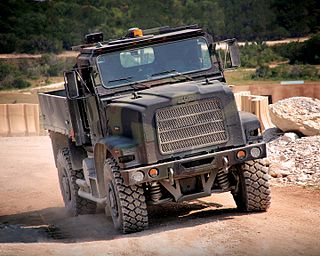
TerraMax is the trademark for autonomous/unmanned ground vehicle technology developed by Oshkosh Defense. Primary military uses for the technology are seen as reconnaissance missions and freight transport in high-risk areas so freeing soldiers from possible attacks, ambushes or the threat of mines and IEDs. The technology could also be used in civilian settings, such as autonomous snow clearing at airports.
The Federal Motor Carrier Safety Administration (FMCSA) is an agency in the United States Department of Transportation that regulates the trucking industry in the United States. The primary mission of the FMCSA is to reduce crashes, injuries, and fatalities involving large trucks and buses.

In road transport, an oversize load is a load that exceeds the standard or ordinary legal size and/or weight limits for a truck to convey on a specified portion of road, highway, or other transport infrastructure, such as air freight or water freight. In Europe, it may be referred to as special transport or heavy and oversized transportation. There may also be load-per-axle limits. However, a load that exceeds the per-axle limits but not the overall weight limits is considered overweight. Examples of oversize/overweight loads include construction machines, pre-built homes, containers, and construction elements.

A flatbed truck is a type of truck the bodywork of which is just an entirely flat, level 'bed' with no sides or roof. This allows for quick and easy loading of goods, and consequently they are used to transport heavy loads that are not delicate or vulnerable to rain, and also for abnormal loads that require more space than is available on a closed body. Flatbed trucks can be either articulated or rigid.
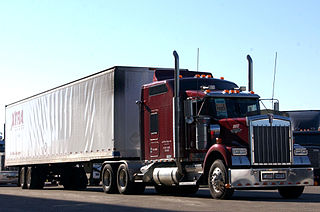
The trucking industry serves the American economy by transporting large quantities of raw materials, works in process, and finished goods over land—typically from manufacturing plants to retail distribution centers. Trucks are also used in the construction industry, two of which require dump trucks and portable concrete mixers to move the large amounts of rocks, dirt, concrete, and other building materials used in construction. Trucks in America are responsible for the majority of freight movement over land and are tools in the manufacturing, transportation, and warehousing industries.
A specialized set of jargon describe the tools, equipment, and employment sectors used in the trucking industry in the United States. Some terms may be used within other English-speaking countries, or within the freight industry in general. For example, shore power is a term borrowed from shipping terminology, in which electrical power is transferred from shore to ship, instead of the ship relying upon idling its engines. Drawing power from land lines is more efficient than engine idling and eliminates localized air pollution. Another borrowed term is "landing gear", which refers to the legs which support the front end of a semi-trailer when it is not connected to a semi-truck. Some nicknames are obvious wordplay, such as "portable parking lot", in reference to a truck that carries automobiles.
The American Trucking Associations (ATA), founded in 1933, is the largest national trade association for the trucking industry. ATA represents more than 37,000 members covering every type of motor carrier in the United States through a federation of other trucking groups, industry-related conferences, and its 50 affiliated state trucking associations. Former Governor of Kansas Bill Graves was replaced by Chris Spear as the ATA's president and CEO in July 2016.
DAT Freight & Analytics, originally known as Dial-a-Truck, is a US-based freight exchange service and provider of transportation information serving North America. Freight exchange services are used to match material ("loads") that needs to be shipped with over-the-road carriers, which can be hired to move those loads. DAT was established in 1978 and is part of Roper Technologies. It is co-headquartered in Denver, Colorado and Beaverton, Oregon. Satish Maripuri, President and CEO, is responsible for DAT’s strategy and execution.
Urban freight distribution is the system and process by which goods are collected, transported, and distributed within urban environments. The urban freight system can include seaports, airports, manufacturing facilities, and warehouse/distribution centers that are connected by a network of railroads, rail yards, pipelines, highways, and roadways that enable goods to get to their destinations.

On May 23, 2013, at approximately 7:00 pm PDT, a span of the bridge carrying Interstate 5 over the Skagit River in the U.S. state of Washington collapsed. Three people in two different vehicles fell into the river below and were rescued by boat, escaping serious injury. The cause of the catastrophic failure was determined to be an oversize load striking several of the bridge's overhead support beams, leading to an immediate collapse of the northernmost span.

WTI Transport, Inc. is a for-hire carrier based in Tuscaloosa, Alabama with terminals in Birmingham, Mobile and Whites Creek, TN. A flatbed company of approximately 370 tractors, WTI hauls freight throughout the Southeast, Midwest, Southwest, and East Coast. WTI’s fleet is a mixture of company drivers and owner-operators. Shipments consist mainly of roofing, building materials, and all types of aluminum, iron and steel products. Currently, WTI is a subsidiary of Daseke
The freight technology sector, also known as FreightTech, refers to software companies and technologies which assist in supply chain management and the movement of freight. In the five years following 2014, investment in FreightTech companies grew from $118 million to $3 billion per year.
