Related Research Articles

Tracy Stebbins Voorhees served as Under Secretary of the United States Army from August 1949 to April 1950. He held numerous positions within the U.S. Government as a civilian. A practicing attorney, Voorhees, with the Judge Advocate General's Department, he served as part of the Surgeon General's office in the European and Pacific theatres during World War II. After the War, he served in various positions in the Defense Department.

The 85th United States Congress was a meeting of the legislative branch of the United States federal government, composed of the United States Senate and the United States House of Representatives. It met in Washington, D.C. from January 3, 1957, to January 3, 1959, during the fifth and sixth years of Dwight Eisenhower's presidency. The apportionment of seats in the House of Representatives was based on the 1950 United States census.
General Charles Douglas Jackson was a United States government propagandist and senior executive of Time Inc. As an expert on psychological warfare he served in the Office of Strategic Services in World War II and later as Special Assistant to the President in the Eisenhower administration.
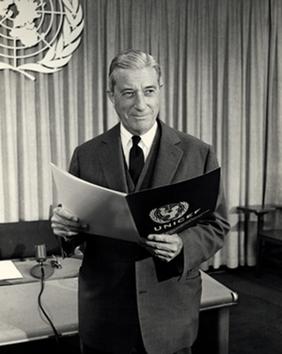
Henry Richardson Labouisse Jr. was an American diplomat and statesman. He was the third Director of the United Nations Relief and Works Agency for Palestine Refugees in the Near East (UNRWA) from 1954 to 1958. He was the director of the United Nations Children's Fund for years (1965–1979). He was also a member of the Council on Foreign Relations. A lawyer, he was United States Ambassador to France 1952–1954, as well as United States Ambassador to Greece 1962–1965. Labouisse had been the principal United States Department of State official dealing with the implementation of the Marshall Plan.

Dwight D. Eisenhower's tenure as the 34th president of the United States began with his first inauguration on January 20, 1953, and ended on January 20, 1961. Eisenhower, a Republican from Kansas, took office following a landslide victory over Democrat Adlai Stevenson in the 1952 presidential election. John F. Kennedy succeeded him after winning the 1960 presidential election.
The President's Science Advisory Committee (PSAC) was created on November 21, 1957, by President of the United States Dwight D. Eisenhower, as a direct response to the Soviet launching of the Sputnik 1 and Sputnik 2 satellites. PSAC was an upgrade and move to the White House of the Science Advisory Committee (SAC) established in 1951 by President Harry S. Truman, as part of the Office of Defense Mobilization (ODM). Its purpose was to advise the president on scientific matters in general, and those related to defense issues in particular. Eisenhower appointed James R. Killian as PSAC's first director.
Rowland Roberts Hughes (1896–1957) was a director of the United States' Office of Management and Budget from April 16, 1954, until April 1, 1956. Hughes, known for his distinctive black eye patch, was called "the logical man" in a 1956 Time Magazine cover story.

Donald Aubrey Quarles was a communications engineer, senior level executive with Bell Telephone Laboratories and Western Electric, and a top official in the United States Department of Defense during the Eisenhower Administration. He served as both Secretary of the Air Force and Deputy Secretary of Defense.
John H. Hamlin graduated from Stanford University with an A.B. in 1929. He was born in Wilkinsburg, Pennsylvania.
Karl Gottlieb Harr Jr. was an American defense policy expert.
Clarence Francis was a business executive and internationally recognized expert on food.

Gabriel Hauge was a prominent American bank executive and economist. Hauge served as assistant to the president for economic affairs during the administration of Dwight D. Eisenhower.
Henry Roemer McPhee Jr. was an American government official who was Associate Special Counsel to President Dwight D. Eisenhower.
L. Arthur Minnich was born in Lorain, Ohio, and graduated from Princeton University in 1940. After serving in the army during World War II he earned a doctorate in history from Cornell University and then taught history at Lafayette College from 1948 to 1952.
The U.S. President's Committee on Information Activities Abroad was created in 1959 by President Dwight D. Eisenhower in order to review the findings and recommendations of the Committee on International Information Activities in its report dated June 30, 1953, and consider changes in the international situation which affect the validity of the findings and recommendations in that report.
Charles F. Masterson was the Special Assistant to the President on the White House Staff during the Eisenhower Administration.
Kevin C. McCann was a biographer of Dwight D. Eisenhower and he served as president of Defiance College in Defiance, Ohio.
The U.S. Council on Foreign Economic Policy (CFEP) was a high-level organization created by President Dwight D. Eisenhower in December 1954 to coordinate the development of the foreign economic policy of the United States.
The U.S. President's Committee on International Information Activities was appointed on January 24, 1953 by President Dwight D. Eisenhower in order to survey and evaluate the government’s information and related policies and activities with particular reference to international relations and the national security. In his announcement on January 26 President Eisenhower said, "It has long been my conviction that a unified and dynamic effort in this field is essential to the security of the United States and of the peoples in the community of free nations."

John Stewart Bragdon, was a major general in the United States Army.
References
- ↑ "Van Voorhees Park", New York City Dept. of Parks and Recreation
- ↑ "The Presidential Papers of Dwight David Eisenhower" Archived 2010-12-16 at the Wayback Machine , The Eisenhower Memorial Commission