Related Research Articles
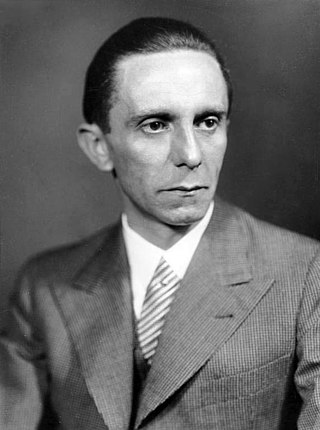
Paul Joseph Goebbels was a German Nazi politician and philologist who was the Gauleiter of Berlin, chief propagandist for the Nazi Party, and then Reich Minister of Propaganda from 1933 to 1945. He was one of Adolf Hitler's closest and most devoted followers, known for his skills in public speaking and his deeply virulent antisemitism which was evident in his publicly voiced views. He advocated progressively harsher discrimination, including the extermination of the Jews in the Holocaust.

Helene Bertha Amalie "Leni" Riefenstahl was a German film director, photographer and actress known for producing Nazi propaganda.
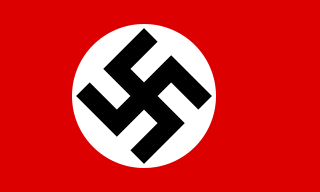
Nazi Germany, officially known as the German Reich and later the Greater German Reich, was the German state between 1933 and 1945, when Adolf Hitler and the Nazi Party controlled the country, transforming it into a totalitarian dictatorship. The Third Reich, meaning "Third Realm" or "Third Empire", referred to the Nazi claim that Nazi Germany was the successor to the earlier Holy Roman Empire (800–1806) and German Empire (1871–1918). The Third Reich, which the Nazis referred to as the Thousand-Year Reich, ended in May 1945, after only 12 years, when the Allies defeated Germany and entered the capital, Berlin, ending World War II in Europe.

Propaganda is communication that is primarily used to influence or persuade an audience to further an agenda, which may not be objective and may be selectively presenting facts to encourage a particular synthesis or perception, or using loaded language to produce an emotional rather than a rational response to the information that is being presented. Propaganda can be found in a wide variety of different contexts.

The 1936 Summer Olympics, officially the Games of the XI Olympiad and officially branded as Berlin 1936, was an international multi-sport event held from 1 to 16 August 1936 in Berlin, Germany. Berlin won the bid to host the Games over Barcelona at the 29th IOC Session on 26 April 1931. The 1936 Games marked the second and most recent time the International Olympic Committee gathered to vote in a city that was bidding to host those Games. Later rule modifications forbade cities hosting the bid vote from being awarded the games.

Baldur Benedikt von Schirach was a German politician who served as head of the Hitler Youth from 1931 to 1940. From 1940 to 1945, he was the Gauleiter and Reichsstatthalter of Vienna.
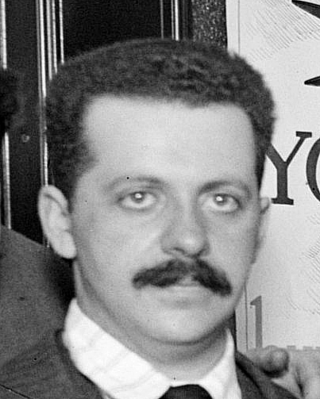
Edward Louis Bernays was an American pioneer in the field of public relations and propaganda, and referred to in his obituary as "the father of public relations". His best-known campaigns include a 1929 effort to promote female smoking by branding cigarettes as feminist "Torches of Freedom", and his work for the United Fruit Company in the 1950s, connected with the CIA-orchestrated overthrow of the democratically elected Guatemalan government in 1954. He worked for dozens of major American corporations, including Procter & Gamble and General Electric, and for government agencies, politicians, and nonprofit organizations. His uncle was psychoanalyst Sigmund Freud.
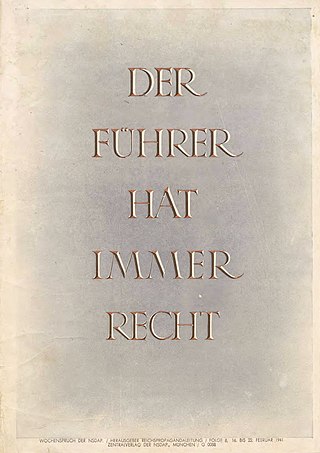
In the political history of Germany, the Führerprinzip was the basis of executive authority in the Government of Nazi Germany (1933–1945), which meant that the word of the Führer is above all written law, and that government policies, decisions, and offices all work towards the realisation of the will of the Führer. In practise, the Führerprinzip was the dictatorship of the leader to dictate the ideology and policies of a political party; therefore, such a personal dictatorship is a basic characteristic of fascism.
Operation Mockingbird is an alleged large-scale program of the United States Central Intelligence Agency (CIA) that began in the early years of the Cold War and attempted to manipulate domestic American news media organizations for propaganda purposes. According to author Deborah Davis, Operation Mockingbird recruited leading American journalists into a propaganda network and influenced the operations of front groups. CIA support of front groups was exposed when an April 1967 Ramparts article reported that the National Student Association received funding from the CIA. In 1975, Church Committee Congressional investigations revealed Agency connections with journalists and civic groups.

The Ministry of Information (MOI), headed by the Minister of Information, was a United Kingdom government department created briefly at the end of the First World War and again during the Second World War. Located in Senate House at the University of London during the 1940s, it was the central government department responsible for publicity and propaganda. The MOI was dissolved in March 1946, with its residual functions passing to the Central Office of Information (COI); which was itself dissolved in December 2011 due to the reforming of the organisation of government communications.
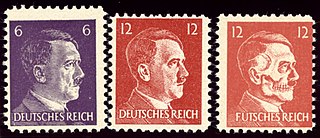
Operation Cornflakes was a morale operation by the Office of Strategic Services during World War II that aimed to trick Deutsche Reichspost into inadvertently delivering anti-Nazi propaganda to German citizens through mail.

The United States Office of War Information (OWI) was a United States government agency created during World War II. The OWI operated from June 1942 until September 1945. Through radio broadcasts, newspapers, posters, photographs, films and other forms of media, the OWI was the connection between the battlefront and civilian communities. The office also established several overseas branches, which launched a large-scale information and propaganda campaign abroad. From 1942 to 1945, the OWI reviewed film scripts, flagging material which portrayed the United States in a negative light, including anti-war sentiment.

Heinrich Hoffmann was Adolf Hitler's official photographer, and a Nazi politician and publisher, who was a member of Hitler's intimate circle. Hoffmann's photographs were a significant part of Hitler's propaganda campaign to present himself and the Nazi Party as a significant mass phenomenon. He received royalties from all uses of Hitler's image, which made him a millionaire over the course of Hitler's rule. After the Second World War he was tried and sentenced to 10 years in prison for war profiteering. He was classified by the Allies' Art Looting Investigators to be a "major offender" in Nazi art plundering of Jews, as both art dealer and collector and his art collection, which contained many artworks looted from Jews, was ordered confiscated by the Allies.
The propaganda used by the German Nazi Party in the years leading up to and during Adolf Hitler's dictatorship of Germany from 1933 to 1945 was a crucial instrument for acquiring and maintaining power, and for the implementation of Nazi policies.

In the United States, propaganda is spread by both government and non-government entities. Throughout its history, to the present day, the United States government has issued various forms of propaganda to both domestic and international audiences. The US government has instituted various domestic propaganda bans throughout its history, however, some commentators question the extent to which these bans are respected.
Jewish Bolshevism, also Judeo–Bolshevism, is an antisemitic and anti-communist conspiracy theory that claims that the Russian Revolution of 1917 was a Jewish plot and that Jews controlled the Soviet Union and international communist movements, often in furtherance of a plan to destroy Western civilization. It was one of the main Nazi beliefs that served as an ideological justification for the German invasion of the Soviet Union and the Holocaust.
Friends of New Germany, sometimes called Friends of the New Germany, was an organization founded in the United States by German immigrants to support Nazism and the Third Reich.
The Central Intelligence Agency (CIA) is a civilian foreign intelligence service of the United States federal government, tasked with gathering, processing, and analyzing national security information from around the world.

Propaganda is a form of communication that aims to shape people's beliefs, actions and behaviours. It is generally not impartial. It is often biased, misleading, or even false to promote a specific agenda or perspective. Propagandists use various techniques to manipulate people's opinions, including selective presentation of facts, the omission of relevant information, and the use of emotionally charged language.
The international Jewish conspiracy or the world Jewish conspiracy has been described as "one of the most widespread and long-running conspiracy theories". Although it typically claims that a malevolent, usually global Jewish circle, referred to as International Jewry, conspires for world domination, the theory's content is extremely variable, which helps explain its wide distribution and long duration. It was popularized in the late nineteenth and early twentieth century especially by the antisemitic forgery The Protocols of the Elders of Zion. Among the beliefs that posit an international Jewish conspiracy are Jewish Bolshevism, Cultural Marxism, Judeo-Masonic conspiracy theory, White genocide conspiracy theory and Holocaust denial. The Nazi leadership's belief in an international Jewish conspiracy that it blamed for starting World War II and controlling the Allied powers was key to their decision to launch the Final Solution.
References
- ↑ Manning, Martin (2004). Historical Dictionary of American Propaganda . Greenwood Publishing Group. pp. 64. ISBN 978-0313296055.
- ↑ Turner, Fred (2014). The Democratic Surround. Chicago: University of Chicago Press. pp. ch 2. ISBN 978-0-226-81746-0.
- ↑ Turner 2014, ch. 7.
- ↑ Hoffman, Louise (February 1992). "American Psychologists and Wartime Research on Germany, 1941-1945" (PDF). American Psychologist. 47 (2): 264–273. doi:10.1037/0003-066x.47.2.264. Archived from the original (PDF) on 2014-12-22.
 | This United States government–related article is a stub. You can help Wikipedia by expanding it. |