
Leonard Simon Nimoy was an American actor, famed for playing Spock in the Star Trek franchise for almost 50 years. This includes originating Spock in Star Trek in 1965, then Star Trek: The Animated Series, the first six Star Trek films, and Star Trek: The Next Generation. Nimoy also directed films, including Star Trek III: The Search for Spock (1984) and Star Trek IV: The Voyage Home (1986), and appeared in several films, television shows, and voice acted in several video games. His final role as Spock was in 2013.
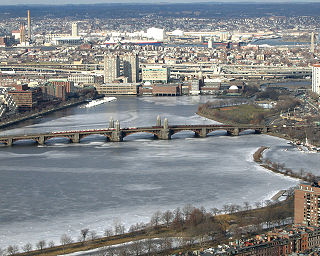
The Charles River is an 80-mile-long (129 km) river in eastern Massachusetts. It flows northeast from Hopkinton to Boston along a highly meandering route, that doubles back on itself several times and travels through 23 cities and towns before reaching the Atlantic Ocean. The indigenous Massachusett named it Quinobequin, meaning "meandering".

The Head of the Charles Regatta, also known as HOCR, is a rowing head race held on the penultimate complete weekend of October each year on the Charles River, which separates Boston and Cambridge, Massachusetts United States. It is the largest 3-day regatta in the world, with 11,000 athletes rowing in over 1,900 boats in 61 events. According to the Greater Boston Convention & Visitors Bureau, the three-day event brings 225,000 people to the Greater Boston area and $72 million to the local economy.
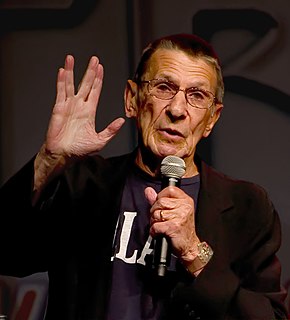
The Vulcan salute is a hand gesture popularized by the 1960s television series Star Trek. It consists of a raised hand with the palm forward and the thumb extended, while the fingers are parted between the middle and ring finger.

A Bermuda rig, Bermudian rig, or Marconi rig is a configuration of mast and rigging for a type of sailboat and is the typical configuration for most modern sailboats. This configuration was developed in Bermuda in the 1600s; the term Marconi, a reference to the inventor of the radio, Guglielmo Marconi, became associated with this configuration in the early 1900s because the wires that stabilize the mast of a Bermuda rig reminded observers of the wires on early radio masts.

Launch is a name given to several different types of boat. The wide range of usage of the name extends from utilitarian craft through to pleasure boats built to a very high standard.

The Sunfish is a personal-size, beach-launched sailing dinghy. It features a very flat, boardlike hull carrying a lateen sail mounted to an un-stayed mast.

"The Ballad of Bilbo Baggins" is a song composed by Charles Randolph Grean and performed by Leonard Nimoy, telling the story of Bilbo Baggins and his adventures in J. R. R. Tolkien's 1937 novel The Hobbit. The recording was featured on the 1968 album Two Sides of Leonard Nimoy, the second of Nimoy's albums on Dot Records. It was also released as a single in July 1967, backed with a "modern thought-image" folk song called "Cotton Candy".

America was a 19th-century racing yacht and first winner of the America's Cup international sailing trophy.

The Charles River Esplanade of Boston, Massachusetts, is a state-owned park situated in the Back Bay area of the city, on the south bank of the Charles River Basin.
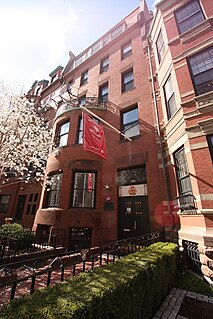
The Newman School is a private school in the Back Bay district of Boston, Massachusetts.

The USS Constitution Museum is located in the Charlestown Navy Yard, which is part of the Boston National Historical Park in Boston, Massachusetts, United States. The museum is situated near the ship USS Constitution at the end of Boston's Freedom Trail. The museum is housed in a restored shipyard building at the foot of Pier 2.

The Mugar Omni Theater is a domed IMAX theater at the Museum of Science, in Boston, Massachusetts.
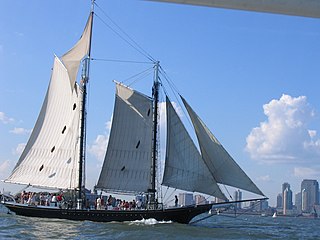
Pioneer is a restored nineteenth century schooner sailing out of South Street Seaport in New York, New York.
Bridge Island Meadows is an 80-acre (320,000 m2) nature reserve owned by The Trustees of Reservations on the floodplains of the upper Charles River in Millis, Massachusetts. The property was a 1974 gift from Dr. and Mrs. John D. Constable to the Trustees of Reservations. The property is surrounded by wetlands, and is only accessible by boat.
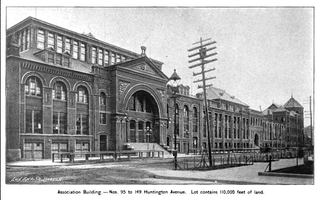
Mechanics Hall was a building and community institution on Huntington Avenue at West Newton Street, from 1881 to 1959. Commissioned by the Massachusetts Charitable Mechanic Association, it was built by the noted architect William Gibbons Preston. The building was located between the Boston and Albany railroad yards and Huntington avenue. It was razed for the Prudential Center urban renewal project of the early 1960s. The site is on the north side of Huntington Avenue, and since 1941 has been served by Prudential Station of the MBTA Green Line E branch.
The men's Laser was a sailing event on the Sailing at the 2012 Summer Olympics program in Weymouth and Portland National Sailing Academy. Eleven races were scheduled and completed. 49 sailors, on 49 boats, from 49 nations competed. Ten boats qualified for the medal race. For the medal race, the top ten boats qualified. Each position scored double points. All medal races were sailed on course area Nothe in front of Weymouth.

RMS Lady Hawkins was a steam turbine ocean liner. She was one of a class of five sister ships popularly known as "Lady Boats" that Cammell Laird of Birkenhead, England built in 1928 and 1929 for the Canadian National Steamship Company. The five vessels were Royal Mail Ships that CN operated from Halifax, Nova Scotia and the Caribbean via Bermuda. In 1942 the German submarine U-66 sank Lady Hawkins in the North Atlantic, killing 251 of the 322 people aboard.


