Related Research Articles
E-commerce is the activity of electronically buying or selling products on online services or over the Internet. E-commerce draws on technologies such as mobile commerce, electronic funds transfer, supply chain management, Internet marketing, online transaction processing, electronic data interchange (EDI), inventory management systems, and automated data collection systems. E-commerce is the largest sector of the electronics industry and is in turn driven by the technological advances of the semiconductor industry.
Purchasing power parity (PPP) is a measure of the price of specific goods in different countries and is used to compare the absolute purchasing power of the countries' currencies. PPP is effectively the ratio of the price of a market basket at one location divided by the price of the basket of goods at a different location. The PPP inflation and exchange rate may differ from the market exchange rate because of tariffs, and other transaction costs.

Shopping is an activity in which a customer browses the available goods or services presented by one or more retailers with the potential intent to purchase a suitable selection of them. A typology of shopper types has been developed by scholars which identifies one group of shoppers as recreational shoppers, that is, those who enjoy shopping and view it as a leisure activity.
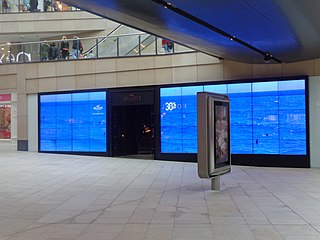
Sales are activities related to selling or the number of goods sold in a given targeted time period. The delivery of a service for a cost is also considered a sale. A period during which goods are sold for a reduced price may also be referred to as a "sale".
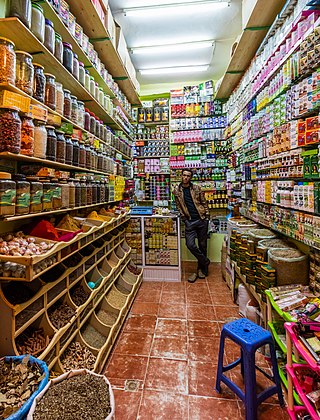
Retail is the sale of goods and services to consumers, in contrast to wholesaling, which is the sale to business or institutional customers. A retailer purchases goods in large quantities from manufacturers, directly or through a wholesaler, and then sells in smaller quantities to consumers for a profit. Retailers are the final link in the supply chain from producers to consumers.
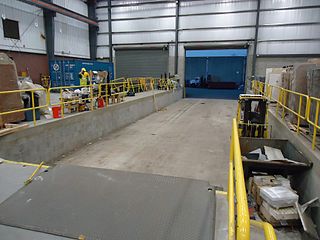
Distribution is the process of making a product or service available for the consumer or business user who needs it, and a distributor is a business involved in the distribution stage of the value chain. Distribution can be done directly by the producer or service provider or by using indirect channels with distributors or intermediaries. Distribution is one of the four elements of the marketing mix: the other three elements being product, pricing, and promotion.

Pricing is the process whereby a business sets the price at which it will sell its products and services and may be part of the business's marketing plan. In setting prices, the business will take into account the price at which it could acquire the goods, the manufacturing cost, the marketplace, competition, market condition, brand, and quality of the product.

A sales tax is a tax paid to a governing body for the sales of certain goods and services. Usually laws allow the seller to collect funds for the tax from the consumer at the point of purchase.
Merchandising is any practice which contributes to the sale of products to a retail consumer. At a retail in-store level, merchandising refers to displaying products that are for sale in a creative way that entices customers to purchase more items or products.

Consumer behaviour is the study of individuals, groups, or organisations and all the activities associated with the purchase, use and disposal of goods and services. Consumer behaviour consists of how the consumer's emotions, attitudes, and preferences affect buying behaviour. Consumer behaviour emerged in the 1940–1950s as a distinct sub-discipline of marketing, but has become an interdisciplinary social science that blends elements from psychology, sociology, social anthropology, anthropology, ethnography, ethnology, marketing, and economics.

In economics, a luxury good is a good for which demand increases more than what is proportional as income rises, so that expenditures on the good become a more significant proportion of overall spending. Luxury goods are in contrast to necessity goods, where demand increases proportionally less than income. Luxury goods is often used synonymously with superior goods.

Online shopping is a form of electronic commerce which allows consumers to directly buy goods or services from a seller over the Internet using a web browser or a mobile app. Consumers find a product of interest by visiting the website of the retailer directly or by searching among alternative vendors using a shopping search engine, which displays the same product's availability and pricing at different e-retailers. As of 2020, customers can shop online using a range of different computers and devices, including desktop computers, laptops, tablet computers and smartphones.
In statistics, economics, and finance, an index is a statistical measure of change in a representative group of individual data points. These data may be derived from any number of sources, including company performance, prices, productivity, and employment. Economic indices track economic health from different perspectives. Examples include the consumer price index, which measures changes in retail prices paid by consumers, and the cost-of-living index (COLI), which measures the relative cost of living over time.

Fast-moving consumer goods (FMCG), also known as consumer packaged goods (CPG) or convenience goods, are products that are sold quickly and at a relatively low cost. Examples include non-durable household goods such as packaged foods, beverages, toiletries, candies, cosmetics, over-the-counter drugs, dry goods, and other consumables.
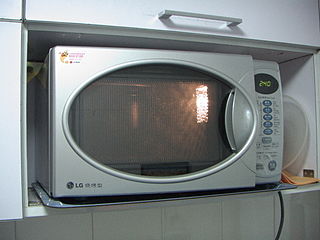
A final good or consumer good is a final product ready for sale that is used by the consumer to satisfy current wants or needs, unlike an intermediate good, which is used to produce other goods. A microwave oven or a bicycle is a final good.
An online marketplace is a type of e-commerce website where product or service information is provided by multiple third parties. Online marketplaces are the primary type of multichannel ecommerce and can be a way to streamline the production process.

Visual merchandising is the practice in the retail industry of optimizing the presentation of products and services to better highlight their features and benefits. The purpose of such visual merchandising is to attract, engage, and motivate the customer towards making a purchase.
Speciality goods are a class of consumer goods. Consumer goods can be categorized into convenience goods, shopping goods, and specialty goods. The classification scheme is based on the way consumers purchase. This system is based on the definition that convenience and speciality goods are both purchased with a predetermined pattern in mind. In the case of the convenience good, the pattern is that the most accessible brand will be purchased; in the case of a speciality good, the pattern is that only a specific brand will be purchased. For example, if the customer utilizes an outlet because it is the most accessible, it would be considered, for that customer at least, a convenience store; while one in which the consumer shops even if he has to go considerably out of his way to reach it, would be considered a speciality store. A shopping good is one in which the consumer does not have a predetermined pattern in mind. Likewise, a shopping store is one which the consumer will undertake a search to select a store to patronize.

Omnichannel retail strategy, originally also known in the U.K. as bricks and clicks, is a business model by which a company integrates both offline (bricks) and online (clicks) presences, sometimes with the third extra flips.
The retail format influences the consumer's store choice and addresses the consumer's expectations. At its most basic level, a retail format is a simple marketplace, that is; a location where goods and services are exchanged. In some parts of the world, the retail sector is still dominated by small family-run stores, but large retail chains are increasingly dominating the sector, because they can exert considerable buying power and pass on the savings in the form of lower prices. Many of these large retail chains also produce their own private labels which compete alongside manufacturer brands. Considerable consolidation of retail stores has changed the retail landscape, transferring power away from wholesalers and into the hands of the large retail chains.
References
- 1 2 3 4 5 "How and why is retail changing?", BBC Bitesize . Retrieved 26 August 2020.
- 1 2 3 "Comparison goods" Archived 2020-09-22 at the Wayback Machine , BusinessDictionary. Retrieved 26 August 2020.