| Club information | |
|---|---|
| Established | 1976 |
| Type | public |
| Total holes | 18 [1] |
| Website | https://www.cooberpedygolfclub.com.au/ |
| Par | 72 |
Coober Pedy Opal Fields Golf Club is an 18-hole golf course that was constructed in Coober Pedy. [2]
The local golf course – mostly played at night with glowing balls, to avoid daytime heat – is completely free of grass, and golfers take a small piece of "turf" around to use for teeing off. As a result of correspondence between the two clubs, the Coober Pedy Opal Fields Golf Club is the only club in the world to enjoy reciprocal rights at The Royal and Ancient Golf Club of St Andrews. [3]

Opal is a hydrated amorphous form of silica (SiO2·nH2O); its water content may range from 3% to 21% by weight, but is usually between 6% and 10%. Due to its amorphous property, it is classified as a mineraloid, unlike crystalline forms of silica, which are considered minerals. It is deposited at a relatively low temperature and may occur in the fissures of almost any kind of rock, being most commonly found with limonite, sandstone, rhyolite, marl, and basalt.

Coober Pedy is a town in northern South Australia, 846 km (526 mi) north of Adelaide on the Stuart Highway. The town is sometimes referred to as the "opal capital of the world" because of the quantity of precious opals that are mined there. A blower truck is raised above the town sign, representing the importance of opal mining to the town's history. Coober Pedy is also renowned for its below-ground dwellings, called "dugouts", which are built in this fashion due to the scorching daytime heat.
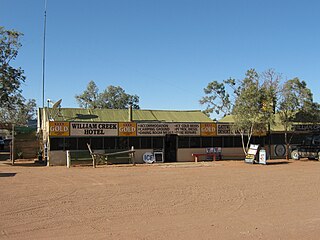
William Creek, Australia is located halfway on the Oodnadatta Track, 210 km (130 mi) north west of Marree and 166 km (103 mi) east of Coober Pedy in South Australia. The town has a permanent population of 10. William Creek is in the federal Division of Grey and the state electorate of Stuart. It is outside of council areas, and administered by the Outback Communities Authority.

The Amazing Race 2 is the second season of the American reality competition show The Amazing Race. Hosted by Phil Keoghan, it featured eleven teams of two, each with a pre-existing relationship, competing in a race around the world to win US$1,000,000. This season visited five continents and eight countries and traveled over 52,000 miles (84,000 km) during thirteen legs. Starting in Pahrump, Nevada, racers traveled through Brazil, South Africa, Namibia, Thailand, Hong Kong, Australia, New Zealand, Hawaii, and Alaska before finishing in the San Francisco Bay Area. The season premiered on CBS on March 11, 2002, and ended on May 15, 2002.

Anne Beadell Highway is an outback unsealed track linking Coober Pedy, South Australia, and Laverton, Western Australia, a total distance of 1,325 km (823 mi). The track was surveyed and built by Len Beadell, Australian surveyor, who named it after his wife.

Umoonasaurus is an extinct genus of plesiosaur belonging to the family Leptocleididae. This genus lived approximately 115 million years ago during the Early Cretaceous period, in shallow seas covering parts of what is now Australia. It was a relatively small animal around 2.5 metres (8.2 ft) long. An identifying trait of Umoonasaurus is three crest-ridges on its skull.
Opal Dream is a 2006 Australian drama film, based on the 2000 Ben Rice novella Pobby and Dingan, directed by Peter Cattaneo and starring an ensemble cast including Vince Colosimo, Jacqueline McKenzie, Christian Byers and Sapphire Boyce. It was filmed on location around South Australia, in Adelaide, Coober Pedy and Woomera. Opal Dream was released in Australia on 28 September 2006, with eventual release around the world.
Coober Pedy Airport serves the opal mining town of Coober Pedy in outback South Australia. It is located southwest of the township. The airfield, which was renamed Redstone Airport in-game, was featured in the 2016 racing video game Forza Horizon 3 on the Xbox One and is often used for drag races.
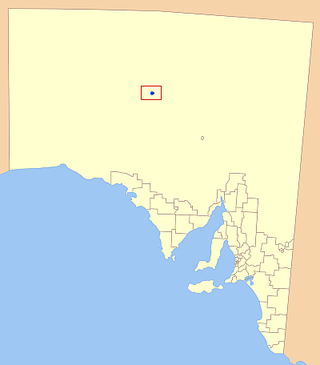
The District Council of Coober Pedy is a local government area located around the opal mining town of the same name in Outback South Australia. The district's economy is based on the large opal deposits found beneath it, which have made it a major mining centre and also a popular tourist destination.
Mintabie is an opal mining community in the Anangu Pitjantjatjara Yankunytjatjara in South Australia. It was unique in comparison to other communities situated in the APY Lands, in that its residents were largely not of Aboriginal Australian origin, and the land had been leased to the Government of South Australia for opal mining purposes since the 1980s.
The Kanku-Breakaways Conservation Park, formerly known as The Breakaways Reserve or simply The Breakaways, is a protected area in northern South Australia, just off the Stuart Highway 33 km (21 mi) north of Coober Pedy.

The Coober Pedy Oodnadatta One Day Mail Run is a 4WD mail service in the outback of South Australia.
The Coober Pedy Solar Power Station was planned to be Australia's largest off-grid solar power station, located at remote Coober Pedy in South Australia's far north. The project would cost $7.1 million and the Australian Government promised providing $3.55 million under its Renewable Remote Power Generation program. When completed at the end of 2009, the power station was to consist of 26 solar dishes, each one 14 metres high, which would track the arc of the Sun. The power plant was to generate about 1860 megawatt-hours per year, 13 per cent of Coober Pedy's total electricity requirements. It would cut Diesel fuel consumption by up to 520,000 litres a year, saving 1,500 tonnes of greenhouse gas emissions.
The Olympic Australis opal is the largest and most valuable opal yet found and was valued at A$2,500,000 in 1997. It was found in 1956 at the 'Eight Mile' opal field near the town of Coober Pedy in South Australia.
The Fire in the Stone is a 1984 Australian made for television drama about teenagers in the town of Coober Pedy. It is based on the 1973 novel of the same name by Colin Thiele.

The Church of Saint Elijah the Prophet is the Serbian Orthodox church in Coober Pedy, South Australia, built in 1993 and is dedicated to Saint Elijah. It belongs to the Serbian Orthodox Eparchy of Australia and New Zealand. The church is a popular tourist attraction because of its underground location. The whole church complex, with a church, a community hall, a parish house and a religious school, is carved in the sandstone between 3 and 17 metres under the ground level.
The Fire of Australia opal is a 998 gram uncut opal mined by Walter Bartram in 1946 at the Eight Mile field in Coober Pedy, South Australia.
Elsie "Ma" May Jenkins was an opal and mica miner who worked at Lightning Ridge and Coober Pedy in South Australia and Alice Springs in the Northern Territory of Australia. She is best known as the "Opal Queen" referencing her impressive opal collection.
Manguri Siding is located in the Adelaide–Darwin rail corridor at the locality of Mount Clarence Station, about 42 kilometres (26 mi) west of the opal mining town of Coober Pedy.
