Analogy
Various authors and theorists have evoked Copernican heliocentrism to describe tiers of government. Here an analogy is made between the hierarchical organization of the solar system and governments within a nation. There are various approaches.
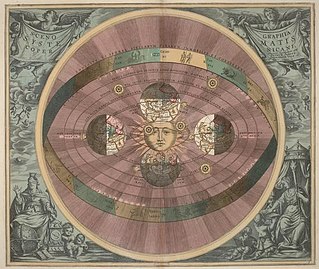
Heliocentrism is the astronomical model in which the Earth and planets revolve around the Sun at the center of the Solar System. Historically, heliocentrism was opposed to geocentrism, which placed the Earth at the center. The notion that the Earth revolves around the Sun had been proposed as early as the 3rd century BC by Aristarchus of Samos, but at least in the medieval world, Aristarchus's heliocentrism attracted little attention—possibly because of the loss of scientific works of the Hellenistic Era.
A government is the system or group of people governing an organized community, often a state.
A hierarchy is an arrangement of items in which the items are represented as being "above", "below", or "at the same level as" one another. Hierarchy is an important concept in a wide variety of fields, such as philosophy, mathematics, computer science, organizational theory, systems theory, and the social sciences.
The most common approach describes the Sun as analogous to a federal government and the states and other administrative divisions as planets. Thomas Jefferson wrote that the U.S. states were "like the planets revolving round their common sun, acting and acted upon according to their respective weights and distances," Alexander Hamilton invoked a similar analogy in Federalist No. 9, using the word "orbit." Jefferson used the analogy to emphasize the systematic, self-balancing nature of the new United States Constitution. The analogy is also employed in an attempt to borrow Copernican simplicity as compared to Ptolemaic complexity. The implication here is that federal structures are more practicable than having many-to-many relationships.

The Sun is the star at the center of the Solar System. It is a nearly perfect sphere of hot plasma, with internal convective motion that generates a magnetic field via a dynamo process. It is by far the most important source of energy for life on Earth. Its diameter is about 1.39 million kilometers, or 109 times that of Earth, and its mass is about 330,000 times that of Earth. It accounts for about 99.86% of the total mass of the Solar System. Roughly three quarters of the Sun's mass consists of hydrogen (~73%); the rest is mostly helium (~25%), with much smaller quantities of heavier elements, including oxygen, carbon, neon, and iron.

An administrative division, unit, entity, area or region, also referred to as a subnational entity, statoid, constituent unit, or country subdivision, is a portion of a country or other region delineated for the purpose of administration. Administrative divisions are granted a certain degree of autonomy and are usually required to manage themselves through their own local governments. Countries are divided up into these smaller units to make managing their land and the affairs of their people easier. A country may be divided into provinces, which, in turn, may be divided in whole or in part into municipalities.

A planet is an astronomical body orbiting a star or stellar remnant that is massive enough to be rounded by its own gravity, is not massive enough to cause thermonuclear fusion, and has cleared its neighbouring region of planetesimals.
Some theorists have used the analogy in the context of improving international relations, for example Emery Reves in The Anatomy of Peace: "Our political and social conceptions are Ptolemaic. The world in which we live is Copernican."
Emery Reves was a writer, publisher, literary agent and advocate of world federalism.
The Anatomy of Peace was a book by Emery Reves, first published in 1945. It expressed the world federalist sentiments shared by Albert Einstein and many others in the late 1940s, in the period immediately following World War II.

In physical cosmology, the Copernican principle states that humans, on the Earth or in the Solar System, are not privileged observers of the universe.
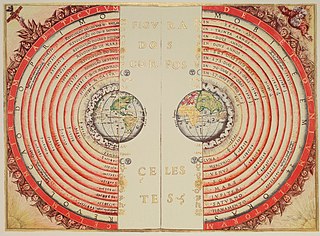
In astronomy, the geocentric model is a superseded description of the Universe with Earth at the center. Under the geocentric model, the Sun, Moon, stars, and planets all orbited Earth. The geocentric model served as the predominant description of the cosmos in many ancient civilizations, such as those of Aristotle and Ptolemy.
In the Hipparchian and Ptolemaic systems of astronomy, the epicycle was a geometric model used to explain the variations in speed and direction of the apparent motion of the Moon, Sun, and planets. In particular it explained the apparent retrograde motion of the five planets known at the time. Secondarily, it also explained changes in the apparent distances of the planets from the Earth.

The "Letter to The Grand Duchess Christina" is an essay written in 1615 by Galileo Galilei. The intention of this letter was to accommodate Copernicanism with the doctrines of the Catholic Church. Galileo tried to use the ideas of Church Fathers and Doctors to show that the condemnation of Copernicanism would be inappropriate.
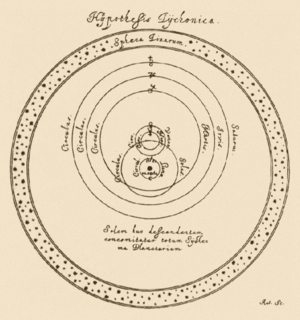
The Tychonic system is a model of the Solar System published by Tycho Brahe in the late 16th century, which combines what he saw as the mathematical benefits of the Copernican system with the philosophical and "physical" benefits of the Ptolemaic system. The model may have been inspired by Valentin Naboth and Paul Wittich, a Silesian mathematician and astronomer. A similar model was implicit in the calculations a century earlier by Nilakantha Somayaji of the Kerala school of astronomy and mathematics.

Nicolaus Copernicus was a Renaissance-era mathematician and astronomer who formulated a model of the universe that placed the Sun rather than the Earth at the center of the universe, in all likelihood independently of Aristarchus of Samos, who had formulated such a model some eighteen centuries earlier.

The celestial spheres, or celestial orbs, were the fundamental entities of the cosmological models developed by Plato, Eudoxus, Aristotle, Ptolemy, Copernicus, and others. In these celestial models, the apparent motions of the fixed stars and planets are accounted for by treating them as embedded in rotating spheres made of an aetherial, transparent fifth element (quintessence), like jewels set in orbs. Since it was believed that the fixed stars did not change their positions relative to one another, it was argued that they must be on the surface of a single starry sphere.

Equant is a mathematical concept developed by Claudius Ptolemy in the 2nd century AD to account for the observed motion of the planets. The equant is used to explain the observed speed change in planetary orbit during different stages of the orbit. This planetary concept allowed Ptolemy to keep the theory of uniform circular motion alive by stating that the path of heavenly bodies was uniform around one point and circular around another point.

De revolutionibus orbium coelestium is the seminal work on the heliocentric theory of the astronomer Nicolaus Copernicus (1473–1543) of the Polish Renaissance. The book, first printed in 1543 in Nuremberg, Holy Roman Empire, offered an alternative model of the universe to Ptolemy's geocentric system, which had been widely accepted since ancient times.

ʿAbu al-Ḥasan Alāʾ al‐Dīn ʿAlī ibn Ibrāhīm al-Ansari known as Ibn al-Shatir or Ibn ash-Shatir was a Syrian Arab astronomer, mathematician and engineer. He worked as muwaqqit in the Umayyad Mosque in Damascus and constructed a sundial for its minaret in 1371/72.
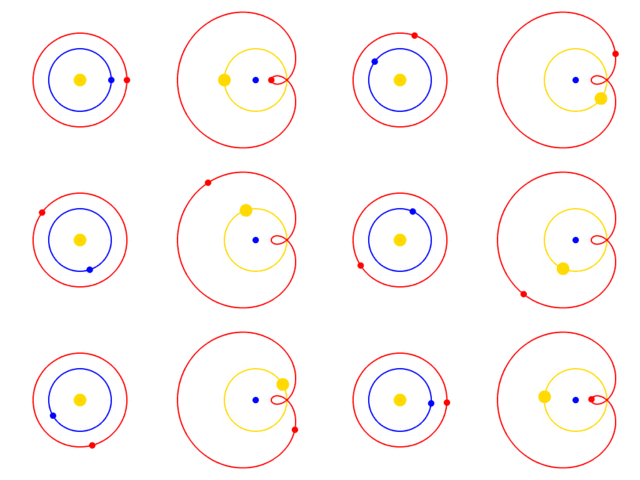
The Copernican Revolution was the paradigm shift from the Ptolemaic model of the heavens, which described the cosmos as having Earth stationary at the center of the universe, to the heliocentric model with the Sun at the center of the Solar System. Beginning with the publication of Nicolaus Copernicus’s De revolutionibus orbium coelestium, contributions to the “revolution” continued until finally ending with Isaac Newton’s work over a century later.

During the Renaissance, great advances occurred in geography, astronomy, chemistry, physics, mathematics, manufacturing, anatomy and engineering. The rediscovery of ancient scientific texts was accelerated after the Fall of Constantinople in 1453, and the invention of printing democratized learning and allowed a faster propagation of new ideas. But, at least in its initial period, some see the Renaissance as one of scientific backwardness. Historians like George Sarton and Lynn Thorndike have criticized how the Renaissance affected science, arguing that progress was slowed for some amount of time. Humanists favored human-centered subjects like politics and history over study of natural philosophy or applied mathematics. Others have focused on the positive influence of the Renaissance, pointing to factors like the rediscovery of lost or obscure texts and the increased emphasis on the study of language and the correct reading of texts.
Dual federalism, also known as layer-cake federalism or divided sovereignty, is a political arrangement in which power is divided between the federal and state governments in clearly defined terms, with state governments exercising those powers accorded to them without interference from the federal government. Dual federalism is defined in contrast to cooperative federalism, in which federal and state governments collaborate on policy.
Cooperative federalism, also known as marble-cake federalism, is a concept of federalism in which national, state, and local governments interact cooperatively and collectively to solve common problems, rather than making policies separately but more or less equally or clashing over a policy in a system dominated by the national government.

The Commentariolus is Nicolaus Copernicus's brief outline of an early version of his revolutionary heliocentric theory of the universe. After further long development of his theory, Copernicus published the mature version in 1543 in his landmark work, De revolutionibus orbium coelestium.

Copernican heliocentrism is the name given to the astronomical model developed by Nicolaus Copernicus and published in 1543. It positioned the Sun near the center of the Universe, motionless, with Earth and the other planets orbiting around it in circular paths modified by epicycles and at uniform speeds. The Copernican model displaced the geocentric model of Ptolemy that had prevailed for centuries, placing Earth at the center of the Universe. It is often regarded as the launching point to modern astronomy and the Scientific Revolution.
The center of the Universe is a concept that lacks a coherent definition in modern astronomy; according to standard cosmological theories on the shape of the universe, it has no center.
Venus has an orbit with a semi-major axis of 0.723 au, and an eccentricity of 0.007. The low eccentricity and comparatively small size of its orbit give Venus the least range in distance between perihelion and aphelion of the planets: 1.46 Gm. The planet orbits the Sun once every 225 days and travels 4.54 au in doing so, giving an average orbital speed of 35 km/s (78,000 mph).