Related Research Articles
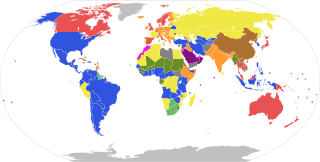
Constitutional monarchy, also known as limited monarchy, parliamentary monarchy or democratic monarchy, is a form of monarchy in which the monarch exercises their authority in accordance with a constitution and is not alone in making decisions. Constitutional monarchies differ from absolute monarchies in that they are bound to exercise powers and authorities within limits prescribed by an established legal framework.
A head of state is the public persona of a sovereign state. The specific naming of the head of state depends on the country's form of government and separation of powers, the head of state may be a ceremonial figurehead or concurrently the head of government and more.
Republicanism in Australia is a movement to change Australia's system of government from a constitutional parliamentary monarchy to a republic, typically a parliamentary republic that would replace the monarch of Australia with a non-royal Australian head of State, as opposed to monarchism in Australia. Republicanism was first espoused in Australia before Federation in 1901. After a period of decline after Federation, the movement again became prominent at the end of the 20th century after successive legal and socio-cultural changes loosened Australia's ties with the United Kingdom.
The Republic Advisory Committee was a committee established by the then Australian Prime Minister Paul Keating in April 1993 to examine the constitutional and legal issues that would arise were Australia to become a republic. The committee's mandate was to "prepare an options paper describing 'the minimum constitutional changes necessary to achieve a viable Federal Republic of Australia, maintaining the effect of our current conventions and principles of government'." The committee was asked to consider issues such as
In a parliamentary or semi-presidential system of government, a reserve power, also known as discretionary power, is a power that may be exercised by the head of state without the approval of another branch or part of the government. Unlike in a presidential system of government, the head of state is generally constrained by the cabinet or the legislature in a parliamentary system, and most reserve powers are usable only in certain exceptional circumstances.
George Graham Winterton was an Australian academic specialising in Australian constitutional law. Winterton taught for 28 years at the University of New South Wales before taking up an appointment of Professor of Constitutional Law at the University of Sydney in 2004.

The Australian Republic Movement (ARM) is a non-partisan organisation campaigning for Australia to become a republic. ARM and its supporters have promoted various models of a republic including parliamentary republic and it is, again, reviewing its preferred model.
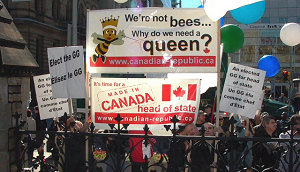
Canadian republicanism is a movement for the replacement of the monarchy of Canada and a monarch as head of state with a parliamentary republic and a democratically-selected Canadian as head of state. Republicans are driven by various factors, such as a perception of inequality in the concept of excluding all but members of the royal family from the position or the argument that Canadian independence will not be achieved until Canadians can choose their own head of state independently and democratically.
The McGarvie model is a proposition for change to the Australian Constitution to remove references to the monarchy and establish a republic. It is also known as the Australian Democracy Model.

The Australian republic referendum held on 6 November 1999 was a two-question referendum to amend the Constitution of Australia. The first question asked whether Australia should become a republic, with a president appointed by Parliament following a bi-partisan appointment model which had been approved by a half-elected, half-appointed Constitutional Convention held in Canberra in February 1998. The second question, generally deemed to be far less important politically, asked whether Australia should alter the Constitution to insert a preamble. Since the early 1990s opinion polls had suggested that a majority of the electorate favoured a republic in principle. Nonetheless, the republic referendum was defeated.
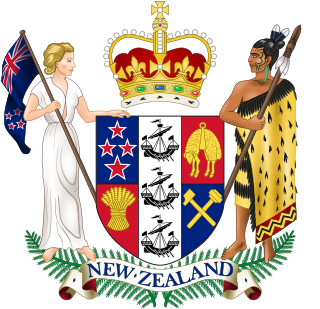
Republicanism in New Zealand is the political position that New Zealand's system of government should be changed from a constitutional monarchy to a republic.
The Bi-partisan appointment republican model was a proposal for Australian constitutional reform. If approved at referendum, the model would have established Australia as a republic with a Head of State appointed by the Australian Federal Parliament. The model was put to the people at the November 1999 republican referendum and was defeated by 54.4% of voters.
A direct election republican model is a proposal for Australian constitutional reform. If a proposal of this type were approved at a referendum, it would establish Australia as a republic with a head of state chosen directly by the Australian electorate.
A process model is, in the context of the republic debate in Australia, a model for the process by which the questions surrounding whether and how Australia should become a republic may be answered. A number of process models have been processed. Proposed process models are a subject of debate within the Republicanism movement. Such debate usually surrounds whether the people should be asked to choose between the current system and a general republican system of government, one specific republican system of government, or multiple alternative republican systems of government.

The monarchy of Australia is a key component of Australia's form of government, embodied by the Australian sovereign and head of state. The Australian monarchy is a constitutional one, modelled on the Westminster system of parliamentary government, while incorporating features unique to the constitution of Australia.
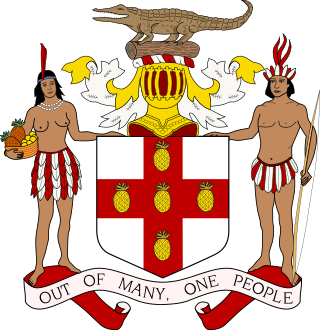
The monarchy of Jamaica is a system of government in which a hereditary monarch is the sovereign and head of state of Jamaica. The current Jamaican monarch and head of state, since 8 September 2022, is King Charles III. As sovereign, he is the personal embodiment of the Jamaican Crown. Although the person of the sovereign is equally shared with 14 other independent countries within the Commonwealth of Nations, each country's monarchy is separate and legally distinct. As a result, the current monarch is officially titled King of Jamaica and, in this capacity, he and other members of the royal family undertake public and private functions domestically and abroad as representatives of the Jamaican state. However, the monarch is the only member of the royal family with any constitutional role.
On 30 November 2021, Barbados transitioned from a parliamentary constitutional monarchy under the hereditary monarch of Barbados to a parliamentary republic with a ceremonial indirectly elected president as head of state. The prime minister remained head of government while the last governor-general, Dame Sandra Mason, was elected as the country's first president on 20 October 2021, and took office on 30 November 2021.
The Australian head of state dispute is a debate as to who is considered to be the head of state of Australia—the monarch, the governor-general, or both. "Head of state" is a description used in official sources for the monarch, but the Australian constitution does not mention the term. In discussion it has been used for describing the person who holds the highest rank among the officers of government. A number of writers, most notably Sir David Smith, have argued that the term is better used to describe the governor-general. The difference of opinion has mainly been discussed in the context of Australia becoming a republic, and was prominently debated in the lead-up to the republic referendum in 1999.
The 1998 Australian Constitutional Convention was a Constitutional Convention which gathered at Old Parliament House, Canberra from 2 to 13 February 1998. It was called by the Howard government to discuss whether Australia should become a republic. The convention concluded with "in principle support" for an Australian republic and proposed a model involving appointment of the head of state by Parliament. The model was put to a referendum in November 1999 and rejected by the Australian electorate.
Publications by or about George Winterton, Australian legal scholar.
References
- The road to a republic, Chapter 7, Report by the Senate Legal and Constitutional Committee's Inquiry into an Australian republic, August 2004.
- Copernican Republic Forum, Articles and forum about the Copernican Paradigm and related republican models.
- The Copernican Gazette, Issue 1, newsletter of the Copernican Group, April 2006.
- Proof Committee Hansard, Senate Legal and Constitutional References Committee about one Copernican republic model, 13 April 2004.
- Democracy - choosing Australia's republic by Richard E. McGarvie, 1999. Discussion of republican models by a former Governor of Victoria.
- Hybrid Republic Model wiki for a Copernican model where the Crown of Australia is democratised, 4 February, 2017.
- Honorary President Model - a full implementation of the Copernican Paradigm examined by a Senate Committee in 2004.