This page is based on this
Wikipedia article Text is available under the
CC BY-SA 4.0 license; additional terms may apply.
Images, videos and audio are available under their respective licenses.

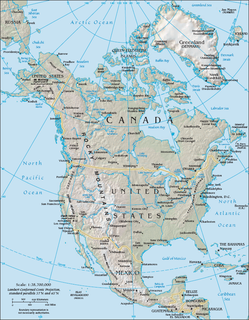
The Pacific Coast Ranges, are the series of mountain ranges that stretch along the West Coast of North America from Alaska south to Northern and Central Mexico.
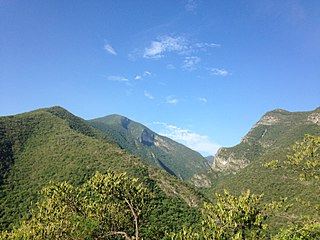
The Sierra Madre Oriental is a mountain range in northeastern Mexico. The Sierra Madre Oriental is part of the American Cordillera, a chain of mountain ranges (cordillera) that consists of an almost continuous sequence of mountain ranges that form the western "backbone" of North America, Central America, South America and Antarctica.

The American Cordillera is a chain of mountain ranges (cordilleras) that consists of an almost continuous sequence of mountain ranges that form the western "backbone" of North America, South America and West Antarctica. It is also the backbone of the volcanic arc that forms the eastern half of the Pacific Ring of Fire.
Central Cordillera refers to the New Guinea Highlands.
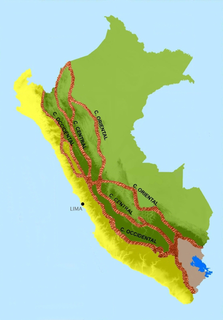
The Cordillera Real is a chain of mountains in the Andes of Ecuador, the largest of them volcanic. They are continued by the Cordillera Central of Peru to the south and the Cordillera Central of Colombia to the north. The Cordillera Real includes Antisana, Cotopaxi, and Cayambe, while Chimborazo is in the Cordillera Occidental.

The Cordillera Oriental is the widest of the three branches of the Colombian Andes. The range extends from south to north dividing from the Colombian Massif in Huila Department to Norte de Santander Department where it splits into the Serranía del Perijá and the Cordillera de Mérida in Venezuelan Andes. The highest peak is Ritacuba Blanco at 5,410 m (17,750 ft) in the Sierra Nevada del Cocuy.

The Cordillera Oriental or Eastern Cordillera is a set of parallel mountain ranges of the Bolivian Andes, emplaced on the eastern and north eastern margin of the Andes. Large parts of Cordillera Oriental are forested and humid areas rich in agricultural and livestock products. Geologically, the Cordillera Oriental is formed by the Central Andean fold and thrust belt.

The Cordillera Occidental or Western Cordillera of Bolivia is part of the Andes, a mountain range characterized by volcanic activity, making up the natural border with Chile and starting in the north with Juqhuri and ending in the south at the Licancabur volcano, which is on the southern limit of Bolivia with Chile. The border goes through the innominated point located at two thirds of elevation of Licancabur's northeastern slope at the southwestermost point of Bolivia at 22° 49' 41" south and 67° 52' 35" west. The climate of the region is cold and inadequate for animal and plant life. Its main feature is its ground, in which are large quantities of metallic minerals including gold, silver, copper, and others. The range consists of three sections:

The Cordillera Central is a Bolivian mountain range that divides the three river basins in the country and also has the second highest peaks in Bolivia. It is rich in minerals and starts in the north with Chawpi Urqu and the three Palumanis that were in the south up to Zapaleri, forming a border with Chile and Argentina. The Cordillera Central is divided into three sections:

Geology of Colombia refers to the geological composition of the Republic of Colombia that determines its geography. Most of the emerged territory of Colombia covers vast areas within the South American plate, whereas much submerged territory lies within the Caribbean plate and the Nazca plate.
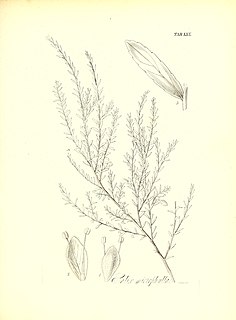
Salix taxifolia, the yewleaf or yew-leaf willow, is a species of willow native to all of southern Mexico, also Pacific Coast regions, north to Sinaloa, and in the south Pacific Coast of Mexico into central Guatemala. Scattered populations are also reported from northern Mexico and from the US states of Texas, New Mexico, and Arizona.

Salix bonplandiana, , is a perennial species of willow tree native to southern and southwest Mexico and extending into central Guatemala; in western Mexico it is a tree of the Sierra Madre Occidental cordillera, but also occurring in other small locales, for example Baja California Sur, northern Sonora, San Luis Potosi, etc. A core disjunct area occurs in central and southeast Arizona, in advantageous locales, especially associated with higher elevations and water.

Frangula betulifolia, the birchleaf buckthorn, is a shrub or small tree in the buckthorn family, Rhamnaceae. It is native in northern Mexico in the Sierra Madre Occidental cordillera, and mountainous, desert regions of the Southwestern United States of Arizona, Utah, New Mexico, and far west Texas; besides being found in Sonora, Chihuahua and Durango of the Occidental cordillera, a large species locale occurs to the east in Nuevo León.
Western Cordilleras can refer to