Related Research Articles
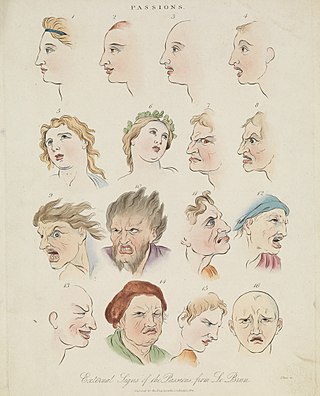
Emotions are physical and mental states brought on by neurophysiological changes, variously associated with thoughts, feelings, behavioral responses, and a degree of pleasure or displeasure. There is no scientific consensus on a definition. Emotions are often intertwined with mood, temperament, personality, disposition, or creativity.
The triangular theory of love is a theory of love developed by Robert Sternberg. In the context of interpersonal relationships, "the three components of love, according to the triangular theory, are an intimacy component, a passion component, and a commitment component."
Coping refers to conscious or unconscious strategies used to reduce and manage unpleasant emotions. Coping strategies can be cognitions or behaviors and can be individual or social. To cope is to deal with struggles and difficulties in life. It is a way for people to maintain their mental and emotional well-being. Everybody has ways of handling difficult events that occur in life, and that is what it means to cope. Coping can be healthy and productive, or destructive and unhealthy. It is recommended that an individual cope in ways that will be beneficial and healthy. "Managing your stress well can help you feel better physically and psychologically and it can impact your ability to perform your best."

Homesickness is the distress caused by being away from home. Its cognitive hallmark is preoccupying thoughts of home and attachment objects. Sufferers typically report a combination of depressive and anxious symptoms, withdrawn behavior and difficulty focusing on topics unrelated to home. Experienced by children and adults, the affected person may be taking a short trip to a nearby place, such as summer camp, or they may be taking a long trip or have moved to a different country.
An emotional expression is a behavior that communicates an emotional state or attitude. It can be verbal or nonverbal, and can occur with or without self-awareness. Emotional expressions include facial movements like smiling or scowling, simple behaviors like crying, laughing, or saying "thank you," and more complex behaviors like writing a letter or giving a gift. Individuals have some conscious control of their emotional expressions; however, they need not have conscious awareness of their emotional or affective state in order to express emotion.
Self-regulation theory (SRT) is a system of conscious, personal management that involves the process of guiding one's own thoughts, behaviors and feelings to reach goals. Self-regulation consists of several stages. In the stages individuals must function as contributors to their own motivation, behavior, and development within a network of reciprocally interacting influences.
Surprise is a rapid, fleeting, mental and physiological state. It is related to the startle response experienced by animals and humans as the result of an unexpected event.
Obsessive relational intrusion (ORI) occurs when someone knowingly and repeatedly invades another person's privacy boundaries by using intrusive tactics to try to get closer to that person. It includes behaviors such as repeated calls and texts, malicious contact, spreading rumors, stalking, and violence.

Richard S. Lazarus was an American psychologist who began rising to prominence in the 1960s. A Review of General Psychology survey, published in 2002, ranked Lazarus as the 80th most cited psychologist of the 20th century. He was well renowned for his theory of cognitive-mediational theory within emotion.
In psychology, the theory of attachment can be applied to adult relationships including friendships, emotional affairs, adult romantic and carnal relationships and, in some cases, relationships with inanimate objects. Attachment theory, initially studied in the 1960s and 1970s primarily in the context of children and parents, was extended to adult relationships in the late 1980s. The working models of children found in Bowlby's attachment theory form a pattern of interaction that is likely to continue influencing adult relationships.
Appraisal theory is the theory in psychology that emotions are extracted from our evaluations of events that cause specific reactions in different people. Essentially, our appraisal of a situation causes an emotional, or affective, response that is going to be based on that appraisal. An example of this is going on a first date. If the date is perceived as positive, one might feel happiness, joy, giddiness, excitement, and/or anticipation, because they have appraised this event as one that could have positive long-term effects, i.e. starting a new relationship, engagement, or even marriage. On the other hand, if the date is perceived negatively, then our emotions, as a result, might include dejection, sadness, emptiness, or fear. Reasoning and understanding of one's emotional reaction becomes important for future appraisals as well. The important aspect of the appraisal theory is that it accounts for individual variability in emotional reactions to the same event.
Emotionally focused therapy and emotion-focused therapy (EFT) are related humanistic approaches to psychotherapy that aim to resolve emotional and relationship issues with individuals, couples, and families. These therapies combine experiential therapy techniques, including person-centered and Gestalt therapies, with systemic therapy and attachment theory. The central premise is that emotions influence cognition, motivate behavior, and are strongly linked to needs. The goals of treatment include transforming maladaptive behaviors, such as emotional avoidance, and developing awareness, acceptance, expression, and regulation of emotion and understanding of relationships. EFT is usually a short-term treatment.

Determination is a positive emotional feeling that promotes persevering towards a difficult goal in spite of obstacles. Determination occurs prior to goal attainment and serves to motivate behavior that will help achieve one's goal.
Emotion classification, the means by which one may distinguish or contrast one emotion from another, is a contested issue in emotion research and in affective science. Researchers have approached the classification of emotions from one of two fundamental viewpoints:
- that emotions are discrete and fundamentally different constructs
- that emotions can be characterized on a dimensional basis in groupings
Display rules are a social group or culture's informal norms that distinguish how one should express oneself. They function as a way to maintain the social order of a given culture, creating an expected standard of behaviour to guide people in their interactions. Display rules can help to decrease situational ambiguity, help individuals to be accepted by their social groups, and can help groups to increase their group efficacy. They can be described as culturally prescribed rules that people learn early on in their lives by interactions and socializations with other people. Members of a social group learn these cultural standards at a young age which determine when one would express certain emotions, where and to what extent.
Cognitive appraisal is the subjective interpretation made by an individual to stimuli in the environment. It is a component in a variety of theories relating to stress, mental health, coping, and emotion. It is most notably used in the transactional model of stress and coping, introduced in a 1984 publication by Richard Lazarus and Susan Folkman. In this theory, cognitive appraisal is defined as the way in which an individual responds to and interprets stressors in life. A variety of mental disorders have been observed as having abnormal patterns of cognitive appraisal in those affected by the disorder. Other work has detailed how personality can influence the way in which individuals cognitively appraise a situation.
Relational transgressions occur when people violate implicit or explicit relational rules. These transgressions include a wide variety of behaviors. The boundaries of relational transgressions are permeable. Betrayal for example, is often used as a synonym for a relational transgression. In some instances, betrayal can be defined as a rule violation that is traumatic to a relationship, and in other instances as destructive conflict or reference to infidelity.
Core self-evaluations (CSE) represent a stable personality trait which encompasses an individual's subconscious, fundamental evaluations about themselves, their own abilities and their own control. People who have high core self-evaluations will think positively of themselves and be confident in their own abilities. Conversely, people with low core self-evaluations will have a negative appraisal of themselves and will lack confidence. The concept of core self-evaluations was first examined by Judge, Locke, and Durham (1997) and involves four personality dimensions: locus of control, neuroticism, generalized self-efficacy, and self-esteem. The trait developed as a dispositional predictor of job satisfaction, but has expanded to predict a variety of other outcomes. Core self-evaluations are particularly important because they represent a personality trait which will remain consistent over time. Furthermore, the way in which people appraise themselves using core self-evaluations has the ability to predict positive work outcomes, specifically, job satisfaction and job performance. These relationships have inspired increasing amounts of research on core self-evaluations and suggest valuable implications about the importance this trait may have for organizations.
Adaptive performance in the work environment refers to adjusting to and understanding change in the workplace. An employee who is versatile is valued and important in the success of an organization. Employers seek employees with high adaptability, due to the positive outcomes that follow, such as excellent work performance, work attitude, and ability to handle stress. Employees, who display high adaptive performance in an organization, tend to have more advantages in career opportunities unlike employees who are not adaptable to change. In previous literature, Pulakos and colleagues established eight dimensions of adaptive performance.
A functional account of emotions posits that emotions facilitate adaptive responses to environmental challenges. In other words, emotions are systems that respond to environmental input, such as a social or physical challenge, and produce adaptive output, such as a particular behavior. Under such accounts, emotions can manifest in maladaptive feelings and behaviors, but they are largely beneficial insofar as they inform and prepare individuals to respond to environmental challenges, and play a crucial role in structuring social interactions and relationships.
References
- Bennett, P., Lowe, R., & Honey, K. (2003). Brief report. Cognition and Emotion, 17, 511-520.
- Lazarus, R.S. (1991). Emotion and Adaptation. New York, NY: Oxford Press.
- Oatley, K., Kelter, D., & Jenkins, J.M. (2006). Understanding Emotions. Malden, MA: Blackwell Publishing.