 |
Corentin de Chatelperron, born in Vannes in 1983, is a French engineer, adventurist and manager of the "Gold of Bengal" project.
|
Corentin de Chatelperron, born in Vannes in 1983, is a French engineer, adventurist and manager of the "Gold of Bengal" project.
After general engineering studies of ICAM he worked 3 years in the ecotourism and aeolian sector.[ citation needed ]
Early in 2009 he went to Bangladesh to work in a modern shipyard producing fiberglass composite boats, the Taratari shipyard. [1] Rapidly he thought of replacing the fibreglass (which is a polluting, expensive and imported material) with jute fiber, a natural local resource.
So as to show the potential of the jute composite and to find partners, he built the sailboat Tara Tari [2] (40% jute fiber, 60% fiberglass) and decided to come back to France on board. This six-month journey at sea, later called the "Tara Tari adventure" [3] was a big success.[ clarification needed ] With several partners, Corentin de Chatelperron launched "Gold of Bengal", [4] a research project on the uses of jute fibre as a composite reinforcement. For 3 years,[ when? ] an eight-person team has been developing this innovation for Bangladesh (research, prototyping, technology transfer).[ citation needed ] This research project gave birth, in March 2013, to a second boat, "Gold of Bengal" [5] made entirely in Bangladesh with 100% jute composite.
Corentin de Chatelperron is a member of the Society of French Explorer and a scientific consultant for the French Sustainable School of Design.[ citation needed ]
• «Gold of Bengal, un voilier 100% jute», Voiles et Voiliers 2013
• «Corentin de Chatelperron un pionnier Shamengo», Kaïa Production, Shamengo
• «Je traverse les océans sur un bateau en fibre de jute», Kaïa Production, Shamengo
«The Tara Tari Adventure», Les Editions Découvrance, 2011
«Jute do it!», Tedx Paris, December 2012

Fiber or fibre is a natural or artificial substance that is significantly longer than it is wide. Fibers are often used in the manufacture of other materials. The strongest engineering materials often incorporate fibers, for example carbon fiber and ultra-high-molecular-weight polyethylene.
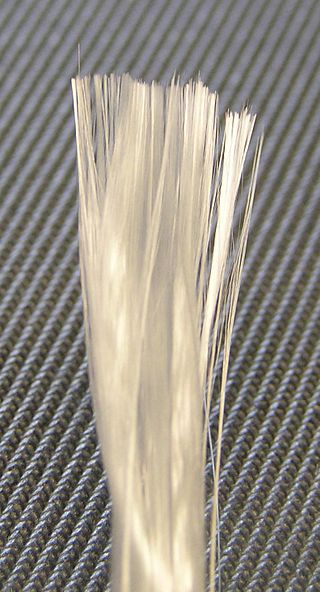
Glass fiber is a material consisting of numerous extremely fine fibers of glass.
Fiberglass or fibreglass is a common type of fiber-reinforced plastic using glass fiber. The fibers may be randomly arranged, flattened into a sheet called a chopped strand mat, or woven into glass cloth. The plastic matrix may be a thermoset polymer matrix—most often based on thermosetting polymers such as epoxy, polyester resin, or vinyl ester resin—or a thermoplastic.
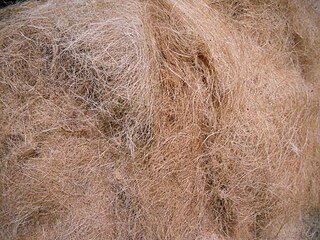
Coir, also called coconut fibre, is a natural fibre extracted from the outer husk of coconut, and used in products such as floor mats, doormats, brushes, and mattresses. Coir is the fibrous material found between the hard, internal shell and the outer coat of a coconut. Other uses of brown coir are in upholstery padding, sacking and horticulture. White coir, harvested from unripe coconuts, is used for making finer brushes, string, rope and fishing nets. It has the advantage of not sinking, so can be used in long lengths in deep water without the added weight dragging down boats and buoys.

Jute is a long, rough, shiny bast fibre that can be spun into coarse, strong threads. It is produced from flowering plants in the genus Corchorus, of the mallow family Malvaceae. The primary source of the fiber is Corchorus olitorius, but such fiber is considered inferior to that derived from Corchorus capsularis.

Kenaf [etymology: Persian], Hibiscus cannabinus, is a plant in the family Malvaceae also called Deccan hemp and Java jute. Hibiscus cannabinus is in the genus Hibiscus and is native to Africa, though its exact origin is unknown. The name also applies to the fibre obtained from this plant. Kenaf is one of the allied fibres of jute and shows similar characteristics.

Auguste René Caillié was a French explorer and the first European to return alive from the town of Timbuktu. Caillié had been preceded at Timbuktu by a British officer, Major Gordon Laing, who was murdered in September 1826 on leaving the city. Caillié was therefore the first to return alive.
The jute trade is centered mainly around India's West Bengal and Assam, and Bangladesh. The major producing country of jute is India and biggest exporter is Bangladesh, due to their natural fertile soil. Production of jute by India and Bangladesh are respectively 1.968 million ton and 1.349 million metric ton. Bengal jute was exported to South East Asia from the 17th century by the Dutch, French and later by other Europeans.
Natural fibers or natural fibres are fibers that are produced by geological processes, or from the bodies of plants or animals. They can be used as a component of composite materials, where the orientation of fibers impacts the properties. Natural fibers can also be matted into sheets to make paper or felt.

The Partition of Bengal in 1947, also known as the Second Partition of Bengal, part of the Partition of India, divided the British Indian Bengal Province along the Radcliffe Line between the Dominion of India and the Dominion of Pakistan. The Bengali Hindu-majority West Bengal became a state of India, and the Bengali Muslim-majority East Bengal became a province of Pakistan.

A biocomposite is a composite material formed by a matrix (resin) and a reinforcement of natural fibers. Environmental concern and cost of synthetic fibres have led the foundation of using natural fibre as reinforcement in polymeric composites. The matrix phase is formed by polymers derived from renewable and nonrenewable resources. The matrix is important to protect the fibers from environmental degradation and mechanical damage, to hold the fibers together and to transfer the loads on it. In addition, biofibers are the principal components of biocomposites, which are derived from biological origins, for example fibers from crops, recycled wood, waste paper, crop processing byproducts or regenerated cellulose fiber (viscose/rayon). The interest in biocomposites is rapidly growing in terms of industrial applications and fundamental research, due to its great benefits. Biocomposites can be used alone, or as a complement to standard materials, such as carbon fiber. Advocates of biocomposites state that use of these materials improve health and safety in their production, are lighter in weight, have a visual appeal similar to that of wood, and are environmentally superior.
Carbon fiber-reinforced polymers, carbon-fibre-reinforced polymers, carbon-fiber-reinforced plastics, carbon-fiber reinforced-thermoplastic, also known as carbon fiber, carbon composite, or just carbon, are extremely strong and light fiber-reinforced plastics that contain carbon fibers. CFRPs can be expensive to produce, but are commonly used wherever high strength-to-weight ratio and stiffness (rigidity) are required, such as aerospace, superstructures of ships, automotive, civil engineering, sports equipment, and an increasing number of consumer and technical applications.
The textile industry in India, traditionally after agriculture, is the only industry in the country that has generated large-scale employment for both skilled and unskilled labour. The textile industry continues to be the second-largest employment generating sector in India. It offers direct employment to over 35 million people in the country. India is the world's second largest exporter of textiles and clothing, and in the fiscal year 2022, the exports stood at US$ 44.4 billion. According to the Ministry of Textiles, the share of textiles in total exports during April–July 2010 was 11.04%. During 2009–2010, the Indian textile industry was pegged at US$55 billion, 64% of which services domestic demand. In 2010, there were 2,500 textile weaving factories and 4,135 textile finishing factories in all of India. According to AT Kearney’s ‘Retail Apparel Index’, India was ranked as the fourth most promising market for apparel retailers in 2009.

Taratari is a shipyard founded in 2004 in Bangladesh by the French sailor Yves Marre. Supported by the French NGO Watever, it aims to develop a modern, safe, and responsible nautical production industry in the country.

James Henry Williams Jr. is a mechanical engineer, consultant, civic commentator, and teacher of engineering. He is currently Professor of Applied Mechanics in the Mechanical Engineering Department at the Massachusetts Institute of Technology (MIT). He is regarded as one of the world's leading experts in the mechanics, design, fabrication, and nondestructive evaluation (NDE) of nonmetallic fiber reinforced composite materials and structures. He is also Professor of Writing and Humanistic Studies at MIT.

Yves Marre is a French entrepreneur, inventor and adventurer, co-founder of Friendship (NGO) in Bangladesh, co-founder of NGO Watever in France and creator of TaraTari Shipyard in Bangladesh.

Watever is a French Non-Governmental Association (NGO) composed of professionals from the maritime, transport, and development industries. It was established in 2010 by Marc Van Peteghem, Yves Marre, Alain Connan and Gérald Similowski with the conviction that boats can be a gateway to development. The NGO primarily focuses on underprivileged populations living on the shores of oceans and rivers, and provides them access to floating solutions uniquely adapted to their economic, social and climatic situation.
Epsilon Composite is a French company created in 1987 by Stephane LULL, its current CEO. Its revenue in 2021 was 33.5 M€ with 230 employees.

Roski Composites inc. is a company located in Roxton Falls, Quebec, Canada. The 12 448 m2 plant specializes in producing molded parts made from composite materials, mainly for the ground transportation, construction and marine industries in North America.
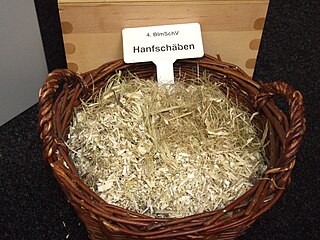
Shives, also known as shoves, boon or hurd, are the wooden refuse removed during processing flax, hemp, or jute, as opposed to the fibres (tow). Shives consist of "the woody inner portion of the hemp stalk, broken into pieces and separated from the fiber in the processes of breaking and scutching" and "correspond to the shives in flax, but are coarser and usually softer in texture". Shives are a by-product of fiber production.
