
Baccarat is a commune in the Meurthe-et-Moselle department in the Grand Est region of north-eastern France.

Nancy is the prefecture of the northeastern French department of Meurthe-et-Moselle. It was the capital of the Duchy of Lorraine, which was annexed by France under King Louis XV in 1766 and replaced by a province, with Nancy maintained as capital. Following its rise to prominence in the Age of Enlightenment, it was nicknamed the "capital of Eastern France" in the late 19th century. The metropolitan area of Nancy had a population of 511,257 inhabitants at the 2018 census, making it the 16th-largest functional urban area in France and Lorraine's largest. The population of the city of Nancy proper is 104,885.
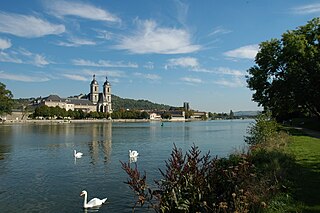
Pont-à-Mousson is a commune in the Meurthe-et-Moselle department in north-eastern France. Its inhabitants are known as Mussipontains in French. It is an industrial town, situated on the river Moselle. Pont-à-Mousson has several historical monuments, including the 18th century Premonstratensian abbey.

Henri Constant Gabriel Pierné was a French composer, conductor, pianist and organist.
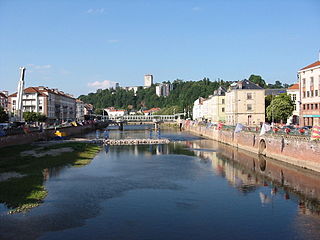
Épinal is a commune in northeastern France and the prefecture of the Vosges department.

Vandœuvre-lès-Nancy is a commune in the Meurthe-et-Moselle department in north-eastern France. Its inhabitants are called Vandopériens.

Sarrebourg is a commune of northeastern France.

Antoine Augustin Calmet, O.S.B., a French Benedictine monk, was born at Ménil-la-Horgne, then in the Duchy of Bar, part of the Holy Roman Empire.

Bellême is a commune in the Orne department in northwestern France. It is classed as a Petites Cités de Caractère. The musicologist Guillaume André Villoteau (1759–1839) was born in Bellême, as was Aristide Boucicaut (1810-1877), owner of LeBon Marché, the world's first department store. This town is possibly the origin of the English and French surname Bellamy.

Lièpvre is a commune in the Haut-Rhin department in Grand Est in north-eastern France. A monastery was built here in the eighth century by Saint Fulrad, who filled it with relics of Saint Cucuphas and Saint Alexander.

Marsal is a commune in the Moselle department in Grand Est in north-eastern France.
Events from the year 1852 in France.

The University of Lorraine, abbreviated as UL, is a public research university based in Lorraine, Grand Est region, France. It was created on 1 January 2012, by the merger of Henri Poincaré University, Nancy 2 University, Paul Verlaine University – Metz and the National Polytechnic Institute of Lorraine (INPL). It aimed to unify the main colleges of the Lorraine region. The merger process started in 2009 with the creation of a Pôle de recherche et d'enseignement supérieur (PRES) and was completed in 2012.

The Florennes Castle in Florennes, Namur, Wallonia, Belgium, is a castle that dates back to the 9th century, although most of the modern structure is much more recent.

The Château de Gerbéviller is a chateau in the small community of Gerbéviller in Lorraine, France. The site has been occupied since at least the 12th century. The present buildings date from the 17th to 19th centuries, and include the chateau, a theater, a chapel, a pavilion and a unique water nymphaeum. The chateau and chapel were badly damaged during World War I, but have been repaired. They have been protected under various designations since 1945, and since February 1996 have had an overall designation as a historical monument. The park of the chateau with its views over the valley of Mortagne has been a classified natural site since 1999.

The history of Nancy, France, the capital city of Lorraine, dates back to at least 800 BC with the earliest signs of human settlement in the area. Early settlers were likely attracted by easily mined iron ore and a ford in the Meurthe River. A small fortified town named Nanciacum (Nancy) was built by Gerard, Duke of Lorraine around 1050.

Écouché-les-Vallées is a commune in the department of Orne, northwestern France. The municipality was established on 1 January 2016 by merger of the former communes of Batilly, La Courbe, Écouché, Loucé, Saint-Ouen-sur-Maire and Serans. On 1 January 2018, the former commune of Fontenai-sur-Orne was merged into Écouché-les-Vallées. It's seat, Écouché, is classed as a Petites Cités de Caractère.

The "Maison du Peuple" in Clichy, classified as official historical monument of France since 1983, is a building built from 1935 to 1939 in the Parisian suburb of Clichy-la-Garenne by the architects Eugène Beaudouin, Marcel Lods, the engineer Vladimir Bodiansky and Jean Prouvé..

Place du Général-de-Gaulle is an urban public space situated in the commune of Lille, Hauts-de-France region. It is the town's historic main square. It has a grand-place style, which is typical of many cities in the former Netherlands.

The Saint-Epvre Basilica in Nancy, France, is a basilica from the Rayonnant neogothic style, built in the 19th century by the architect Prosper Morey.


