Related Research Articles
Spinning is a twisting technique to form yarn from fibers. The fiber intended is drawn out, twisted, and wound onto a bobbin. A few popular fibers that are spun into yarn other than cotton, which is the most popular, are viscose, animal fibers such as wool, and synthetic polyester. Originally done by hand using a spindle whorl, starting in the 500s AD the spinning wheel became the predominant spinning tool across Asia and Europe. The spinning jenny and spinning mule, invented in the late 1700s, made mechanical spinning far more efficient than spinning by hand, and especially made cotton manufacturing one of the most important industries of the Industrial Revolution.

Weaving is a method of textile production in which two distinct sets of yarns or threads are interlaced at right angles to form a fabric or cloth. Other methods are knitting, crocheting, felting, and braiding or plaiting. The longitudinal threads are called the warp and the lateral threads are the weft, woof, or filling. The method in which these threads are interwoven affects the characteristics of the cloth. Cloth is usually woven on a loom, a device that holds the warp threads in place while filling threads are woven through them. A fabric band that meets this definition of cloth can also be made using other methods, including tablet weaving, back strap loom, or other techniques that can be done without looms.

Yarn is a long continuous length of interlocked fibres, used in sewing, crocheting, knitting, weaving, embroidery, ropemaking, and the production of textiles. Thread is a type of yarn intended for sewing by hand or machine. Modern manufactured sewing threads may be finished with wax or other lubricants to withstand the stresses involved in sewing. Embroidery threads are yarns specifically designed for needlework. Yarn can be made of a number of natural or synthetic materials, and comes in a variety of colors and thicknesses. Although yarn may be dyed different colours, most yarns are solid coloured with a uniform hue.

A spinning wheel is a device for spinning thread or yarn from fibres. It was fundamental to the cotton textile industry prior to the Industrial Revolution. It laid the foundations for later machinery such as the spinning jenny and spinning frame, which displaced the spinning wheel during the Industrial Revolution.

Worsted is a high-quality type of wool yarn, the fabric made from this yarn, and a yarn weight category. The name derives from Worstead, a village in the English county of Norfolk. That village, together with North Walsham and Aylsham, formed a manufacturing centre for yarn and cloth in the 12th century, when pasture enclosure and liming rendered the East Anglian soil too rich for the older agrarian sheep breeds. In the same period, many weavers from the County of Flanders moved to Norfolk. "Worsted" yarns/fabrics are distinct from woollens : the former is considered stronger, finer, smoother, and harder than the latter.
In the manufacture of cloth, warp and weft are the two basic components in weaving to transform thread and yarn into textile fabrics. The vertical warp yarns are held stationary in tension on a loom (frame) while the horizontal weft is drawn through the warp thread. In the terminology of weaving, each warp thread is called a warp end ; a pick is a single weft thread that crosses the warp thread.

A spindle is a straight spike, usually made from wood, used for spinning, twisting fibers such as wool, flax, hemp, cotton into yarn. It is often weighted at either the bottom, middle, or top, commonly by a disc or spherical object called a whorl; many spindles, however, are weighted simply by thickening their shape towards the bottom, e.g. Orenburg and French spindles. The spindle may also have a hook, groove, or notch at the top to guide the yarn. Spindles come in many different sizes and weights depending on the thickness of the yarn one desires to spin.

Textile manufacturing is a major industry. It is largely based on the conversion of fibre into yarn, then yarn into fabric. These are then dyed or printed, fabricated into cloth which is then converted into useful goods such as clothing, household items, upholstery and various industrial products.

The spinning mule is a machine used to spin cotton and other fibres. They were used extensively from the late 18th to the early 20th century in the mills of Lancashire and elsewhere. Mules were worked in pairs by a minder, with the help of two boys: the little piecer and the big or side piecer. The carriage carried up to 1,320 spindles and could be 150 feet (46 m) long, and would move forward and back a distance of 5 feet (1.5 m) four times a minute.
The ciud-siorraig was a kind of wool winder, with an arrangement of toothed wheels, worked by the revolving winder, and with a spring which makes a sound when the number of threads forming a "cut" is wound around the rim of the winder wheel.

Spinner's weasel or clock reel is a mechanical yarn-measuring device consisting of a spoked wheel with gears attached to a pointer on a marked face and an internal mechanism which makes a "pop" sound after the desired length of yarn is measured. The pointer allows the spinner to see how close she/he is to reaching a skein. The weasel's gear ratio is usually 40 to 1, and the circumference of the reel is usually two yards, thus producing an 80-yard skein when the weasel pops.

Spinning is an ancient textile art in which plant, animal or synthetic fibres are drawn out and twisted together to form yarn. For thousands of years, fibre was spun by hand using simple tools, the spindle and distaff. It was only with the invention of the spinning wheel in the Islamic world circa 1030, and its subsequent introduction to China, India and Europe in the High Middle Ages, that the output of individual spinners dramatically increased. Mass production later arose in the 18th century with the beginnings of the Industrial Revolution. Hand-spinning remains a popular handicraft.
The manufacture of textiles is one of the oldest of human technologies. To make textiles, the first requirement is a source of fiber from which a yarn can be made, primarily by spinning. The yarn is processed by knitting or weaving, which turns yarn into cloth. The machine used for weaving is the loom. For decoration, the process of colouring yarn or the finished material is dyeing. For more information of the various steps, see textile manufacturing.
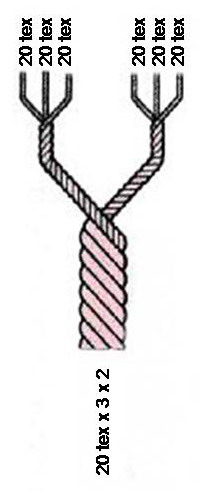
Textile fibers, threads, yarns and fabrics are measured in a multiplicity of units.
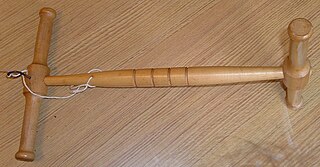
A niddy-noddy is a tool used to make skeins from yarn. It consists of a central bar, with crossbars at each end, offset from each other by 90°. The central bar is generally carved to make it easier to hold. Either one of the crossbars will have a flat edge to allow the skein to slide off, or will be completely removable. Niddy-noddies can be constructed of many different materials including wood, metal, and plastic. Wood is traditional, and most quality niddy-noddies are still made of wood. Budget spinners occasionally use niddy-noddies made from PVC pipes.
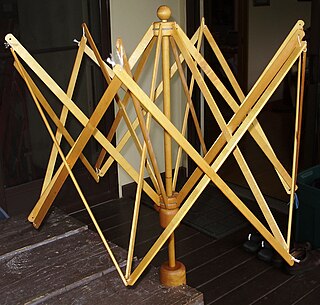
A swift is a tool used to hold a hank of yarn while it is being wound off. It has an adjustable diameter so that it can hold hanks of many sizes, and rotates around a central rod. Developed in the United States, they are generally made out of wood or metal, though other materials may also be used. In the 18th and 19th centuries, swifts were sometimes made of whale ivory and they are now sought-after antiques. Swifts are not used very much in the textile industry but are used more by knitters and crocheters who buy their yarn in hank form. The swift allows for easy balling without the yarn getting tangled and knotted.
Textile manufacturing is one of the oldest human activities. The oldest known textiles date back to about 5000 B.C. In order to make textiles, the first requirement is a source of fibre from which a yarn can be made, primarily by spinning. The yarn is processed by knitting or weaving to create cloth. The machine used for weaving is the loom. Cloth is finished by what are described as wet process to become fabric. The fabric may be dyed, printed or decorated by embroidering with coloured yarns.

The Roberts loom was a cast-iron power loom introduced by Richard Roberts in 1830. It was the first loom that was more viable than a hand loom and was easily adjustable and reliable, which led to its widespread use in the Lancashire cotton industry.

A thread is a long strand of material, often composed of several filaments or fibres, used for joining, creating or decorating textiles. Ancient Egyptians were known for creating thread using plant fibers, wool and hair. Today, thread can also be made of many different materials including but not limited to cotton, wool, linen, nylon, silk, polyester etc. There are also metal threads, which can be made of fine wire.

String is a long flexible structure made from fibers twisted together into a single strand, or from multiple such strands which are in turn twisted together. String is used to tie, bind, or hang other objects. It is also used as a material to make things, such as textiles, and in arts and crafts. String is a simple tool, and its use by humans is known to have been developed tens of thousands of years ago. In Mesoamerica, for example, string was invented some 20,000 to 30,000 years ago, and was made by twisting plant fibers together. String may also be a component in other tools, and in devices as diverse as weapons, musical instruments, and toys.
References
This article incorporates text from Dwelly's [Scottish] Gaelic Dictionary (1911). (Crois-iarna)
The literal meaning of Crois-iarna in English is yarn-cross, which perfectly describes the tool used for winding a measured length of spun and plied yarn. The yarn is wound around the crois-iarna (or niddy-noddy) off a spinning wheel's bobbin, to make a measured hank or skein of yarn used for knitting or weaving.

