
Thebe Hypoplakia, also Cilician Thebe and Placian Thebe, was a city in ancient Anatolia. Alternative names include Placia, Hypoplacia and Hypoplacian Thebe(s), referring to the city's position at the foot of Mount Placus. Near the local village "Tepeoba".
Quintus Fabius Pictor was the earliest known Roman historian. His history, written in Greek and now mostly lost besides some surviving fragments, was highly influential on ancient writers and certainly participated in introducing Greek historiographical methods to the Roman world. However, the work was highly partisan towards Rome, blaming the Second Punic War on Carthage and idealizing the Roman Republic as a well-ordered state loyal to its allies. Fabius probably served as praetor, was a member of the Senate, and participated in a delegation sent to the oracle at Delphi in 216 BC. Some scholars consider him one of the earliest annalists, although this conclusion has been criticized.

Ernst Curtius was a German archaeologist, historian and museum director.

Quintus Curtius Rufus was a Roman historian, probably of the 1st century, author of his only known and only surviving work, Historiae Alexandri Magni, "Histories of Alexander the Great", or more fully Historiarum Alexandri Magni Macedonis Libri Qui Supersunt, "All the Books That Survive of the Histories of Alexander the Great of Macedon." Much of it is missing. Apart from his name on the manuscripts, nothing else certain is known of him. This fact alone has led philologists to believe that he had another historical identity, to which, due to the accidents of time, the link has been broken. A few theories exist. They are treated with varying degrees of credibility by various authors. Meanwhile, the identity of Quintus Curtius Rufus, historian, is maintained separately.
Fabricius is a surname. Notable people with the surname include:
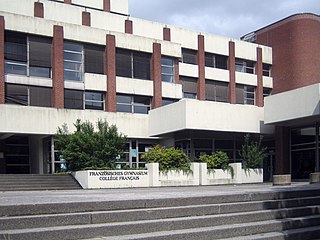
The Französisches Gymnasium is a francophone gymnasium in Berlin, Germany. Traditionally, it is widely regarded as an elite high school. It is also the oldest public school in Berlin. Its creation was ordered by Frederick William of Brandenburg.

The Hermunduri, Hermanduri, Hermunduli, Hermonduri, or Hermonduli were an ancient Germanic tribe, who occupied an inland area near the source of the Elbe river, around what is now Bohemia from the first to the third century, though they have also been speculatively associate with Thuringia further north. According to an old proposal based on the similarity of the names, the Thuringii may have been the descendants of the Hermunduri. At times, they apparently moved to the Danube frontier with Rome. Claudius Ptolemy mentions neither tribe in his geography but instead the Teuriochaemae, who may also be connected to both.
Censorinus was a Roman grammarian and miscellaneous writer.

Rodolfo Amedeo Lanciani was an Italian archaeologist, a pioneering student of ancient Roman topography. Among his many excavations was that of the House of the Vestals in the Roman Forum.
Dioxippus was an ancient Greek pankratiast, renowned for his Olympic victories in the sport of pankration. His fame and skill were such that he was crowned Olympic champion by default in 336 BC when no other pankratiast dared meet him on the field. This kind of victory was called "akoniti". The most famous story of Dioxippus is his victory over Coragus of the Macedonian army.

Christian Karl Friedrich Hülsen was a German architectural historian of the classical era who later changed to studying the Middle Ages and the Renaissance.
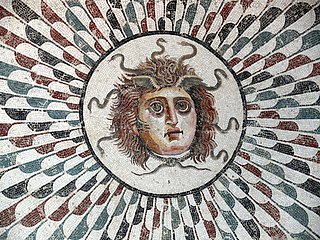
Curtius Rufus was a Roman professional magistrate of senatorial rank mentioned by Tacitus and Pliny the Younger for life events occurring during the reigns of the emperors Tiberius and Claudius. In all probability, he is to be equated with the first-century Roman historian Quintus Curtius Rufus.
Philippson is a patronymic surname meaning "son of Philipp", coming from the German language given name variant of "Philip", both derived from philippos, of Ancient Greek origin.

The gens Curtia was an ancient but minor noble family at Rome, with both patrician and plebeian branches. The only member of the gens invested with the consulship under the Republic was Gaius Curtius Philo, in 445 BC. A few Curtii held lesser magistracies during the Republic, and there were two consuls suffectus in imperial times. However, the gens is best remembered from a series of legends dating from the traditional founding of the city to the early Republic.
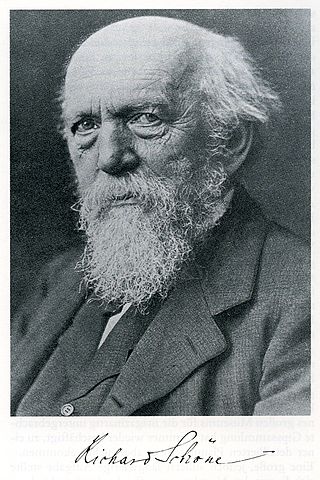
Richard Schöne was a German archaeologist and classical philologist.
This page is based on this
Wikipedia article Text is available under the
CC BY-SA 4.0 license; additional terms may apply.
Images, videos and audio are available under their respective licenses.
