Related Research Articles

Dafydd ap Gwilym is regarded as one of the leading Welsh poets and amongst the great poets of Europe in the Middle Ages. Dafydd’s poetry also offers a unique window into the transcultural movement of cultural practices and preservation of culture in the face of occupation. Dafydd also helps answer questions that linger over the spread of culture. Even though it has been given less attention, cultural development in Wales differed slightly than in other parts of Europe during the same time.

Cynog Glyndwr Dafis is a Welsh politician and member of Plaid Cymru who served as the Member of Parliament for Ceredigion from 1992 to 2000, originally as a joint Plaid Cymru–Green Party MP until 1997 and then only as a Plaid Cymru MP until 2000. He also served as the Member of the Welsh Assembly for Mid and West Wales from 1999 to 2003. Born Cynog Glyndwr Davies at Treboeth in Swansea, Glamorganshire, Wales, he was initially a school teacher and researcher before entering politics.
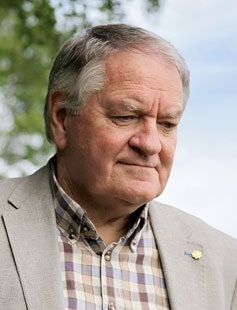
Dafydd Iwan Jones is a Welsh singer and nationalist politician who rose to fame writing and performing folk music in the Welsh language. From 2003 to 2010, Iwan was the president of Plaid Cymru, a political party which advocates for Welsh independence from the UK.

Mynydd Epynt is an upland region of Mid Wales, within the county of Powys. It is bounded on the south by the upper stretch of the Usk Valley, on the north by the Irfon Valley, and on the east by the Wye Valley. Its western boundary is less distinct but lies east of the A483 Llandovery to Llanwrtyd Wells road.

The Afon Ysgir is a river which rises on the southern slopes of Mynydd Epynt in Powys, Wales. The tributaries known as Ysgir Fawr and Ysgir Fechan flow past the hamlets of Pont Rhyd-y-berry and Merthyr Cynog to combine at Pont-faen and continue past the village of Battle to join the River Usk at Aberyscir.
Upper Chapel is a hamlet in the southern part of the county of Powys in mid Wales. It was formerly in the county of Brecknockshire. It lies on the B4520 road from Brecon to Builth Wells, in the valley of the River Honddu. The south-flowing Honddu cuts deeply into the uplands of Mynydd Epynt north of Brecon. To the north and west of Upper Chapel lies the British Army's Sennybridge Training Area.

Merthyr Cynog is a hamlet and a community in the modern county of Powys, Wales, in the historic county of Brecknockshire. The population of the community at the 2021 Census was 245.
Cynog son of Brychan, also known as Saint Cynog or Canog, was an early Welsh saint and martyr. His shrine is at Merthyr Cynog in Wales and his feast day is observed on 7 or 9 October. In Ireland he is known as St. Mocheanog

The Coelbren y Beirdd is a script created in the late eighteenth century by the Welsh antiquarian and literary forger Edward Williams, best known as Iolo Morganwg.
Cynog is a Welsh male given name. In Old Welsh, it was pronounced and written as Kynauc, Kennauc, and in other ways.

Penderyn is a rural village in the Cynon Valley, Rhondda Cynon Taf, Wales, located near Hirwaun.

This is a list of Assembly Memberselected to the first National Assembly for Wales at the 1999 election.
Dafydd ap Dafydd Llwyd was a Welsh poet. His father was Dafydd Llwyd ab Ieuan.
Dafydd Baentiwr was a 16th-century Welsh poet. A bardic controversy (ymryson) contains his only known surviving works.
"The Ruin" is a cywydd by the 14th-century Welsh poet Dafydd ap Gwilym, widely seen as the greatest of the Welsh poets. In it the poet, considering a ruined house and remembering the love-affair he once conducted there, reflects on the transience of all worldly pleasures. "The Ruin" is commonly supposed to have been written in Dafydd's old age. It has been called one of his most poignant poems, and it was included in The Penguin Book of Welsh Verse, The Oxford Book of Welsh Verse, The Oxford Book of Welsh Verse in English and The Longman Anthology of British Literature.

"The Snow" is a 14th- or 15th-century Welsh-language poem in the form of a cywydd evoking a landscape which, to the poet's chagrin, is covered with snow. It has been described as an imaginative tour de force. Manuscripts of the poem mostly attribute it to Dafydd ap Gwilym, widely seen as the greatest of the Welsh poets, though some name Dafydd ab Edmwnd or Ieuan ap Rhys ap Llywelyn as the author. Modern literary historians have differed as to whether it is indeed by Dafydd ap Gwilym, but the two most recent editions of his poems have rejected it. The poem has nevertheless remained popular with translators and it continues to appear in anthologies, including Thomas Parry's own Oxford Book of Welsh Verse and Gwyn Jones's Oxford Book of Welsh Verse in English.

"The Woodland Mass" or "The Mass of the Grove" is a poem in the form of a cywydd by the 14th-century bard Dafydd ap Gwilym, widely seen as the greatest of the Welsh poets. It is one of his most popular works. Sometimes seen as blasphemous, it presents a woodland scene in which a thrush, sent by the poet's lover, and a nightingale officiate at a Mass celebrating both God and sexual love. "The Woodland Mass" is an example of a common type of medieval Welsh poem in which some bird or beast is used as a llatai or love-messenger, though this poem is unusual in that the message is sent to Dafydd rather than by him.

The Epynt clearance was the forced eviction of the Mynydd Epynt community in Powys, Wales, where 200 men, women and children were evicted from their homes which included 54 farms and a pub. The eviction was carried out by the British Army and the War Office in 1940, creating the Sennybridge Training Area (SENTA), which is currently the largest military training area in Wales.
References
- ↑ Looker, Ray. "Dafydd Epynt". Dictionary of Welsh Biography . National Library of Wales . Retrieved 22 November 2016.
| International | |
|---|---|
| National | |

 | This article about a Welsh writer, poet or playwright is a stub. You can help Wikipedia by expanding it. |