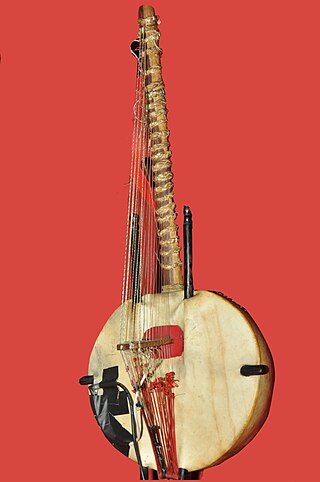
The kora is a stringed instrument used extensively in West Africa. A kora typically has 21 strings, which are played by plucking with the fingers. It combines features of the lute and harp.

The balafon is a gourd-resonated xylophone, a type of struck idiophone. It is closely associated with the neighbouring Mandé, Bwaba Bobo, Senoufo and Gur peoples of West Africa, particularly the Guinean branch of the Mandinka ethnic group, but is now found across West Africa from Guinea, Burkina Faso, Mali. Its common name, balafon, is likely a European coinage combining its Mandinka name ߓߟߊ bala with the word ߝߐ߲ fôn 'to speak' or the Greek root phono.
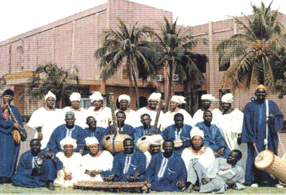
The music of Mali is, like that of most West African nations, ethnically diverse, but one influence predominates: that of the ancient Mali Empire of the Mandinka. Mande people make up around 50% of Mali's population; other ethnic groups include the Fula (17%), Gur-speakers 12%, Songhai people (6%), Tuareg and Moors (10%).

The music of Burkina Faso includes the folk music of 60 different ethnic groups. The Mossi people, centrally located around the capital, Ouagadougou, account for 40% of the population while, to the south, Gurunsi, Gurma, Dagaaba and Lobi populations, speaking Gur languages closely related to the Mossi language, extend into the coastal states. In the north and east the Fulani of the Sahel preponderate, while in the south and west the Mande languages are common; Samo, Bissa, Bobo, Senufo and Marka. Burkinabé traditional music has continued to thrive and musical output remains quite diverse. Popular music is mostly in French: Burkina Faso has yet to produce a major pan-African success.
The music of Guinea-Bissau is most widely associated with the polyrhythmic genre of gumbe, the country's primary musical export. Tina and tinga are other popular genres.

A griot is a West African historian, storyteller, praise singer, poet, and/or musician.

The Mandinka or Malinke are a West African ethnic group primarily found in southern Mali, The Gambia, southern Senegal and eastern Guinea. Numbering about 11 million, they are the largest subgroup of the Mandé peoples and one of the largest ethnolinguistic groups in Africa. They speak the Manding languages in the Mande language family, which are a lingua franca in much of West Africa. Virtually all of Mandinka people are adherent to Islam, mostly based on the Maliki jurisprudence. They are predominantly subsistence farmers and live in rural villages. Their largest urban center is Bamako, the capital of Mali.

The music of the Gambia is closely linked musically with that of its neighbor, Senegal, which surrounds its inland frontiers completely. Among its prominent musicians is Foday Musa Suso. Mbalax is a widely known popular dance music of the Gambia and neighbouring Senegal. It fuses popular Western music and dance, with sabar, the traditional drumming and dance music of the Wolof and Serer people.

Xalam is a traditional lute from West Africa with 1 to 5 strings. The xalam is commonly played in Mali, Gambia, Senegal, Niger, Northern Nigeria, Northern Ghana, Burkina Faso, Mauritania, and Western Sahara. The xalam and its variants are known by various names in other languages, including bappe, diassare, hoddu (Pulaar), koliko (Gurunsi), kologo (Frafra), komsa, kontigi, gurmi, garaya (Hausa), koni, konting (Mandinka), molo (Songhay/Zarma), ndere, ngoni (Bambara), and tidinit.

The music of West Africa has a significant history, and its varied sounds reflect the wide range of influences from the area's regions and historical periods.

The Wolof, the largest ethnic group in Senegal, have a distinctive musical tradition that, along with the influence of neighboring Fulani, Tukulor, Serer, Jola, and Malinke cultures, has contributed greatly to popular Senegalese music, and to West African music in general. Wolof music takes its roots from the Serer musical tradition, particularly from the Serer pre-colonial Kingdom of Saloum. Virtually all Wolof musical terminology including musical instruments comes from the Serer language.

The Jola or Diola are an ethnic group found in Senegal, the Gambia, and Guinea-Bissau. Most Jola live in small villages scattered throughout Senegal, especially in the Lower Casamance region. The main dialect of the Jola language, Fogni, is one of the six national languages of Senegal.

In many parts of sub-Saharan Africa, the use of music is not limited to entertainment: it serves a purpose to the local community and helps in the conduct of daily routines. Traditional African music supplies appropriate music and dance for work and for religious ceremonies of birth, naming, rites of passage, marriage and funerals. The beats and sounds of the drum are used in communication as well as in cultural expression.

Senegal is a multilingual country: Ethnologue lists 36 languages, Wolof being the most widely spoken language.
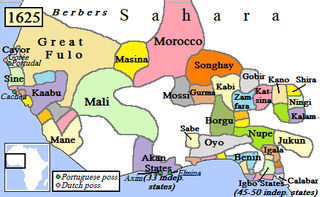
Kaabu (1537–1867), also written Gabu, Ngabou, and N'Gabu, was a federation of Mandinka kingdoms in the Senegambia region centered within modern northeastern Guinea-Bissau, large parts of today's Gambia, and extending into Koussanar, Koumpentoum, and the Casamance in Senegal.

The akonting is the folk lute of the Jola people, found in Senegal, Gambia, and Guinea-Bissau in West Africa. It is a string instrument with a skin-headed gourd body, two long melody strings, and one short drone string, akin to the short fifth "thumb string" on the five-string banjo.

The ngoni is a traditional West African string instrument. Its body is made of wood or calabash with dried animal skin head stretched over it. The ngoni, which can produce fast melodies, appears to be closely related to the akonting and the xalam. This is called a jeli ngoni as it is played by griots at celebrations and special occasions in traditional songs called fasas in Mandingo. Another larger type, believed to have originated among the donso is called the donso ngoni. This is still largely reserved for ceremonial purposes. The donso ngoni, or "hunter's harp," has six strings. It is often accompanies singing along with the karagnan, a serrated metal tube scraped with a metal stick. The donso ngoni was mentioned by Richard Jobson in the 1620s, describing it as the most commonly used instrument in the Gambia. He described it as an instrument with a great gourd for a belly at the bottom of a long neck with six strings.

There are various ethnic groups in Senegal. According to "CIA World Factbook: Senegal", the ethnic groups are Wolof (39%); Fula (27.5%)); Serer group ; Mandinka (4.9%); Jola (4.2%); Soninke (2.4%); other 5.4%, and other minor ethnic groups like the Bassari, Maures or (Naarkajors)). Many subgroups of those can be further distinguished, based on religion, location and language. According to one 2005 estimate, there are at least twenty distinguishable groups of largely varying size.

The simbing is a Malian harp-lute, used by the Mandinka people of Mali, and the Mandinka and Jola peoples of Senegal and Gambia. The instrument consists of a calabash resonator, a stick for a neck, a metal jingle attached to the neck, and a bridge that holds the string over the skin soundboard in a vertical line. For comparison, lutes usually have the strings held in a horizontal line above the soundboard. The instrument has five to nine strings. A simbing from the 1790s was reported as having seven strings by Mungo Park.

The gurmi is a two or three-stringed lute of the Hausa people of northern Nigeria. May also be called gurumi or kumbo. In looking at the two-finger playing style used by musicians who play the gumbri, researchers have listed it as a possible relative to the banjo. Researchers have talked about the gurmi and gurumi as if these are two different but similar instruments.